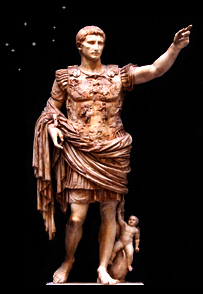
GALLIC WARS
by
Julius Caesar
Gallic Wars:
Book 1 — 58 B.C.
BELLO GALLICO
— Gallic Wars —
BOOK I
58 B.C.
All Gaul is divided into three parts, one of which the Belgae inhabit, the Aquitani another, those who in their own language are called Celts, in ours Gauls, the third. All these differ from each other in language, customs and laws. The river Garonne separates the Gauls from the Aquitani; the Marne and the Seine separate them from the Belgae. Of all these, the Belgae are the bravest, because they are farthest from the civilisation and refinement of the Province, and merchants least frequently resort to them and import those things which tend to effeminate the mind; and they are the nearest to the Germans, who dwell beyond the Rhine, with whom they are continually waging war; for which reason the Helvetii also surpass the rest of the Gauls in valour, as they contend with the Germans in almost daily battles, when they either repel them from their own territories, or themselves wage war on their frontiers. One part of these, which it has been said that the Gauls occupy, takes its beginning at the river Rhone: it is bounded by the river Garonne, the ocean, and the territories of the Belgae: it borders, too, on the side of the Sequani and the Helvetii, upon the river Rhine, and stretches towards the north. The Belgae rise from the extreme frontier of Gaul, extend to the lower part of the river Rhine; and look towards the north and the rising sun. Aquitania extends from the river Garonne to the Pyrenaean mountains and to that part of the ocean which is near Spain: it looks between the setting of the sun and the north star.
Among the
Helvetii, Orgetorix was by far the most distinguished and wealthy. He, when
Marcus Messala and Marcus Piso were consuls, incited by lust of sovereignty,
formed a conspiracy among the nobility, and persuaded the people to go forth
from their territories with all their possessions, saying that it would be very
easy, since they excelled all in valor, to acquire the supremacy of the whole
of Gaul. To this he the more easily persuaded them, because the Helvetii, are
confined on every side by the nature of their situation; on one side by the
Rhine, a very broad and deep river, which separates the Helvetian territory
from the Germans; on a second side by the Jura, a very high mountain between
the Sequani and the Helvetii; on a third by Lake Geneva, and by the river
Rhone, which separates the Province from the Helvetii. From these circumstances
it resulted, that they could range less widely, and could less easily make war
upon their neighbors; for which reason, being as they were men fond of war,
were affected with great regret. They thought, that considering the extent of
their population, and their renown for warfare and bravery, they had but narrow
limits, although they extended in length 240, and in breadth 180 Roman miles.
Induced by these
considerations, and influenced by the authority of Orgetorix, they determined
to provide such things as were necessary for their expedition-to buy up as
great a number as possible of beasts of burden and wagons-to make their sowings
as large as possible, so that on their march plenty of wheat might be in
store-and to establish peace and friendship with the neighboring states. They
reckoned that a term of two years would be sufficient for them to execute their
designs; they fix by decree their departure for the third year. Orgetorix is
chosen to complete these arrangements. He took upon himself the office of
embassador to the states: on this journey he persuades Casticus, the son of
Catamantaledes, one of the Sequani, whose father had possessed the sovereignty
among the people for many years, and had been styled "friend" by the
senate of the Roman people, to seize upon the sovereignty in his own state,
which his father had held before him, and he likewise persuades Dumnorix, an
Aeduan, the brother of Divitiacus, who at that time possessed the chief
authority in the state, and was exceedingly beloved by the people, to attempt
the same, and gives him his daughter in marriage. He proves to them that to
accomplish their attempts was a thing very easy to be done, because he himself
would obtain the government of his own state; that there was no doubt that the
Helvetii were the most powerful of the whole of Gaul; he assures them that he
will, with his own forces and his own army, acquire the sovereignty for them.
Incited by this speech, they give a pledge and oath to one another, and hope
that, when they have seized the sovereignty, they will, by means of the three
most powerful and valiant nations, be enabled to obtain possession of the whole
of Gaul.
When this scheme
was disclosed to the Helvetii by informers, they, according to their custom,
compelled Orgetorix to plead his cause in chains; it was the law that the
penalty of being burned by fire should await him if condemned. On the day
appointed for the pleading of his cause, Orgetorix drew together from all quarters
to the court, all his vassals to the number of ten thousand persons; and led
together to the same place all his dependents and debtor–bondsmen, of whom he
had a great number; by means of those he rescued himself from pleading his
cause. While the state, incensed at this act, was endeavoring to assert its
right by arms, and the magistrates were mustering a large body of men from the
country, Orgetorix died; and there is not wanting a suspicion, as the Helvetii
think, of his having committed suicide.
After his death,
the Helvetii nevertheless attempt to do that which they had resolved on,
namely, to go forth from their territories. When they thought that they were at
length prepared for this undertaking, they set fire to all their towns, in
number about twelve-to their villages about four hundred-and to the private
dwellings that remained; they burn up all the wheat, except what they intend to
carry with them; that after destroying the hope of a return home, they might be
the more ready for undergoing all dangers. They order every one to carry forth
from home for himself provisions for three months, ready ground. They persuade
the Rauraci, and the Tulingi, and the Latobrigi, their neighbors, to adopt the
same plan, and after burning down their towns and villages, to set out with
them: and they admit to their party and unite to themselves as confederates the
Boii, who had dwelt on the other side of the Rhine, and had crossed over into
the Norican territory, and assaulted Noreia.
There were in
all two routes, by which they could go forth from their country, one through
the Sequani, narrow and difficult, between Mount Jura and the river Rhone, by
which scarcely one wagon at a time could be led; there was, moreover, a very
high mountain overhanging, so that a very few might easily intercept them; the
other, through our Province, much easier and freer from obstacles, because the
Rhone flows between the boundaries of the Helvetii and those of the Allobroges,
who had lately been subdued, and is in some places crossed by a ford. The
furthest town of the Allobroges, and the nearest to the territories of the
Helvetii, is Geneva. From this town a bridge extends to the Helvetii. They
thought that they should either persuade the Allobroges, because they did not
seem as yet well-affected toward the Roman people, or compel them by force to
allow them to pass through their territories. Having provided every thing for
the expedition, they appoint a day, on which they should all meet on the bank
of the Rhone. This day was the fifth before the Calends of April (March 28th),
in the consulship of Lucius Piso and Aulus Gabinius (58 B.C).
When it was
reported to Caesar that they were attempting to make their route through our
Province he hastens to set out from the city, and, by as great marches as he
can, proceeds to Further Gaul, and arrives at Geneva. He orders the whole
Province to furnish as great a number of soldiers as possible, as there was in
all only one legion in Further Gaul: he orders the bridge at Geneva to be broken
down. When the Helvetii are apprized of his arrival they send to him, as
embassadors, the most illustrious men of their state, in which embassy Numeius
and Verudoctius held the chief place, to say "that it was their intention
to march through the Province without doing any harm, because they had
according to their own representations, no other route: that they requested,
they might be allowed to do so with his consent." Caesar, inasmuch as he
kept in remembrance that Lucius Cassius, the consul, had been slain, and his
army routed and made to pass under the yoke by the Helvetii, did not think that
their request ought to be granted: nor was he of opinion that men of hostile
disposition, if an opportunity of marching through the Province were given
them, would abstain from outrage and mischief. Yet, in order that a period
might intervene, until the soldiers whom he had ordered should assemble, he
replied to the ambassadors, that he would take time to deliberate; if they
wanted any thing, they might return on the day before the Ides of April (April
12th).
Meanwhile, with
the legion which he had with him and the soldiers which had assembled from the
Province, he carries along for nineteen miles (Roman) a wall, to the height of
sixteen feet, and a trench, from the Lake of Geneva, which flows into the river
Rhone, to Mount Jura, which separates the territories of the Sequani from those
of the Helvetii. When that work was finished, he distributes garrisons, and
closely fortifies redoubts, in order that he may the more easily intercept
them, if they should attempt to cross over against his will. When the day which
he had appointed with the embassadors came, and they returned to him; he says,
that he can not, consistently with the custom and precedent of the Roman people,
grant any one a passage through the Province; and he gives them to understand,
that, if they should attempt to use violence he would oppose them. The
Helvetii, disappointed in this hope, tried if they could force a passage (some
by means of a bridge of boats and numerous rafts constructed for the purpose;
others, by the fords of the Rhone, where the depth of the river was least,
sometimes by day, but more frequently by night), but being kept at bay by the
strength of our works, and by the concourse of the soldiers, and by the
missiles, they desisted from this attempt.
There was left
one way, through the Sequani, by which, on account of its narrowness, they
could not pass without the consent of the Sequani. As they could not of
themselves prevail on them, they send embassadors to Dumnorix the Aeduan, that
through his intercession, they might obtain their request from the Sequani.
Dumnorix, by his popularity and liberality, had great influence among the
Sequani, and was friendly to the Helvetii, because out of that state he had
married the daughter of Orgetorix; and, incited by lust of sovereignty, was
anxious for a revolution, and wished to have as many states as possible
attached to him by his kindness toward them. He, therefore, undertakes the
affair, and prevails upon the Sequani to allow the Helvetii to march through
their territories, and arranges that they should give hostages to each other;
the Sequani not to obstruct the Helvetii in their march; the Helvetii to pass
without mischief and outrage.
It is again told
Caesar, that the Helvetii intended to march through the country of the Sequani
and the Aedui into the territories of the Santones, which are not far distant
from those boundaries of the Tolosates (Toulouse). If this took place, he saw
that it would be attended with great danger to the Province to have warlike
men, enemies of the Roman people, bordering upon an open and very fertile tract
of country. For these reasons he appointed Titus Labienus, his lieutenant, to
the command of the fortification which he had made. He himself proceeds to
Italy by forced marches, and there levies two legions, and leads out from
winter-quarters three which were wintering around Aquileia, and with these five
legions marches rapidly by the nearest route across the Alps into Further Gaul.
Here the Centrones and the Graioceli and the Caturiges, having taken possession
of the higher parts, attempt to obstruct the army in their march. After having
routed these in several battles, he arrives in the territories of the Vocontii
in the Further Province on the seventh day from Ocelum, which is the most
remote town of the Hither Province; thence he leads his army into the country
of the Allobroges, and from the Allobroges to the Segusiani. These people are
the first beyond the Province on the opposite side of the Rhone.
The Helvetii had
by this time led their forces over through the narrow defile and the
territories of the Sequani, and had arrived at the territories of the Aedui,
and were ravaging their lands. The Aedui, as they could not defend themselves
and their possessions against them, send embassadors to Caesar to ask
assistance, pleading that they had at all times so well deserved of the Roman
people, that their fields ought not to have been laid waste-their children
carried off into slavery-their towns stormed, almost within sight of our army.
At the same time the Ambarri, the friends and kinsmen of the Aedui, apprize
Caesar, that it was not easy for them, now that their fields had been
devastated, to ward off the violence of the enemy from their towns: the
Allobroges likewise, who had villages and possessions on the other side of the
Rhone, betake themselves in flight to Caesar, and assure him that they had
nothing remaining, except the soil of their land. Caesar, induced by these
circumstances, decides, that he ought not to wait until the Helvetii, after
destroying all the property of his allies, should arrive among the Santones.
There is a
river, the Saone, which flows through the territories of the Aedui and Sequani
into the Rhone with such incredible slowness, that it can not be determined by
the eye in which direction it flows. This the Helvetii were crossing by rafts
and boats joined together. When Caesar was informed by spies that the Helvetii
had already conveyed three parts of their forces across that river, but that
the fourth part was left behind on this side of the Saone, he set out from the
camp with three legions during the third watch, and came up with that division
which had not yet crossed the river. Attacking them encumbered with baggage,
and not expecting him, he cut to pieces a great part of them; the rest betook
themselves to flight, and concealed themselves in the nearest woods. That
canton was called the Tigurine; for the whole Helvetian state is divided into
four cantons. This single canton having left their country, within the
recollection of our fathers, had slain Lucius Cassius the consul, and had made
his army pass under the yoke. Thus, whether by chance, or by the design of the
immortal gods, that part of the Helvetian state which had brought a signal
calamity upon the Roman people, was the first to pay the penalty. In this
Caesar avenged not only the public but also his own personal wrongs, because
the Tigurini had slain Lucius Piso the lieutenant of Cassius, the grandfather
of Lucius Calpurnius Piso, his Caesar's father-in-law, in the same battle as
Cassius himself.
This battle
ended, that he might be able to come up with the remaining forces of the
Helvetii, he procures a bridge to be made across the Saone, and thus leads his
army over. The Helvetii, confused by his sudden arrival, when they found that
he had effected in one day, what they, themselves had with the utmost
difficulty accomplished in twenty namely, the crossing of the river, send
embassadors to him; at the head of which embassy was Divico, who had been
commander of the Helvetii, in the war against Cassius. He thus treats with
Caesar: that, "if the Roman people would make peace with the Helvetii they
would go to that part and there remain, where Caesar might appoint and desire
them to be; but if he should persist in persecuting them with war that he ought
to remember both the ancient disgrace of the Roman people and the
characteristic valor of the Helvetii. As to his having attacked one canton by
surprise, at a time when those who had crossed the river could not bring
assistance to their friends, that he ought not on that account to ascribe very
much to his own valor, or despise them; that they had so learned from their
sires and ancestors, as to rely more on valor than on artifice and stratagem.
Wherefore let him not bring it to pass that the place, where they were
standing, should acquire a name, from the disaster of the Roman people and the
destruction of their army or transmit the remembrance of such an event to
posterity."
To these words
Caesar thus replied: that "on that very account he felt less hesitation,
because he kept in remembrance those circumstances which the Helvetian
embassadors had mentioned, and that he felt the more indignant at them, in
proportion as they had happened undeservedly to the Roman people: for if they
had been conscious of having done any wrong, it would not have been difficult
to be on their guard, but for that very reason had they been deceived, because
neither were they aware that any offense had been given by them, on account of
which they should be afraid, nor did they think that they ought to be afraid
without cause. But even if he were willing to forget their former outrage,
could he also lay aside the remembrance of the late wrongs, in that they had
against his will attempted a route through the Province by force, in that they
had molested the Aedui, the Ambarri, and the Allobroges? That as to their so
insolently boasting of their victory, and as to their being astonished that
they had so long committed their outrages with impunity, both these things
tended to the same point; for the immortal gods are wont to allow those persons
whom they wish to punish for their guilt sometimes a greater prosperity and
longer impunity, in order that they may suffer the more severely from a reverse
of circumstances. Although these things are so, yet, if hostages were to be
given him by them in order that he may be assured these will do what they
promise, and provided they will give satisfaction to the Aedui for the outrages
which they had committed against them and their allies, and likewise to the
Allobroges, he Caesar will make peace with them." Divico replied, that
"the Helvetii had been so trained by their ancestors, that they were
accustomed to receive, not to give hostages; of that fact the Roman people were
witness." Having given this reply, he withdrew.
On the following
day they move their camp from that place; Caesar does the same, and sends
forward all his cavalry, to the number of four thousand, which he had drawn
together from all parts of the Province and from the Aedui and their allies, to
observe toward what parts the enemy are directing their march. These, having
too eagerly pursued the enemy's rear, come to a battle with the cavalry of the
Helvetii in a disadvantageous place, and a few of our men fall. The Helvetii,
elated with this battle, because they had with five hundred horse repulsed so
large a body of horse, began to face us more boldly, sometimes too from their
rear to provoke our men by an attack. Caesar, however, restrained his men from
battle, deeming it sufficient for the present to prevent the enemy from rapine,
forage, and depredation. They marched for about fifteen days in such a manner
that there was not more than five or six miles between the enemy's rear and our
van.
Meanwhile,
Caesar kept daily importuning the Aedui for the wheat which they had promised
in the name of their state; for, in consequence of the coldness (Gaul, being as
before said, situated toward the north), not only was the wheat in the fields
not ripe, but there was not in store a sufficiently large quantity even of
fodder: besides he was unable to use the wheat which he had conveyed in ships
up the river Saone, because the Helvetii, from whom he was unwilling to retire
had diverted their march from the Saone. The Aedui kept deferring from day to
day, and saying that it was being collected, brought in on the road. When he
saw that he was put off too long, and that the day was close at hand on which
he ought to serve out the wheat to his soldiers; having called together their
chiefs, of whom he had a great number in his camp, among them Divitiacus and
Liscus who was invested with the chief magistracy whom the Aedui style the
Vergobretus, and who is elected annually and has power of life or death over
his countrymen, he severely reprimands them, because he is not assisted by them
on so urgent an occasion, when the enemy were so close at hand, and when wheat
could neither be bought nor taken from the fields, particularly as, in a great
measure urged by their prayers, he had undertaken the war; much more bitterly,
therefore does he complain of his being forsaken.
Then at length
Liscus, moved by Caesar's speech, discloses what he had hitherto kept secret:
that there are some whose influences with the people is very great, who, though
private men, have more power than the magistrates themselves: that these by
seditions and violent language are deterring the populace from contributing the
wheat which they ought to supply; by telling them that, if they can not any
longer retain the supremacy of Gaul, it were better to submit to the government
of Gauls than of Romans, nor ought they to doubt that, if the Romans should
overpower the Helvetii, they would wrest their freedom from the Aedui together
with the remainder of Gaul. By these very men, said he, are our plans and
whatever is done in the camp, disclosed to the enemy; that they could not be
restrained by him: nay more, he was well aware, that though compelled by
necessity, he had disclosed the matter to Caesar, at how great a risk he had
done it; and for that reason, he had been silent as long as he could.
Caesar perceived
that by this speech of Liscus, Dumnorix, the brother of Divitiacus, was
indicated; but, as he was unwilling that these matters should be discussed
while so many were present, he speedily dismisses: the council, but detains
Liscus: he inquires from him when alone, about those things which he had said
in the meeting. He, Liscus, speaks more unreservedly and boldly. He Caesar
makes inquiries on the same points privately of others, and discovered that it
is all true; that "Dumnorix is the person, a man of the highest daring, in
great favor with the people on account of his liberality, a man eager for a
revolution: that for a great many years he has been in the habit of contracting
for the customs and all the other taxes of the Aedui at a small cost, because
when he bids, no one dares to bid against him. By these means he has both
increased his own private property, and amassed great means for giving
largesses; that he maintains constantly at his own expense and keeps about his
own person a great number of cavalry, and that not only at home, but even among
the neighboring states, he has great influence, and for the sake of
strengthening this influence has given his mother in marriage among the
Bituriges to a man the most noble and most influential there; that he has
himself taken a wife from among the Helvetii, and has given his sister by the
mother's side and his female relations in marriage into other states; that he
favors and wishes well to the Helvetii on account of this connection; and that
he hates Caesar and the Romans, on his own account, because by their arrival
his power was weakened, and his brother, Divitiacus, restored to his former
position of influence and dignity: that, if any thing should happen to the
Romans, he entertains the highest hope of gaining the sovereignty by means of
the Helvetii, but that under the government of the Roman people he despairs not
only of royalty, but even of that influence which he already has." Caesar
discovered too, on inquiring into the unsuccessful cavalry engagement which had
taken place a few days before, that the commencement of that flight had been
made by Dumnorix and his cavalry, for Dumnorix was in command of the cavalry
which the Aedui had sent for aid to Caesar; that by their flight the rest of
the cavalry were dismayed.
After learning
these circumstances, since to these suspicions the most unequivocal facts were
added, that he had led the Helvetii through the territories of the Sequani;
that he had provided that hostages should be mutually given; that he had done
all these things, not only without any orders of his Caesar's and of his own
state's, but even without their the Aedui knowing any thing of it themselves;
that he Dumnorix was reprimanded: by the chief magistrate of the Aedui; he
Caesar considered that there was sufficient reason, why he should either punish
him himself, or order the state to do so. One thing, however, stood in the way
of all this; that he had learned by experience his brother Divitiacus's very
high regard for the Roman people, his great affection toward him, his
distinguished faithfulness, justice, and moderation; for he was afraid lest by
the punishment of this man, he should hurt the feelings of Divitiacus.
Therefore, before he attempted any thing, he orders Divitiacus to be summoned
to him, and, when the ordinary interpreters had been withdrawn, converses with
him through Caius Valerius Procillus, chief of the province of Gaul, an
intimate friend of his, in whom he reposed the highest confidence in every
thing; at the same time he reminds him of what was said about Dumnorix in the council
of the Gauls, when he himself was present, and shows what each had said of him
privately in his Caesar's own presence; he begs and exhorts him, that, without
offense to his feelings, he may either himself pass judgment on him Dumnorix
after trying the case, or else order the Aeduan state to do so.
Divitiacus,
embracing Caesar, begins to implore him, with many tears, that "he would
not pass any very severe sentence upon his brother; saying, that he knows that
those charges are true, and that nobody suffered more pain on that account than
he himself did; for when he himself could effect a very great deal by his
influence at home and in the rest of Gaul, and he Dumnorix very little on
account of his youth, the latter had become powerful through his means, which
power and strength he used not only to the lessening of his Divitiacus
popularity, but almost to his ruin; that he, however, was influenced both by
fraternal affection and by public opinion. But if any thing very severe from
Caesar should befall him Dumnorix, no one would think that it had been done
without his consent, since he himself held such a place in Caesar's friendship:
from which circumstance it would arise, that the affections of the whole of
Gaul would be estranged from him." As he was with tears begging these
things of Caesar in many words, Caesar takes his right hand, and, comforting
him, begs him to make an end of entreating, and assures him that his regard for
him is so great, that he forgives both the injuries of the republic and his
private wrongs, at his desire and prayers. He summons Dumnorix to him; he
brings in his brother; he points out what he censures in him; he lays before
him what he of himself perceives, and what the state complains of; he warns him
for the future to avoid all grounds of suspicion; he says that he pardons the
past, for the sake of his brother, Divitiacus. He sets spies over Dumnorix that
he may be able to know what he does, and with whom he communicates.
Being on the
same day informed by his scouts, that the enemy had encamped at the foot of a
mountain eight miles from his own camp; he sent persons to ascertain what the
nature of the mountain was, and of what kind the ascent on every side. Word was
brought back, that it was easy. During the third watch he orders Titus
Labienus, his lieutenant with praetorian powers, to ascend to the highest ridge
of the mountain with two legions, and with those as guides who had examined the
road; he explains what his plan is. He himself during the fourth watch, hastens
to them by the same route by which the enemy had gone, and sends on all the
cavalry before him. Publius Considius, who was reputed to be very experienced
in military affairs, and had been in the army of Lucius Sulla, and afterward in
that of Marcus Crassus, is sent forward with the scouts.
At day-break,
when the summit of the mountain was in the possession of Titus Labienus, and he
himself was not further off than a mile and half from the enemy's camp, nor, as
he afterward ascertained from the captives, had either his arrival or that of
Labienus been discovered; Considius, with his horse at full gallop, comes up to
him says that the mountain which he Caesar wished should be seized by Labienus,
is in possession of the enemy; that he has discovered this by the Gallic arms
and ensigns. Caesar leads off his forces to the next hill and draws them up in
battle-order. Labienus, as he had been ordered by Caesar not to come to an
engagement unless Caesar's own forces were seen near the enemy's camp, that the
attack upon the enemy might be made on every side at the same time, was, after
having taken possession of the mountain, waiting for our men, and refraining
from battle. When, at length, the day was far advanced, Caesar learned through
spies, that the mountain was in possession of his own men, and that the
Helvetii had moved their camp, and that Considius, struck with fear, had
reported to him, as seen, that which he had not seen. On that day he follows
the enemy at his usual distance, and pitches his camp three miles from theirs.
The next day, as
there remained in all only two day's space when he must serve out the wheat to
his army, and as he was not more than eighteen miles from Bibracte, by far the
largest and best-stored town of the Aedui, he thought that he ought to provide
for a supply of wheat; and diverted his march from the Helvetii, and advanced
rapidly to Bibracte. This circumstance is reported to the enemy by some
deserters from Lucius Aemilius, a captain, of the Gallic horse. The Helvetii,
either because they thought that the Romans, struck with terror, were
retreating from them, the more so, as the day before, though they had seized on
the higher grounds, they had not joined battle or because they flattered
themselves that they might be cut of from the provisions, altering their plan
and changing their route, began to pursue, and to annoy our men in the rear.
Caesar, when he
observes this, draws off his forces to the next hill, and sent the cavalry to
sustain the attack of the enemy. He himself, meanwhile, drew up on the middle
of the hill a triple line of his four veteran legions in such a manner, that he
placed above him on the very summit the two legions, which he had lately levied
in Hither Gaul, and all the auxiliaries; and he ordered that the whole mountain
should be covered with men, and that meanwhile the baggage should be brought
together into one place, and the position be protected by those who were posted
in the upper line. The Helvetii having followed with all their wagons,
collected their baggage into one place: they themselves, after having repulsed
our cavalry and formed a phalanx, advanced up to our front line in very close
order.
Caesar, having
removed out of sight first his own horse, then those of all, that he might make
the danger of all equal, and do away with the hope of flight, after encouraging
his men, joined battle. His soldiers hurling their javelins from the higher
ground, easily broke the enemy's phalanx. That being dispersed, they made a
charge on them with drawn swords. It was a great hinderance to the Gauls in
fighting, that, when several of their bucklers had been by one stroke of the
Roman javelins pierced through and pinned fast together, as the point of the
iron had bent itself, they could neither pluck it out, nor, with their left
hand entangled, fight with sufficient ease; so that many, after having long
tossed their arm about, chose rather to cast away the buckler from their hand,
and to fight with their person unprotected. At length, worn out with wounds,
they began to give way, and, as there was in the neighborhood a mountain about
a mile off, to betake themselves thither. When the mountain had been gained,
and our men were advancing up, the Boii and Tulingi, who with about 15,000 men
closed the enemy's line of march and served as a guard to their rear, having
assailed our men on the exposed flank as they advanced to surround them; upon
seeing which, the Helvetii who had betaken themselves to the mountain, began to
press on again and renew the battle. The Romans having faced about, advanced to
the attack in two divisions; the first and second line, to withstand those who
had been defeated and driven off the field; the third to receive those who were
just arriving.
Thus, was the
contest long and vigorously carried on with doubtful success. When they could
no longer withstand the attacks of our men, the one division, as they had begun
to do, betook themselves to the mountain; the other repaired to their baggage
and wagons. For during the whole of this battle, although the fight lasted from
the seventh hour after sunrise to eventide, no one could see an enemy with his
back turned. The fight was carried on also at the baggage till late in the
night, for they had set wagons in the way as a rampart, and from the higher ground
kept throwing weapons upon our men, as they came on, and some from between the
wagons and the wheels kept darting their lances and javelins from beneath, and
wounding our men. After the fight had lasted some time, our men gained
possession of their baggage and camp. There the daughter and one of the sons of
Orgetorix was taken. After the battle about 130,000 men of the enemy remained
alive, who marched incessantly during the whole of that night; and after a
march discontinued for no part of the night, arrived in the territories of the
Lingones on the fourth day, while our men, having stopped for three days, both
on account of the wounds of the soldiers and the burial of the slain, had not
been able to follow them. Caesar sent letters and messengers to the Lingones
that they should not assist them with wheat or with any thing else; for that if
they should assist them, he would regard them in the same light as the
Helvetii. After the three days' interval he began to follow them himself with
all his forces.
The Helvetii,
compelled by the want of every thing, sent embassadors to him about a
surrender. When these had met him on the way and had thrown themselves at his
feet, and speaking in suppliant tone had with tears sued for peace, and when he
ordered them to await his arrival, in the place where they then were, they
obeyed his commands. When Caesar arrived at that place, he demanded hostages,
their arms, and the slaves who had deserted to them. While those things are
being sought for and got together, after a night's interval, about 6,000 men of
that canton which is called the Verbigene, whether terrified by fear, lest
after delivering up their arms, they should suffer punishment, or else induced
by the hope of safety, because they supposed that, amid so vast a multitude of
those who had surrendered themselves, their flight might either be concealed or
entirely overlooked, having at night-fall departed out of the camp of the
Helvetii, hastened to the Rhine and the territories of the Germans.
But when Caesar
discovered this, he commanded those through whose territory they had gone, to
seek them out and to bring them back again, if they meant to be acquitted
before him; and considered them, when brought back, in the light of enemies; he
admitted all the rest to a surrender, upon their delivering up the hostages,
arms, and deserters. He ordered the Helvetii, the Tulingi, and the Latobrigi,
to return to their territories from which they had come, and as there was at
home nothing whereby they might support their hunger, all the productions of
the earth having been destroyed, he commanded the Allobroges to let them have a
plentiful supply of wheat; and ordered them to rebuild the towns and villages
which they had burned. This he did, chiefly, on this account, because he was
unwilling that the country, from which the Helvetii had departed, should be
untenanted, lest the Germans, who dwell on the other side of the Rhine, should,
on account of the excellence of the lands, cross over from their own
territories into those of the Helvetii, and become borderers upon the province
of Gaul and the Allobroges. He granted the petition of the Aedui, that they
might settle the Boii, in their own (Aeduan) territories, as these were known
to be of distinguished valor, to whom they gave lands, and whom they afterward
admitted to the same state of rights and freedom as themselves.
In the camp of
the Helvetii, lists were found, drawn up in Greek characters, and were brought
to Caesar, in which an estimate had been drawn up, name by name, of the number
which had gone forth from their country of those who were able to bear arms;
and likewise the boys, the old men, and the women, separately. Of all which
items the total was:
Of the Helvetii:
263,000
Of the Tulingi:
36,000
Of the Latobrigi:
14,000
Of the Rauraci:
23,000
Of the Boii:
32,000
The sum of all
amounted to: 368,000
Out of these,
such as could bear arms, amounted to about 92,000. When the census of those who
returned home was taken, as Caesar had commanded, the number was found to be
110,000.
When the war
with the Helvetii was concluded, embassadors from almost all parts of Gaul, the
chiefs of states, assembled to congratulate Caesar, saying that they were well
aware, that, although he had taken vengeance on the Helvetii in war, for the
old wrong done by them to the Roman people, yet that circumstance had happened
no less to the benefit of the land of Gaul than of the Roman people, because
the Helvetii, while their affairs were most flourishing, had quitted their
country with the design of making war upon the whole of Gaul, and seizing the
government of it, and selecting, out of a great abundance, that spot for an
abode, which they should judge to be the most convenient and most productive of
all Gaul, and hold the rest of the states as tributaries. They requested that
they might be allowed to proclaim an assembly of the whole of Gaul for a
particular day, and to do that with Caesar's permission, stating that they had
some things which, with the general consent, they wished to ask of him. This
request having been granted, they appointed a day for the assembly, and
ordained by an oath with each other, that no one should disclose their
deliberations except those to whom this office should be assigned by the
general assembly.
When that
assembly was dismissed, the same chiefs of states, who had before been to
Caesar, returned, and asked that they might be allowed to treat with him
privately concerning the safety of themselves and of all. That request having
been obtained, they all threw themselves in tears at Caesar's feet, saying that
they no less begged and earnestly desired that what they might say should not
be disclosed, than that they might obtain those things which they wished for;
inasmuch as they saw, that, if a disclosure was made, they should be put to the
greatest tortures. For these Divitiacus the Aeduan spoke and told him:
"That there were two parties in the whole of Gaul: that the Aedui stood at
the head of one of these, the Arverni of the other. After these had been violently
struggling with one another for the superiority for many years, it came to pass
that the Germans were called in for hire by the Arverni and the Sequani. That
about 15,000 of them Germans had at first crossed the Rhine: but after that
these wild and savage men had become enamored of the lands and the refinement
and the abundance of the Gauls, more were brought over, that there were now as
many as 120,000 of them in Gaul: that with these the Aedui and their dependents
had repeatedly struggled in arms-that they had been routed, and had sustained a
great calamity-had lost all their nobility, all their senate, all their
cavalry. And that broken by such engagements and calamities, although they had
formerly been very powerful in Gaul, both from their own valor and from the
Roman people's hospitality and friendship, they were now compelled to give the
chief nobles of their state, as hostages to the Sequani, and to bind their
state by an oath, that they would neither demand hostages in return, nor
supplicate aid from the Roman people, nor refuse to be forever under their sway
and empire. That he was the only one out of all the state of the Aedui, who
could not be prevailed upon to take the oath or to give his children as
hostages. On that account he had fled from his state and had gone to the senate
at Rome to beseech aid, as he alone was bound neither by oath nor hostages. But
a worse thing had befallen the victorious Sequani than the vanquished Aedui,
for Ariovistus the king of the Germans, had settled in their territories, and
had seized upon a third of their land, which was the best in the whole of Gaul,
and was now ordering them to depart from another third part, because a few
months previously 24,000 men of the Harudes had come to him, for whom room and settlements
must be provided. The consequence would be, that in a few years they would all
be driven from the territories of Gaul, and all the Germans would cross the
Rhine; for neither must the land of Gaul be compared with the land of the
Germans, nor must the habit of living of the latter be put on a level with that
of the former. Moreover, Ariovistus, no sooner did he defeat the forces of the
Gauls in a battle which took place at Magetobria, than he began to lord it
haughtily and cruelly, to demand as hostages the children of all the principal
nobles, and wreak on them every kind of cruelty, if every thing was not done at
his nod or pleasure; that he was a savage, passionate, and reckless man, and
that his commands could no longer be borne. Unless there was some aid in Caesar
and the Roman people, the Gauls must all do the same thing that the Helvetii
have done, emigrate from their country, and seek another dwelling place, other
settlements remote from the Germans, and try whatever fortune may fall to their
lot. If these things were to be disclosed to Ariovistus, Divitiacus adds that
he doubts not that he would inflict the most severe punishment on all the
hostages who are in his possession, and says that Caesar could, either by his
own influence and by that of his army, or by his late victory, or by name of
the Roman people, intimidate him, so as to prevent a greater number of Germans
being brought over the Rhine, and could protect all Gaul from the outrages of
Ariovistus.
When this speech
had been delivered by Divitiacus, all who were present began with loud
lamentation to entreat assistance of Caesar. Caesar noticed that the Sequani
were the only people of all who did none of those things which the others did,
but, with their heads bowed down, gazed on the earth in sadness. Wondering what
was the reason of this conduct, he inquired of themselves. No reply did the
Sequani make, but silently continued in the same sadness. When he had
repeatedly inquired of them and could not elicit any answer at all, the same
Divitiacus the Aeduan answered, that: "the lot of the Sequani was more
wretched and grievous than that of the rest, on this account, because they
alone durst not even in secret complain or supplicate aid; and shuddered at the
cruelty of Ariovistus even when absent, just as if he were present; for, to the
rest, despite of every thing there was an opportunity of flight given; but all
tortures must be endured by the Sequani, who had admitted Ariovistus within
their territories, and whose towns were all in his power."
Caesar, on being
informed of these things, cheered the minds of the Gauls with his words, and
promised that this affair should be an object of his concern, that he had great
hopes that Ariovistus, induced both by his kindness and his power, would put an
end to his oppression. After delivering this speech, he dismissed the assembly;
and, besides those statements, many circumstances induced him to think that
this affair ought to be considered and taken up by him; especially as he saw
that the Aedui, styled repeatedly by the senate "brethren" and
"kinsmen," were held in the thraldom and dominion of the Germans, and
understood that their hostages were with Ariovistus and the Sequani, which in
so mighty an empire as that of the Roman people he considered very disgraceful
to himself and the republic. That, moreover, the Germans should by degrees
become accustomed to cross the Rhine, and that a great body of them should come
into Gaul, he reckoned dangerous to the Roman people, and judged, that wild and
savage men would not be likely to restrain themselves, after they had possessed
themselves of all Gaul, from going forth into the province and thence marching
into Italy, as the Cimbri and Teutones had done before them, particularly as
the Rhone separated the Sequani from our province. Against which events he
thought he ought to provide as speedily as possible. Moreover, Ariovistus, for
his part, had assumed to himself such pride and arrogance, that he was felt to
be quite insufferable.
He therefore
determined to send embassadors to Ariovistus to demand of him to name some
intermediate spot for a conference between the two, saying that he wished to
treat him on state-business and matters of the highest importance to both of
them. To this embassy Ariovistus replied, that if he himself had had need of
any thing from Caesar, he would have gone to him; and that if Caesar wanted any
thing from him he ought to come to him. That, besides, neither dare he go
without an army into those parts of Gaul which Caesar had possession of, nor
could he, without great expense and trouble, draw his army together to one
place; that to him, moreover, it appeared strange, what business either Caesar
or the Roman people at all had in his own Gaul, which he had conquered in war.
When these
answers were reported to Caesar, he sends embassadors to him a second time with
this message. "Since, after having been treated with so much kindness by
himself and the Roman people, as he had in his consulship been styled 'king and
friend' by the senate, he makes this recompense to Caesar himself and the Roman
people, that when invited to a conference he demurs, and does not think that it
concerns him to advise and inform himself about an object of mutual interest,
these are the things which he requires of him; first, that he do not any more
bring over any body of men across the Rhine into Gaul; in the next place, that
he restore the hostages, which he has from the Aedui, and grant the Sequani
permission to restore to them with his consent those hostages which they have,
and that he neither provoke the Aedui by outrage nor make war upon them or
their allies; if he would accordingly do this," Caesar says "he
himself and the Roman people will entertain a perpetual feeling of favor and
friendship toward him; but that if he Caesar does not obtain his desires,
forasmuch as in the consulship of Marcus Messala and Marcus Piso the senate had
decreed that: Whoever should have the administration of the province of Gaul
should, as far as he could do so consistently with the interests of the
republic, protect the Aedui and the other friends of the Roman people, Caesar
will not overlook the wrongs of the Aedui."
To this
Ariovistus replied, that "the right of war was, that they who had
conquered should govern those whom they had conquered, in what manner they
pleased; that in that way the Roman people were wont to govern the nations
which they had conquered, not according to the dictation of any other, but
according to their own discretion. If he for his part did not dictate to the
Roman people as to the manner in which they were to exercise their right, he
ought not to be obstructed by the Roman people in his right; that the Aedui,
inasmuch as they had tried the fortune of war and had engaged in arms and been
conquered, had become tributaries to him; that Caesar was doing a great
injustice, in that by his arrival he was making his revenues less valuable to
him; that he should not restore their hostages to the Aedui, but should not
make war wrongfully either upon them or their allies, if they abided by that
which had been agreed on, and paid their tribute annually: if they did not
continue to do that, the Roman people's name of 'brothers' would avail them
naught. As to Caesar's threatening him, that he would not overlook the wrongs
of the Aedui, he said that no one had ever entered into a contest with him
Ariovistus without utter ruin to himself. That Caesar might enter the lists
when he chose; he would feel what the invincible Germans, well-trained beyond
all others to arms, who for fourteen years had not been beneath a roof, could
achieve by their valor."
At the same time
that this message was delivered to Caesar, embassadors came from the Aedui and
the Treviri; from the Aedui to complain that the Harudes, who had lately been
brought over into Gaul, were ravaging their territories; that they had not been
able to purchase peace from Ariovistus, even by giving hostages: and from the
Treviri, that a hundred cantons of the Suevi had encamped on the banks of the
Rhine, and were attempting to cross it; that the brothers, Nasuas and
Cimberius, headed them. Being greatly alarmed at these things, Caesar thought
that he ought to use all dispatch, lest, if this new band of Suevi should unite
with the old troops of Ariovistus, he Ariovistus might be less easily
withstood. Having therefore, as quickly as he could, provided a supply of
wheat, he hastened to Ariovistus by forced marches.
When he had
proceeded three days' journey, word was brought to him that Ariovistus was
hastening with all his forces to seize on Vesontio, which is the largest town
of the Sequani, and had advanced three days' journey from its territories.
Caesar thought that he ought to take the greatest precautions lest this should
happen, for there was in that town a most ample supply of every thing which was
serviceable for war; and so fortified was it by the nature of the ground, as to
afford a great facility for protracting the war, inasmuch as the river Doubs
almost surrounds the whole town, as though it were traced round it with a pair
of compasses. A mountain of great height shuts in the remaining space, which is
not more than 600 feet, where the river leaves a gap, in such a manner that the
roots of that mountain extend to the river's bank on either side. A wall thrown
around it makes a citadel of this, and connects it with the town. Hither Caesar
hastens by forced marches by night and day, and, after having seized the town,
stations a garrison there.
While he is
tarrying a few days at Vesontio, on account of wheat and provisions, it
happened. From the inquiries of our men, and the reports of the Gauls and
traders who asserted that the Germans were men of huge stature, of incredible
valor and practice in arms, that oftentimes they on encountering them could not
bear even their countenance, and the fierceness of their eyes, a great panic
seized the whole army, as to discompose the minds and spirits of all in no
slight degree. This first arose from the tribunes of the soldiers, the prefects
and the rest, who, having followed Caesar from the city Rome from motives of
friendship, had no great experience in military affairs. And alleging, some of
them one reason, some another, which they said made it necessary for them to
depart, they requested that by his consent they might be allowed to withdraw;
some, influenced by shame, stayed behind in order that they might avoid the
suspicion of cowardice. These could neither compose their countenance, nor even
sometimes check their tears: but hidden in their tents, either bewailed their
fate, or deplored with their comrades the general danger. Wills were sealed
universally throughout the whole camp. By the expressions and cowardice of
these men, even those who possessed great experience in the camp, both soldiers
and centurions, and those the decurions who were in command of the cavalry,
were gradually disconcerted. Such of them as wished to be considered less
alarmed, said that they did not dread the enemy, but feared the narrowness of
the roads and the vastness of the forests which lay between them and
Ariovistus, or else that the supplies could not be brought up readily enough.
Some even declared to Caesar, that when he gave orders for the camp to be moved
and the troops to advance, the soldiers would not be obedient to the command,
nor advance in consequence of their fear.
When Caesar
observed these things, having called a council, and summoned to it the
centurions of all the companies, he severely reprimanded them,
"particularly, for supposing that it belonged to them to inquire or
conjecture, either in what direction they were marching, or with what object.
That Ariovistus, during his Caesar's consulship, had most anxiously sought
after the friendship of the Roman people; why should any one judge that he
would so rashly depart from his duty? He for his part was persuaded, that, when
his demands were known and the fairness of the terms considered, he would
reject neither his nor the Roman people's favor. But even if, driven on by rage
and madness, he should make war upon them, what after all were they afraid
of?-or why should they despair either of their own valor or of his zeal? Of
that enemy a trial had been made within our fathers' recollection, when, on the
defeat of the Cimbri and Teutones by Caius Marius, the army was regarded as
having deserved no less praise than their commander himself. It had been made
lately, too, in Italy, during the rebellion of the slaves, whom, however, the
experience and training which they had received from us, assisted in some
respect. From which a judgment might be formed of the advantages which
resolution carries with it inasmuch as those whom for some time they had
groundlessly dreaded when unarmed, they had afterward vanquished, when well
armed and flushed with success. In short, that these were the same men whom the
Helvetii, in frequent encounters, not only in their own territories, but also
in theirs German, have generally vanquished, and yet can not have been a match
for our army. If the unsuccessful battle and flight of the Gauls disquieted
any, these, if they made inquiries, might discover that, when the Gauls had
been tired out by the long duration of the war, Ariovistus, after he had many
months kept himself in his camp and in the marshes, and had given no
opportunity for an engagement, fell suddenly upon them, by this time despairing
of a battle and scattered in all directions, and was victorious more through
stratagem and cunning than valor. But though there had been room for such
stratagem against savage and unskilled men, not even Ariovistus himself
expected that thereby our armies could be entrapped. That those who ascribed
their fear to a pretense about the supplies and the narrowness of the roads,
acted presumptuously, as they seemed either to distrust their general's discharge
of his duty, or to dictate to him. That these things were his concern; that the
Sequani, the Leuci, and the Lingones were to furnish the wheat; and that it was
already ripe in the fields; that as to the road they would soon be able to
judge for themselves. As to its being reported that the soldiers would not be
obedient to command, or advance, he was not at all disturbed at that; for he
knew, that in the case of all those whose army had not been obedient to
command, either upon some mismanagement of an affair, fortune had deserted
them, or, that upon some crime being discovered, covetousness had been clearly
proved. His integrity had been seen throughout his whole life, his good fortune
in the war with the Helvetii. That he would therefore instantly set about what
he had intended to put off till a more distant day, and would break up his camp
the next night, in the fourth watch, that he might ascertain, as soon as
possible, whether a sense of honor and duty, or whether fear had more influence
with them. But that, if no one else should follow, yet he would go with only
the tenth legion, of which he had no misgivings, and it should be his
praetorian cohort." This legion Caesar had both greatly favored, and in
it, on account of its valor, placed the greatest confidence.
Upon the
delivery of this speech, the minds of all were changed in a surprising manner,
and the highest ardor and eagerness for prosecuting the war were engendered;
and the tenth legion was the first to return thanks to him, through their military
tribunes, for his having expressed this most favorable opinion of them; and
assured him that they were quite ready to prosecute the war. Then, the other
legions endeavored, through their military tribunes and the centurions of the
principal companies, to excuse themselves to Caesar, saying that they had never
either doubted or feared, or supposed that the determination of the conduct of
the war was theirs and not their general's. Having accepted their excuse, and
having had the road carefully reconnoitered by Divitiacus, because in him of
all others he had the greatest faith, he found that by a circuitous route of
more than fifty miles he might lead his army through open parts; he then set
out in the fourth watch, as he had said. On the seventh day, as he did not
discontinue his march, he was informed by scouts that the forces of Ariovistus
were only four and twenty miles distant from ours.
Upon being
apprized of Caesar's arrival, Ariovistus sends embassadors to him, saying that
what he had before requested as to a conference, might now, as far as his
permission went, take place, since he Caesar had approached nearer, and he
considered that he might now do it without danger. Caesar did not reject the
proposal and began to think that he was now returning to a rational state of
mind as he spontaneously proffered that which he had previously refused to him
when requesting it; and was in great hopes that, in consideration of his own
and the Roman people's great favors toward him, the issue would be that he would
desist from his obstinacy upon his demands being made known. The fifth day
after that was appointed as the day of conference. Meanwhile, as ambassadors
were being often sent to and fro between them, Ariovistus demanded that Caesar
should not bring any foot-soldier with him to the conference, saying that
"he was afraid of being ensnared by him through treachery; that both
should come accompanied by cavalry; that he would not come on any other
condition." Caesar, as he neither wished that the conference should, by an
excuse thrown in the way, be set aside, nor durst trust his life to the cavalry
of the Gauls, decided that it would be most expedient to take away from the
Gallic cavalry all their horses, and thereon to mount the legionary soldiers of
the tenth legion, in which he placed the greatest confidence, in order that he
might have a body-guard as trustworthy as possible, should there be any need
for action. And when this was done, one of the soldiers of the tenth legion
said, not without a touch of humor, "that Caesar did more for them than he
had promised; he had promised to have the tenth legion in place of his
praetorian cohort; but he now converted them into horse."
There was a
large plain, and in it a mound of earth of considerable size. This spot was at
nearly an equal distance from both camps. Thither, as had been appointed, they
came for the conference. Caesar stationed the legion, which he had brought on
horseback, 200 paces from this mound. The cavalry of Ariovistus also took their
stand at an equal distance. Ariovistus then demanded that they should confer on
horseback, and that, besides themselves, they should bring with them ten men
each to the conference. When they were come to the place, Caesar, in the
opening of his speech, detailed his own and the senate's favors toward him
Ariovistus, in that he had been styled king, in that he had been styled friend,
by the senate-in that very considerable presents had been sent him; which
circumstance he informed him had both fallen to the lot of few, and had usually
been bestowed in consideration of important personal services; that he,
although he had neither an introduction, nor a just ground for the request, had
obtained these honors through the kindness and munificence of himself Caesar
and the senate. He informed him too, how old and how just were the grounds of
connection that existed between themselves Romans and the Aedui, what decrees
of the senate had been passed in their favor, and how frequent and how
honorable; how from time immemorial the Aedui had held the supremacy of the
whole of Gaul; even, said Caesar, before they had sought our friendship; that
it was the custom of the Roman people to desire not only that its allies and
friends should lose none of their property, but be advanced in influence,
dignity, and honor: who then could endure that what they had brought with them
to the friendship of the Roman people should be torn from them?" He then
made the same demands which he had commissioned the embassadors to make, that
Ariovistus should not make war either upon the Aedui or their allies, that he
should restore the hostages; that if he could not send back to their country
any part of the Germans, he should at all events suffer none of them any more
to cross the Rhine.
Ariovistus briefly
replied to the demands of Caesar; but expatiated largely on his own virtues,
"that he had crossed the Rhine not of his own accord, but on being invited
and sent for by the Gauls; that he had not left home and kindred without great
expectations and great rewards; that he had settlements in Gaul, granted by the
Gauls themselves; that the hostages had been given by their good-will; that he
took by right of war the tribute which conquerors are accustomed to impose on
the conquered; that he had not made war upon the Gauls, but the Gauls upon him;
that all the states of Gaul came to attack him, and had encamped against him;
that all their forces had been routed and beaten by him in a single battle;
that if they chose to make a second trial, he was ready to encounter them
again; but if they chose to enjoy peace, it was unfair to refuse the tribute,
which of their own free-will they had paid up to that time. That the friendship
of the Roman people ought to prove to him an ornament and a safeguard, not a
detriment; and that he sought it with that expectation. But if through the
Roman people the tribute was to be discontinued, and those who surrendered to
be seduced from him, he would renounce the friendship of the Roman people no
less heartily than he had sought it. As to his leading over a host of Germans
into Gaul, that he was doing this with a view of securing himself, not of
assaulting Gaul: that there was evidence of this, in that he did not come
without being invited, and in that he did not make war, but merely warded it
off. That he had come into Gaul before the Roman people. That never before this
time did a Roman army go beyond the frontiers of the province of Gaul. What
does Caesar desire? Why come into his Ariovistus domains? That this was his
province of Gaul, just as that is ours. As it ought not to be pardoned in him,
if he were to make an attack upon our territories; so, likewise, that we were
unjust, to obstruct him in his prerogative. As for Caesar's saying that the
Aedui had been styled 'brethren' by the senate, he was not so uncivilized nor
so ignorant of affairs, as not to know that the Aedui in the very last war with
the Allobroges had neither rendered assistance to the Romans, nor received any
from the Roman people in the struggles which the Aedui had been maintaining
with him and with the Sequani. He must feel suspicious, that Caesar, though
feigning friendship as the reason for his keeping an army in Gaul, was keeping
it with the view of crushing him. And that unless he depart and withdraw his army
from these parts, he shall regard him not as a friend, but as a foe; and that,
even if he should put him to death, he should do what would please many of the
nobles and leading men of the Roman people; he had assurance of that from
themselves through their messengers, and could purchase the favor and the
friendship of them all by his Caesar's death. But if he would depart and resign
to him the free possession of Gaul, he would recompense him with a great
reward, and would bring to a close whatever wars he wished to be carried on,
without any trouble or risk to him."
Many things were
stated by Caesar to the effect to show; “why he could not waive the business,
and that neither his nor the Roman people's practice would suffer him to
abandon most meritorious allies, nor did he deem that Gaul belonged to
Ariovistus rather than to the Roman people; that the Arverni and the Ruteni had
been subdued in war by Quintus Fabius Maximus, and that the Roman people had
pardoned them and had not reduced them into a province or imposed a tribute
upon them. And if the most ancient period was to be regarded, then was the
sovereignty of the Roman people in Gaul most just: if the decree of the Senate
was to be observed, then ought Gaul to be free, which they the Romans had conquered
in war, and had permitted to enjoy its own laws."
While these
things are being transacted in the conference it was announced to Caesar that
the cavalry of Ariovistus were approaching nearer the mound, and were riding up
to our men, and casting stones and weapons at them. Caesar made an end of his
speech and betook himself to his men; and commanded them that they should by no
means return a weapon upon the enemy. For though he saw that an engagement with
the cavalry would be without any danger to his chosen legion, yet he did not
think proper to engage, lest, after the enemy were routed, it might be said
that they had been insnared by him under the sanction of a conference. When it
was spread abroad among the common soldiery with what haughtiness Ariovistus
had behaved at the conference, and how he had ordered the Romans to quit Gaul,
and how his cavalry had made an attack upon our men, and how this had broken
off the conference, a much greater alacrity and eagerness for battle was
infused into our army.
Two days after,
Ariovistus sends embassadors to Caesar, to state "that he wished to treat
with him about those things which had been begun to be treated of between them,
but had not been concluded;" and to beg that "he would either again appoint
a day for a conference; or, if he were not willing to do that, that he would
send one of his officers as an embassador to him." There did not appear to
Caesar any good reason for holding a conference; and the more so as the day
before the Germans could not be restrained from casting weapons at our men. He
thought he should not without great danger send to him as embassador one of his
Roman officers, and should expose him to savage men. It seemed therefore most
proper to send to him C. Valerius Procillus, the son of C. Valerius Caburus, a
young man of the highest courage and accomplishments, whose father had been
presented with the freedom of the city by C. Valerius Flaccus, both on account
of his fidelity and on account of his knowledge of the Gallic language, which
Ariovistus, by long practice, now spoke fluently; and because in his case the
Germans would have no motive for committing violence; and as his colleague M.
Mettius, who had shared the hospitality of Ariovistus. He commissioned them to
learn what Ariovistus had to say, and to report to him. But when Ariovistus saw
them before him in his camp, he cried out in the presence of his army,
"Why were they come to him? Was it for the purpose of acting as
spies?" He stopped them when attempting to speak, and cast them into
chains.
The same day he
moved his camp forward and pitched under a hill six miles from Caesar's camp.
The day following he led his forces past Caesar's camp, and encamped two miles
beyond him; with this design that he might cut off Caesar from the wheat and
provisions, which might be conveyed to him from the Sequani and the Aedui. For
five successive days from that day, Caesar drew out his forces before the camp,
and put them in battle order, that, if Ariovistus should be willing to engage in
battle, an opportunity might not be wanting to him. Ariovistus all this time
kept his army in camp: but engaged daily in cavalry skirmishes. The method of
battle in which the Germans had practiced themselves was this. There were 6,000
horse, and as many very active and courageous foot, one of whom each of the
horse selected out of the whole army for his own protection. By these foot they
were constantly accompanied in their engagements; to these the horse retired;
these on any emergency rushed forward; if any one, upon receiving a very severe
wound, had fallen from his horse, they stood around him: if it was necessary to
advance further than usual, or to retreat more rapidly, so great, from
practice, was their swiftness, that, supported by the manes of the horses, they
could keep pace with their speed.
Perceiving that
Ariovistus kept himself in camp, Caesar, that he might not any longer be cut
off from provisions, chose a convenient position for a camp beyond that place
in which the Germans had encamped, at about 600 paces from them, and having
drawn up his army in three lines, marched to that place. He ordered the first
and second lines to be under arms; the third to fortify the camp. This place
was distant from the enemy about 600 paces, as has been stated. Thither
Ariovistus sent light troops, about 16,000 men in number, with all his cavalry;
which forces were to intimidate our men, and hinder them in their
fortification. Caesar nevertheless, as he had before arranged, ordered two
lines to drive off the enemy: the third to execute the work. The camp being
fortified, he left there two legions and a portion of the auxiliaries; and led
back the other four legions into the larger camp.
The next day,
according to his custom, Caesar led out his forces from both camps, and having
advanced a little from the larger one, drew up his line of battle, and gave the
enemy an opportunity of fighting. When he found that they did not even then
come out from their intrenchments, he led back his army into camp about noon. Then
at last Ariovistus sent part of his forces to attack the lesser camp. The
battle was vigorously maintained on both sides till the evening. At sunset,
after many wounds had been inflicted and received, Ariovistus led back his
forces into camp. When Caesar inquired of his prisoners, wherefore Ariovistus
did not come to an engagement, he discovered this to be the reason-that among
the Germans it was the custom for their matrons to pronounce from lots and
divination, whether it were expedient that the battle should be engaged in or
not; that they had said, "that it was not the will of heaven that the
Germans should conquer, if they engaged in battle before the new moon."
The day
following, Caesar left what seemed sufficient as a guard for both camps; and
then drew up all the auxiliaries in sight of the enemy, before the lesser camp,
because he was not very powerful in the number of legionary soldiers,
considering the number of the enemy; that thereby he might make use of his
auxiliaries for appearance. He himself, having drawn up his army in three
lines, advanced to the camp of the enemy. Then at last of necessity the Germans
drew their forces out of camp, and disposed them canton by canton, at equal
distances, the Harudes, Marcomanni, Tribocci, Vangiones, Nemetes, Sedusii,
Suevi; and surrounded their whole army with their chariots and wagons, that no
hope might be left in flight. On these they placed their women, who, with
disheveled hair and in tears, entreated the soldiers, as they went forward to
battle, not to deliver them into slavery to the Romans.
Caesar appointed
over each legion a lieutenant and a questor, that every one might have them as
witnesses of his valor. He himself began the battle at the head of the right
wing, because he had observed that part of the enemy to be the least strong.
Accordingly our men, upon the signal being given, vigorously made an attack
upon the enemy, and the enemy so suddenly and rapidly rushed forward, that
there was no time for casting the javelins at them. Throwing aside therefore
their javelins, they fought with swords hand to hand. But the Germans,
according to their custom, rapidly forming a phalanx, sustained the attack of
our swords. There were found very many of our soldiers who leaped upon the
phalanx, and with their hands tore away the shields, and wounded the enemy from
above. Although the army of the enemy was routed on the left wing and put to
flight, they still pressed heavily on our men from the right wing, by the great
number of their troops. On observing which, P. Crassus, a young man, who
commanded the cavalry-as he was more disengaged than those who were employed in
the fight-sent the third line as a relief to our men who were in distress.
Thereupon the
engagement was renewed, and all the enemy turned their backs, nor did they
cease to flee until they arrived at the river Rhine, about fifty miles from
that place. There some few, either relying on their strength, endeavored to
swim over, or, finding boats, procured their safety. Among the latter was Ariovistus,
who meeting with a small vessel tied to the bank, escaped in it; our horse
pursued and slew all the rest of them. Ariovistus had two wives, one a Suevan
by nation, whom he brought with him from home; the other a Norican, the sister
of king Vocion, whom he had married in Gaul, she having been sent thither for
that purpose by her brother. Both perished in that flight. Of their two
daughters, one was slain, the other captured. C. Valerius Procillus, as he was
being dragged by his guards in the fight, bound with a triple chain, fell into
the hands of Caesar himself, as he was pursuing the enemy with his cavalry.
This circumstance indeed afforded Caesar no less pleasure than the victory
itself; because he saw a man of the first rank in the province of Gaul, his
intimate acquaintance and friend, rescued from the hand of the enemy, and
restored to him, and that fortune had not diminished aught of the joy and
exultation of that day by his destruction. He Procillus said that, in his own
presence, the lots had been thrice consulted respecting him, whether he should
immediately be put to death by fire, or be reserved for another time: that by
the favor of the lots he was uninjured. M. Mettius, also, was found and brought
back to him Caesar.
This battle
having been reported beyond the Rhine, the Suevi, who had come to the banks of
that river, began to return home, when the Ubii, who dwelt nearest to the
Rhine, pursuing them, while much alarmed, slew a great number of them. Caesar
having concluded two very important wars in one campaign, conducted his army
into winter quarters among the Sequani, a little earlier than the season of the
year required. He appointed Labienus over the winter-quarters, and set out in
person for Hither Gaul to hold the assizes.
— END OF BOOK I —
BOOK II
57 B.C.
While Caesar was
in winter quarters in Hither Gaul, as we have shown above, frequent reports
were brought to him, and he was also informed by letters from Labienus, that
all the Belgae, who we have said are a third part of Gaul, were entering into a
confederacy against the Roman people, and giving hostages to one another; that
the reasons of the confederacy were these: First, because they feared that,
after all Gaul was subdued, our army would be led against them; secondly, because
they were instigated by several of the Gauls; some of whom, on the one hand,
had been unwilling that the Germans should remain any longer in Gaul and, on
the other, were dissatisfied that the army of the Roman people should pass the
winter in it, and settle there; and others of them, from a natural instability
and fickleness of disposition, were anxious for a revolution. They were
instigated by some, also, because the government in Gaul was generally seized
upon by the more powerful persons and by those who had the means of hiring
troops, and they could less easily effect this object under our dominion.
Alarmed by these
tidings and letters, Caesar levied two new legions in Hither Gaul, and, at the
beginning of summer, sent Q. Pedius, his lieutenant, to conduct them further
into Gaul. He, himself, as soon as there began to be plenty of forage, came to
the army. He gives a commission to the Senones and the other Gauls who were
neighbors of the Belgae, to learn what is going on among them and inform him of
these matters. These all uniformly reported that troops were being raised, and
that an army was being collected in one place. Then, indeed, he thought that he
ought not to hesitate about proceeding toward them, and having provided
supplies, moves his camp, and in about fifteen days arrives at the territories
of the Belgae.
As he arrived
there unexpectedly and sooner than any one anticipated, the Remi, who are the
nearest of the Belgae to Gaul, sent to him Iccius and Antebrogius, the
principal persons of the state, as their embassadors: to tell him that they
surrendered themselves and all their possessions to the protection and disposal
of the Roman people: and that they had neither combined with the rest of the
Belgae, nor entered into any confederacy against the Roman people: and were
prepared to give hostages, to obey his commands, to receive him into their
towns, and to aid him with wheat and other things; that all the rest of the
Belgae were in arms; and that the Germans, who dwell on this side of the Rhine,
had joined themselves to them; and that so great was the infatuation of them
all, that they could not restrain even the Suessiones, their own brethren and
kinsmen, who enjoy the same rights, and the, same laws, and who have one
government and one magistracy in common with themselves, from uniting with
them.
When Caesar
inquired of them what states were in arms, how powerful they were, and what
they could do, in war, he received the following information: that the greater
part of the Belgae were sprung, from the Germans, and that having crossed the
Rhine at an early period, they had settled there, on account of the fertility
of the country, and had driven out the Gauls who inhabited those regions; and
that they were the only people who, in the memory of our fathers, when all Gaul
was overrun, had prevented the Teutones and the Cimbri from entering their
territories; the effect of which was, that, from the recollection of those
events, they assumed to themselves great authority and haughtiness in military
matters. The Remi said, that they had known accurately every thing respecting
their number, because being united to them by neighborhood and by alliances,
they had learned what number each state had in the general council of the
Belgae promised for that war. That the Bellovaci were the most powerful among
them in valor, influence, and the number of men; that these could muster
100,000 armed men, and had promised 60,000 picked men out of that number, and
demanded for themselves the command of the whole war. That the Suessiones were
their nearest neighbors and possessed a very extensive and fertile country;
that among them, even in our own memory, Divitiacus, the most powerful man of
all Gaul, had been king; who had held the government of a great part of these
regions, as well as of Britain; that their king at present was Galba; that the
direction of the whole war was conferred by the consent of all, upon him, on
account of his integrity and prudence; that they had twelve towns; that they
had promised 50,000 armed men; and that the Nervii, who are reckoned the most
warlike among them, and are situated at a very great distance, had promised as
many; the Atrebates 15,000; the Ambiani, 10,000; the Morini, 25,000; the
Menapii, 9,000; the Caleti, 10,000; the Velocasses and the Veromandui as many;
the Aduatuci 19,000; that the Condrusi, the Eburones, the Caeraesi, the
Paemani, who are called by the common name of Germans had promised, they
thought, to the number of 40,000.
Caesar, having
encouraged the Remi, and addressed them courteously, ordered the whole senate
to assemble before him, and the children of their chief men to be brought to
him as hostages; all which commands they punctually performed by the day
appointed. He, addressing himself to Divitiacus, the Aeduan, with great
earnestness, points out how much it concerns the republic and their common
security, that the forces of the enemy should be divided, so that it might not
be necessary to engage with so large a number at one time. He asserts that this
might be affected if the Aedui would lead their forces into the territories of
the Bellovaci, and begin to lay waste their country. With these instructions he
dismissed him from his presence. After he perceived that all the forces of the
Belgae, which had been collected in one place, were approaching toward him, and
learned from the scouts whom he had sent out, and also from the Remi, that they
were then not far distant, he hastened to lead his army over the Aisne, which
is on the borders of the Remi, and there pitched his camp. This position
fortified one side of his camp by the banks of the river, rendered the country
which lay in his rear secure from the enemy, and furthermore insured that
provisions might without danger be brought to him by the Remi and the rest of
the states. Over that river was a bridge: there he places a guard; and on the
other side of the river he leaves Q. Titurius Sabinus, his lieutenant, with six
cohorts. He orders him to fortify a camp with a rampart twelve feet in height,
and a trench eighteen feet in breadth.
There was a town
of the Remi, by name Bibrax, eight miles distant from this camp. This the
Belgae on their march began to attack with great vigor. The assault was with
difficulty sustained for that day. The Gauls' mode of besieging is the same as
that of the Belgae: when after having drawn a large number of men around the
whole of the fortifications, stones have begun to be cast against the wall on
all sides, and the wall has been stripped of its defenders, then, forming a testudo,
they advance to the gates and undermine the wall: which was easily effected on
this occasion; for while so large a number were casting stones and darts, no
one was able to maintain his position upon the wall. When night had put an end
to the assault, Iccius, who was then in command of the town, one of the Remi, a
man of the highest rank and influence among his people, and one of those who
had come to Caesar as embassador to sue for peace, sends messengers to him, to
report "That, unless assistance were sent to him he could not hold out any
longer."
Thither,
immediately after midnight, Caesar, using as guides the same persons who had
come to him as messengers from Iccius, sends some Numidian and Cretan archers,
and some Balearian slingers as a relief to the towns-people, by whose arrival
both a desire to resist together with the hope of making good their defense,
was infused into the Remi, and, for the same reason, the hope of gaining the
town, abandoned the enemy. Therefore, after staying a short time before the
town, and laying waste the country of the Remi, when all the villages and
buildings which they could approach had been burned, they hastened with all
their forces to the camp of Caesar, and encamped within less than two miles of
it; and their camp, as was indicated by the smoke and fires, extended more than
eight miles in breadth.
Caesar at first
determined to decline a battle, as well on account of the great number of the
enemy as their distinguished reputation for valor: daily, however, in cavalry
actions, he strove to ascertain by frequent trials, what the enemy could effect
by their prowess and what our men would dare. When he perceived that our men
were not inferior, as the place before the camp was naturally convenient and
suitable for marshaling an army (since the hill where the camp was pitched,
rising gradually from the plain, extended forward in breadth as far as the
space which the marshaled army could occupy, and had steep declines of its side
in either direction, and gently sloping in front gradually sank to the plain);
on either side of that hill he drew a cross trench of about four hundred paces,
and at the extremities of that trench built forts, and placed there his
military engines, lest, after he had marshaled his army, the enemy, since they
were so powerful in point of number, should be able to surround his men in the
flank, while fighting. After doing this, and leaving in the camp the two
legions which he had last raised, that, if there should be any occasion, they
might be brought as a reserve, he formed the other six legions in order of
battle before the camp. The enemy, likewise, had drawn up their forces which
they had brought out of the camp.
There was a
marsh of no great extent between our army and that of the enemy. The latter
were waiting to see if our men would pass this; our men, also, were ready in
arms to attack them while disordered, if the first attempt to pass should be
made by them. In the mean time battle was commenced between the two armies by a
cavalry action. When neither army began to pass the marsh, Caesar, upon the
skirmishes of the horse proving favorable to our men, led back his forces into
the camp. The enemy immediately hastened from that place to the river Aisne,
which it has been; stated was behind our camp. Finding a ford there, they
endeavored to lead a part of their forces over it; with the design, that, if
they could, they might carry by storm the fort which Q. Titurius, Caesar's
lieutenant, commanded, and might cut off the bridge; but, if they could not do
that, they should lay waste the lands of the Remi, which were of great use to
us in carrying on the war, and might hinder our men from foraging.
Caesar, being
apprized of this by Titurius, leads all his cavalry and light-armed Numidians,
slingers and archers, over the bridge, and hastens toward them. There was a
severe struggle in that place. Our men, attacking in the river the disordered
enemy, slew a great part of them. By the immense number of their missiles they
drove back the rest, who, in a most courageous manner were attempting to pass
over their bodies, and surrounded with their cavalry, and cut to pieces those
who had first crossed the river. The enemy, when they perceived that their
hopes had deceived them both with regard to their taking the town by storm and
also their passing the river, and did not see our men advance to a more
disadvantageous place for the purpose of fighting, and when provisions began to
fail them, having called a council, determined that it was best for each to return
to his country, and resolved to assemble from all quarters to defend those into
whose territories the Romans should first march an army; that they might
contend in their own rather than in a foreign country, and might enjoy the
stores of provision which they possessed at home. Together with other causes,
this consideration also led them to that resolution, viz: that they had learned
that Divitiacus and the Aedui were approaching the territories of the
Bellovaci. And it was impossible to persuade the latter to stay any longer, or
to deter them from conveying succor to their own people.
That matter
being determined on, marching out of their camp at the second watch, with great
noise and confusion, in no fixed order, nor under any command, since each sought
for himself the foremost place in the journey, and hastened to reach home, they
made their departure appear very like a flight. Caesar, immediately learning
this through his scouts, but fearing an ambuscade, because he had not yet
discovered for what reason they were departing, kept his army and cavalry
within the camp. At daybreak, the intelligence having been confirmed by the
scouts, he sent forward his cavalry to harass their rear; and gave the command
of it to two of his lieutenants, Q. Pedius, and L. Aurunculeius Cotta. He
ordered T. Labienus, another of his lieutenants, to follow them closely with
three legions. These, attacking their rear, and pursuing them for many miles,
slew a great number of them as they were fleeing; while those in the rear with
whom they had come up, halted, and bravely sustained the attack of our
soldiers; the van, because they appeared to be removed from danger, and were
not restrained by any necessity or command, as soon as the noise was heard,
broke their ranks, and, to a man, rested their safety in flight. Thus without
any risk to themselves our men killed as great a number of them as the length
of the day allowed; and at sunset desisted from the pursuit, and betook
themselves into the camp, as they had been commanded.
On the day
following, before the enemy could recover from their terror and flight, Caesar
led his army into the territories of the Suessiones, which are next to the
Remi, and having accomplished a long march, hastens to the town named
Noviodunum. Having attempted to take it by storm on his march, because he heard
that it was destitute of sufficient defenders, he was not able to carry it by
assault, on account of the breadth of the ditch and the height of the wall,
though few were defending it. Therefore, having fortified the camp, he began to
bring up the vineae, and to provide whatever things were necessary for the
storm. In the mean time the whole body of the Suessiones, after their flight,
came the next night into the town. The vineae having been quickly brought up
against the town, a mound thrown up, and towers built, the Gauls, amazed by the
greatness of the works, such as they had neither seen nor heard of before, and
struck also by the dispatch of the Romans, send embassadors to Caesar
respecting a surrender, and succeed in consequence of the Remi requesting that
they the Suessiones might be spared.
Caesar, having
received as hostages the first men of the state, and even the two sons of king
Galba himself; and all the arms in the town having been delivered up, admitted
the Suessiones to a surrender, and led his army against the Bellovaci. Who,
when they had conveyed themselves and all their possessions into the town
Galled Bratuspantium, and Caesar with his army was about five miles distant
from that town, all the old men, going out of the town, began to stretch out
their hands to Caesar, and to intimate by their voice that they would throw
themselves on his protection and power, nor would contend in arms against the
Roman people. In like manner, when he had come up to the town, and there
pitched his camp, the boys and the women from the wall, with outstretched
hands, after their custom, begged peace from the Romans.
For these
Divitiacus pleads (for after the departure of the Belgae, having dismissed the
troops of the Aedui, he had returned to Caesar). "The Bellovaci had at all
times been in the alliance and friendship of the Aeduan state; that they had
revolted from the Aedui and made war upon the Roman people, being urged thereto
by their nobles, who said that the Aedui, reduced to slavery by Caesar, were
suffering every indignity and insult. That they who had been the leaders of
that plot, because they perceived how great a calamity they had brought upon
the state, had fled into Britain. That not only the Bellovaci, but also the
Aedui, entreated him to use his accustomed clemency and lenity toward them the
Bellovaci: which if he did, he would increase the influence of the Aedui among
all the Belgae, by whose succor and resources they had been accustomed to
support themselves whenever any wars occurred."
Caesar said that
on account of his respect for Divitiacus and the Aeduans, he would receive them
into his protection, and would spare them; but, because the state was of great
influence among the Belgae, and pre-eminent in the number of its population, he
demanded 600 hostages. When these were delivered, and all the arms in the town
collected, he went from that place into the territories of the Ambiani, who,
without delay, surrendered themselves and all their possessions. Upon their
territories bordered the Nervii, concerning whose character and customs when
Caesar inquired he received the following information:-That there was no access
for merchants to them; that they suffered no wine and other things tending to
luxury to be imported; because, they thought that by their use the mind is
enervated and the courage impaired: that they were a savage people and of great
bravery: that they upbraided and condemned the rest of the Belgae who had
surrendered themselves to the Roman people and thrown aside their national
courage: that they openly declared they would neither send embassadors, nor
accept any condition of peace."
After he had
made three days march through their territories, he discovered from some prisoners,
that the river Sambre was not more than ten miles from his camp; that all the
Nervii had stationed themselves on the other side of that river, and together
with the Atrebates and the Veromandui, their neighbors, were there awaiting the
arrival of the Romans; for they had persuaded both these nations to try the
same fortune of war as themselves: that the forces of the Aduatuci were also
expected by them, and were on their march; that they had put their women, and
those who through age appeared useless for war, in a place to which there was
no approach for an army, on account of the marshes.
Having learned
these things, he sends forward scouts and centurions to choose a convenient
place for the camp. And as a great many of the surrounding Belgae and other
Gauls, following Caesar, marched with him; some of these, as was afterwards
learned from the prisoners, having accurately observed, during those days, the
army's method of marching, went by night to the Nervii, and informed them that
a great number of baggage-trains passed between the several legions, and that
there would be no difficulty, when the first legion had come into the camp, and
the other legions were at a great distance, to attack that legion while under
baggage, which being routed, and the baggage-train seized, it would come to
pass that the other legions would not dare to stand their ground. It added
weight also to the advice of those who reported that circumstance, that the
Nervii, from early times, because they were weak in cavalry, (for not even at
this time do they attend to it, but accomplish by their infantry whatever they
can,) in order that they might the more easily obstruct the cavalry of their
neighbors if they came upon them for the purpose of plundering, having cut
young trees, and bent them, by means of their numerous branches extending on to
the sides, and the quick-briars and thorns springing up between them, had made
these hedges present a fortification like a wall, through which it was not only
impossible to enter, but even to penetrate with the eye. Since therefore the
march of our army would be obstructed by these things, the Nervii thought that
the advice ought not to be neglected by them.
The nature of
the ground which our men had chosen for the camp was this: A hill, declining
evenly from the top, extending to the river Sambre, which we have mentioned
above: from this river there arose a second hill of like ascent, on the other
side and opposite to the former, and open for about 200 paces at the lower
part; but in the upper part, woody, (so much so) that it was not easy to see
through it into the interior. Within these woods the enemy kept themselves in
concealment; a few troops of horse-soldiers appeared on the open ground, along
the river. The depth of the river was about three feet.
Caesar, having
sent his cavalry on before, followed close after them with all his forces; but
the plan and order of the march was different from that which the Belgae had
reported to the Nervii. For as he was approaching the enemy, Caesar, according
to his custom, led on as the van six legions unencumbered by baggage; behind
them he had placed the baggage-trains of the whole army; then the two legions
which had been last raised closed the rear, and were a guard for the
baggage-train. Our horse, with the slingers and archers, having passed the
river, commenced action with the cavalry of the enemy. While they from time to
time betook themselves into the woods to their companions, and again made an
assault out of the wood upon our men, who did not dare to follow them in their
retreat further than the limit to which the plain and open parts extended, in
the mean time the six legions which had arrived first, having measured out the
work, began to fortify the camp. When the first part of the baggage train of
our army was seen by those who lay hid in the woods, which had been agreed on
among them as the time for commencing action, as soon as they had arranged
their line of battle and formed their ranks within the woods, and had
encouraged one another, they rushed out suddenly with all their forces and made
an attack upon our horse. The latter being easily routed and thrown into
confusion, the Nervii ran down to the river with such incredible speed that
they seemed to be in the woods, the river, and close upon us almost at the same
time. And with the same speed they hastened up the hill to our camp, and to
those who were employed in the works.
Caesar had every
thing to do at one time: the standard to be displayed, which was the sign when
it was necessary to run to arms; the signal to be given by the trumpet; the
soldiers to be called off from the works; those who had proceeded some distance
for the purpose of seeking materials for the rampart, to be summoned; the order
of battle to be formed; the soldiers to be encouraged; the watchword to be
given. A great part of these arrangements was prevented by the shortness of
time and the sudden approach and charge of the enemy. Under these difficulties
two things proved of advantage; first the skill and experience of the soldiers,
because, having been trained by former engagements, they could suggest to
themselves what ought to be done, as conveniently as receive information from
others; and secondly that Caesar had forbidden his several lieutenants to depart
from the works and their respective legions, before the camp was fortified.
These, on account of the near approach and the speed of the enemy, did not then
wait for any command from Caesar, but of themselves executed whatever appeared
proper.
Caesar, having
given the necessary orders, hastened to and fro into whatever quarter fortune
carried him, to animate the troops, and came to the tenth legion. Having
encouraged the soldiers with no further speech than that "they should keep
up the remembrance of their wonted valor, and not be confused in mind, but
valiantly sustain the assault of the enemy ;" as the latter were not
further from them than the distance to which a dart could be cast, he gave the
signal for commencing battle. And having gone to another quarter for the
purpose of encouraging the soldiers, he finds them fighting. Such was the
shortness of the time, and so determined was the mind of the enemy on fighting,
that time was wanting not only for affixing the military insignia, but even for
putting on the helmets and drawing off the covers from the shields. To whatever
part any one by chance came from the works (in which he had been employed), and
whatever standards he saw first, at these he stood, lest in seeking his own
company he should lose the time for fighting.
The army having
been marshaled, rather as the nature of the ground and the declivity of the
hill and the exigency of the time, than as the method and order of military
matters required; while the legions in the different places were withstanding
the enemy, some in one quarter, some in another, and the view was obstructed by
the very thick hedges intervening, as we have before remarked, neither could
proper reserves be posted, nor could the necessary measures be taken in each
part, nor could all the commands be issued by one person. Therefore, in such an
unfavorable state of affairs, various events of fortune followed.
The soldiers of
the ninth and tenth legions, as they had been stationed on the left part of the
army, casting their weapons, speedily drove the Atrebates (for that division
had been opposed to them,) who were breathless with running and fatigue, and
worn out with wounds, from the higher ground into the river; and following them
as they were endeavoring to pass it, slew with their swords a great part of
them while impeded (therein). They themselves did not hesitate to pass the
river; and having advanced to a disadvantageous place, when the battle was
renewed, they nevertheless again put to flight the enemy, who had returned and
were opposing them. In like manner, in another quarter two different legions,
the eleventh and the eighth, having routed the Veromandui, with whom they had
engaged, were fighting from the higher ground upon the very banks of the river.
But, almost the whole camp on the front and on the left side being then
exposed, since the twelfth legion was posted in the right wing, and the seventh
at no great distance from it, all the Nervii, in a very close body, with
Boduognatus, who held the chief command, as their leader, hastened toward that
place; and part of them began to surround the legions on their unprotected
flank, part to make for the highest point of the encampment.
At the same time
our horsemen, and light-armed infantry, who had been with those, who, as I have
related, were routed by the first assault of the enemy, as they were betaking
themselves into the camp, met the enemy face to face, and again sought flight
into another quarter; and the camp-followers who from the Decuman Gate, and
from the highest ridge of the hill had seen our men pass the river as victors,
when, after going out for the purposes of plundering, they looked back and saw
the enemy parading in our camp, committed themselves precipitately to flight;
at the same time there arose the cry and shout of those who came with the
baggage-train: and they (affrighted), were carried some one way, some another.
By all these circumstances the cavalry of the Treviri were much alarmed, (whose
reputation for courage is extraordinary among the Gauls, and who had come to
Caesar, being sent by their state as auxiliaries), and, when they saw our camp
filled with a large number of the enemy, the legions hard pressed and almost
held surrounded, the camp-retainers, horsemen, slingers, and Numidians fleeing
on all sides divided and scattered, they, despairing of our affairs, hastened
home, and related to their state that the Romans were routed and conquered, and
that the enemy were in possession of their camp and baggage-train.
Caesar
proceeded, after encouraging the tenth legion, to the right wing; where he
perceived that his men were hard pressed, and that in consequence of the
standards of the twelfth legion being collected together in one place, the
crowded soldiers were a hinderance to themselves in the fight; that all the
centurions of the fourth cohort were slain, and the standard-bearer killed, the
standard itself lost, almost all the centurions of the other cohorts either
wounded or slain, and among them the chief centurion of the legion P. Sextius Baculus,
a very valiant man, who was so exhausted by many and severe wounds, that he was
already unable to support himself; he likewise perceived that the rest were
slackening their efforts, and that some, deserted by those in the rear, were
retiring from the battle and avoiding the weapons; that the enemy on the other
hand though advancing from the lower ground, were not relaxing in front, and
were at the same time pressing hard on both flanks; he also perceived that the
affair was at a crisis, and that there was not any reserve which could be
brought up, having therefore snatched a shield from one of the soldiers in the
rear (for he himself had come without a shield), he advanced to the front of
the line, and addressing the centurions by name, and encouraging the rest of
the soldiers, he ordered them to carry forward the standards, and extend the
companies, that they might the more easily use their swords. On his arrival, as
hope was brought to the soldiers and their courage restored, while every one
for his own part, in the sight of his general, desired to exert his utmost
energy, the impetuosity of the enemy was a little checked.
Caesar, when he
perceived that the seventh legion, which stood close by him, was also hard
pressed by the enemy, directed the tribunes of the soldiers to effect a
junction of the legions gradually, and make their charge upon the enemy with a
double front; which having been done, since they brought assistance the one to
the other, nor feared lest their rear should be surrounded by the enemy, they
began to stand their ground more boldly, and to fight more courageously. In the
mean time, the soldiers of the two legions which had been in the rear of the
army, as a guard for the baggage-train, upon the battle being reported to them,
quickened their pace, and were seen by the enemy on the top of the hill; and
Titus Labienus, having gained possession of the camp of the enemy, and observed
from the higher ground what was going on in our camp, sent the tenth legion as
a relief to our men, who, when they had learned from the flight of the horse
and the sutlers in what position the affair was, and in how great danger the
camp and the legion and the commander were involved, left undone nothing which
tended to dispatch.
By their
arrival, so great a change of matters was made, that our men, even those who
had fallen down exhausted with wounds, leaned on their shields, and renewed the
fight: then the camp-retainers, though unarmed, seeing the enemy completely
dismayed, attacked them though armed; the horsemen too, that they might by
their valor blot the disgrace of their flight, thrust themselves before the
legionary soldiers in all parts of the battle. But the enemy, even in the last
hope of safety, displayed such great courage, that when the foremost of them
had fallen, the next stood upon them prostrate, and fought from their bodies;
when these were overthrown, and their corpses heaped up together, those who
survived cast their weapons against our men thence, as from a mound, and
returned our darts which had fallen short between the armies; so that it ought
not to be concluded, that men of such great courage had injudiciously dared to
pass a very broad river, ascend very high banks, and come up to a very
disadvantageous place; since their greatness of spirit had rendered these
actions easy, although in themselves very difficult.
This battle
being ended, and the nation and name of the Nervii being almost reduced to
annihilation, their old men, whom together with the boys and women we have
stated to have been collected together in the fenny places and marshes, on this
battle having been reported to them, since they were convinced that nothing was
an obstacle to the conquerors, and nothing safe to the conquered, sent
embassadors to Caesar by the consent of all who remained, and surrendered
themselves to him; and in recounting the calamity of their state, said that
their senators were reduced from 600 to three; that from 60,000 men they were
reduced to scarcely 500 who could bear arms; whom Caesar, that he might appear
to use compassion toward the wretched and the suppliant, most carefully spared;
and ordered them to enjoy their own territories and towns, and commanded their
neighbors that they should restrain themselves and their dependents from offering
injury or outrage to them.
When the
Aduatuci, of whom we have written above, were coming up with all their forces
to the assistance of the Nervii, upon this battle being reported to them, they
returned home after they were on the march; deserting all their towns and
forts, they conveyed together all their possessions into one town, eminently
fortified by nature. While this town had on all sides around it very high rocks
and precipices, there was left on one side a gently ascending approach, of not
more than 200 feet in width; which place they had fortified with a very lofty
double wall: besides, they had placed stones of great weight and sharpened
stakes upon the walls. They were descended from the Cimbri and Teutones, who,
when they were marching into our province and Italy, having deposited on this
side the river Rhine such of their baggage-trains as they could not drive or
convey with them, left 6,000 of their men as a guard and defense for them.
These having, after the destruction of their countrymen, been harassed for many
years by their neighbors, while one time they waged war offensively, and at
another resisted it when waged against them, concluded a peace with the consent
of all, and chose this place as their settlement.
And on the first
arrival of our army they made frequent sallies from the town, and contended
with our men in trifling skirmishes; afterward, when hemmed in by a rampart of
twelve feet in height, and fifteen miles in circuit, they kept themselves
within the town. When, vineae having been brought up and a mound raised, they
observed that a tower also was being built at a distance, they at first began
to mock the Romans from their wall, and to taunt them with the following
speeches. "For what purpose was so vast a machine constructed at so great
a distance? With what hands," or "with what strength did they,
especially as they were men of such very small stature" (for our shortness
of stature, in comparison to the great size of their bodies, is generally a
subject of much contempt to the men of Gaul) "trust to place against their
walls a tower of such great weight."
But when they
saw that it was being moved, and was approaching their walls, startled by the
new and unaccustomed sight, they sent embassadors to Caesar to treat about peace;
who spoke in the following manner: "That they did not believe the Romans
waged war without divine aid, since they were able to move forward machines of
such a height with so great speed, and thus fight from close quarters; that
they resigned themselves and all their possessions to Caesar's disposal: that
they begged and earnestly entreated one thing, viz., that if perchance,
agreeable to his clemency and humanity, which they had heard of from others, he
should resolve that the Aduatuci were to be spared, he would not deprive them
of their arms; that all their neighbors were enemies to them and envied their
courage, from whom they could not defend themselves if their arms were
delivered up: that it was better for them, if they should be reduced to that state,
to suffer any fate from the Roman people, than to be tortured to death by those
among whom they had been accustomed to rule."
To these things
Caesar replied, "That he, in accordance with his custom, rather than owing
to their desert, should spare the state, if they should surrender themselves
before the battering-ram should touch the wall; but that there was no condition
of surrender, except upon their arms being delivered up; that he should do to
them that which he had done in the case of the Nervii, and would command their
neighbors not to offer any injury to those who had surrendered to the Roman
people." The matter being reported to their countrymen, they said that
they would execute his commands. Having cast a very large quantity of their
arms from the wall into the trench that was before the town, so that the heaps
of arms almost equalled the top of the wall and the rampart, and nevertheless
having retained and concealed, as we afterward discovered, about a third part
in the town, the gates were opened, and they enjoyed peace for that day.
Toward evening
Caesar ordered the gates to be shut, and the soldiers to go out of the town,
lest the towns-people should receive any injury from them by night. They the
Aduatuci, by a design before entered into, as we afterwards understood, because
they believed that, as a surrender had been made, our men would dismiss their
guards, or at least would keep watch less carefully, partly with those arms
which they had retained and concealed, partly with shields made of bark or
interwoven wickers, which they had hastily covered over with skins, (as the
shortness of time required) in the third watch, suddenly made a sally from the
town with all their forces in that direction in which the ascent to our
fortifications seemed the least difficult. The signal having been immediately
given by fires, as Caesar had previously commended, a rush was made thither i.
e. by the Roman soldiers from the nearest fort; and the battle was fought by
the enemy as vigorously as it ought to be fought by brave men, in the last hope
of safety, in a disadvantageous place, and against those who were throwing
their weapons from a rampart and from towers; since all hope of safety depended
on their courage alone. About 4,000 of the men having been slain, the rest were
forced back into the town. The day after, Caesar, after breaking open the
gates, which there was no one then to defend, and sending in our soldiers, sold
the whole spoil of that town. The number of 53,000 persons was reported to him
by those who had bought them.
At the same time
he was informed by P. Crassus, whom he had sent with one legion against the
Veneti, the Unelli, the Osismii, the Curiosolitae, the Sesuvii, the Aulerci,
and the Rhedones, which are maritime states, and touch upon the Atlantic ocean,
that all these nations were brought under the dominion and power of the Roman
people.
These things
being achieved, all Gaul being subdued, so high an opinion of this war was
spread among the barbarians, that embassadors were sent to Caesar by those
nations who dwelt beyond the Rhine, to promise that they would give hostages
and execute his commands. Which embassies Caesar, because he was hastening into
Italy and Illyricum, ordered to return to him at the beginning of the following
summer. He himself, having led his legions into winter quarters among the
Carnutes, the Andes, and the Turones, which states were close to those regions
in which he had waged war, set out for Italy; and a thanksgiving of fifteen
days was decreed for those achievements, upon receiving Caesar's letter; an
honor which before that time had been conferred on none.
— END OF BOOK II —
BOOK III
56 B.C.
When Caesar was
setting out for Italy, he sent Servius Galba with the twelfth legion and part
of the cavalry, against the Nantuates, the Veragri, and Seduni, who extend from
the territories of the Allobroges, and the lake of Geneva, and the River Rhone
to the top of the Alps. The reason for sending him was, that he desired that
the pass along the Alps, through which the Roman merchants had been accustomed
to travel with great danger, and under great imposts, should be opened. He
permitted him, if he thought it necessary, to station the legion in these
places, for the purpose of wintering. Galba having fought some successful
battles and stormed several of their forts, upon embassadors being sent to him
from all parts and hostages given and a peace concluded, determined to station
two cohorts among the Nantuates, and to winter in person with the other cohorts
of that legion in a village of the Veragri, which is called Octodurus; and this
village being situated in a valley, with a small plain annexed to it, is
bounded on all sides by very high mountains. As this village was divided into
two parts by a river, he granted one part of it to the Gauls, and assigned the
other, which had been left by them unoccupied, to the cohorts to winter in. He
fortified this latter part with a rampart and a ditch.
When several
days had elapsed in winter quarters, and he had ordered wheat to be brought in
he was suddenly informed by his scouts that all the people had gone off in the
night from that part of the town which he had given up to the Gauls, and that
the mountains which hung over it were occupied by a very large force of the Seduni
and Veragri. It had happened for several reasons that the Gauls suddenly formed
the design of renewing the war and cutting off that legion. First, because they
despised a single legion, on account of its small number, and that not quite
full (two cohorts having been detached, and several individuals being absent,
who had been dispatched for the purpose of seeking provision); then, likewise,
because they thought that on account of the disadvantageous character of the
situation, even their first attack could not be sustained by us when they would
rush from the mountains into the valley, and discharge their weapons upon us.
To this was added, that they were indignant that their children were torn from
them under the title of hostages, and they were persuaded that the Romans
designed to seize upon the summits of the Alps, and unite those parts to the
neighboring province of Gaul, not only to secure the passes, but also a
constant possession.
Having received
these tidings, Galba, since the works of the winter-quarters and the
fortifications were not fully completed, nor was sufficient preparation made
with regard to wheat and other provisions (since, as a surrender had been made,
and hostages received, he had thought he need entertain no apprehension of war),
speedily summoning a council, began to anxiously inquire their opinions. In
which council, since so much sudden danger had happened contrary to the general
expectation, and almost all the higher places were seen already covered with a
multitude of armed men, nor could either troops come to their relief, or
provisions be brought in, as the passes were blocked up by the enemy; safety
being now nearly despaired of, some opinions of this sort were delivered: that,
"leaving their baggage, and making a sally, they should hasten away for
safety by the same routes by which they had come thither." To the greater
part, however, it seemed best, reserving that measure to the last, to await the
issue of the matter, and to defend the camp.
A short time
only having elapsed, so that time was scarcely given for arranging and
executing those things which they had determined on, the enemy, upon the signal
being given, rushed down upon our men from all parts, and discharged stones and
darts, upon our rampart. Our men at first, while their strength was fresh,
resisted bravely, nor did they cast any weapon ineffectually from their higher
station. As soon as any part of the camp, being destitute of defenders, seemed
to be hard pressed, thither they ran, and brought assistance. But they were
over-matched in this, that the enemy when wearied by the long continuance of
the battle, went out of the action, and others with fresh strength came in
their place; none of which things could be done by our men, owing to the
smallness of their number; and not only was permission not given to the wearied
Roman to retire from the fight, but not even to the wounded was liberty granted
to quit the post where he had been stationed, and recover.
When they had
now been fighting for more than six hours, without cessation, and not only
strength, but even weapons were failing our men, and the enemy were pressing on
more rigorously, and had begun to demolish the rampart and to fill up the
trench, while our men were becoming exhausted, and the matter was now brought
to the last extremity, P. Sextius Baculus, a centurion of the first rank, whom
we have related to have been disabled by severe wounds in the engagement with
the Nervii, and also C. Volusenus, a tribune of the soldiers, a man of great
skill and valor, hasten to Galba, and assure him that the only hope of safety
lay in making a sally, and trying the last resource. Whereupon assembling the
centurions, he quickly gives orders to the soldiers to discontinue the fight a
short time, and only collect the weapons flung at them, and recruit themselves
after their fatigue, and afterward, upon the signal being given, sally forth
from the camp, and place in their valor all their hope of safety.
They do what
they were ordered; and, making a sudden sally from all the gates of the camp,
leave the enemy the means neither of knowing what was taking place, nor of
collecting themselves. Fortune thus taking a turn, our men surround on every
side, and slay those who had entertained the hope of gaining the camp and having
killed more than the third part of an army of more than 30,000 men (which
number of the barbarians it appeared certain had come up to our camp), put to
flight the rest when panic-stricken, and do not suffer them to halt even upon
the higher grounds. All the forces of the enemy being thus routed, and stripped
of their arms, our men betake themselves to their camp and fortifications.
Which battle being finished, inasmuch as Galba was unwilling to tempt fortune
again, and remembered that he had come into winter quarters with one design,
and saw that he had met with a different state of affairs; chiefly however
urged by the want of wheat and provision, having the next day burned all the
buildings of that village, he hastens to return into the province; and as no
enemy opposed or hindered his march, he brought the legion safe into the
country of the Nantuates, thence into that of the Allobroges, and there
wintered.
These things
being achieved, while Caesar had every reason to suppose that Gaul was reduced
to a state of tranquillity, the Belgae being overcome, the Germans expelled,
the Seduni among the Alps defeated, and when he had, therefore, in the
beginning of winter, set out for Illyricum, as he wished to visit those
nations, and acquire a knowledge of their countries, a sudden war sprang up in
Gaul. The occasion of that war was this: P. Crassus, a young man, had taken up
his winter quarters with the seventh legion among the Andes, who border upon
the Atlantic ocean. He, as there was a scarcity of wheat in those parts, sent
out some officers of cavalry, and several military tribunes among the
neighbouring states, for the purpose of procuring wheat and provision; in which
number T. Terrasidius was sent among the Esubii; M. Trebius Gallus among the
Curiosolitae; Q. Velanius, T. Silius, amongst the Veneti.
The influence of
this state is by far the most considerable of any of the countries on the whole
sea coast, because the Veneti both have a very great number of ships, with
which they have been accustomed to sail to Britain, and thus excel the rest in
their knowledge and experience of nautical affairs; and as only a few ports lie
scattered along that stormy and open sea, of which they are in possession, they
hold as tributaries almost all those who are accustomed to traffic in that sea.
With them arose the beginning of the revolt by their detaining Silius and
Velanius; for they thought that they should recover by their means the hostages
which they had given to Crassus. The neighboring people led on by their influence
(as the measures of the Gauls are sudden and hasty), detain Trebius and
Terrasidius for the same motive; and quickly sending embassadors, by means of
their leading men, they enter into a mutual compact to do nothing except by
general consent, and abide the same issue of fortune; and they solicit the
other states to choose rather to continue in that liberty which they had
received from their ancestors, than endure slavery under the Romans. All the
sea coast being quickly brought over to their sentiments, they send a common
embassy to P. Crassus to say, "If he wished to receive back his officers,
let him send back to them their hostages."
Caesar, being
informed of these things by Crassus, since he was so far distant himself,
orders ships of war to be built in the mean time on the river Loire, which
flows into the ocean; rowers to be raised from the province; sailors and pilots
to be provided. These matters being quickly executed, he himself, as soon as
the season of the year permits, hastens to the army. The Veneti, and the other
states also, being informed of Caesar's arrival, when they reflected how great
a crime they had committed, in that, the embassadors (a character which had
among all nations ever been sacred and inviolable) had by them been detained
and thrown into prison, resolve to prepare for a war in proportion to the
greatness of their danger, and especially to provide those things which
appertain to the service of a navy, with the greater confidence, inasmuch as
they greatly relied on the nature of their situation. They knew that the passes
by land were cut off by estuaries, that the approach by sea was most difficult,
by reason of our ignorance of the localities, and the small number of the
harbors, and they trusted that our army would not be able to stay very long
among them, on account of the insufficiency of wheat; and again, even if all
these things should turn out contrary to their expectation, yet they were very
powerful in their navy. They well understood that the Romans neither had any
number of ships, nor were acquainted with the shallows, the harbors, or the
islands of those parts where they would have to carry on the war; and the
navigation was very different in a narrow sea from what it was in the vast and
open ocean. Having come to this resolution, they fortify their towns, convey
wheat into them from the country parts, bring together as many ships as
possible to Venetia, where it appeared Caesar would at first carry on the war.
They unite to themselves as allies for that war, the Osismii, the Lexovii, the
Nannetes, the Ambiliati, the Morini, the Diablintes, and the Menapii; and send
for auxiliaries from Britain, which is situated over against those regions.
There were these
difficulties which we have mentioned above, in carrying on the war, but many
things, nevertheless, urged Caesar to that war;-the open insult offered to the
state in the detention of the Roman knights, the rebellion raised after
surrendering, the revolt after hostages were given, the confederacy of so many
states, but principally, lest if, the conduct of this part was overlooked, the
other nations should think that the same thing was permitted them. Wherefore,
since he reflected that almost all the Gauls were fond of revolution, and
easily and quickly excited to war; that all men likewise, by nature, love
liberty and hate the condition of slavery, he thought he ought to divide and
more widely distribute his army, before more states should join the
confederation.
He therefore
sends T. Labienus, his lieutenant, with the cavalry to the Treviri, who are
nearest to the river Rhine. He charges him to visit the Remi and the other
Belgians, and to keep them in their allegiance and repel the Germans (who were
said to have been summoned by the Belgae to their aid,) if they attempted to
cross the river by force in their ships. He orders P. Crassus to proceed into
Aquitania with twelve legionary cohorts and a great number of the cavalry, lest
auxiliaries should be sent into Gaul by these states, and such great nations be
united. He sends Q. Titurius Sabinus his lieutenant, with three legions, among
the Unelli, the Curiosolitae, and the Lexovii, to take care that their forces
should be kept separate from the rest. He appoints D. Brutus, a young man, over
the fleet and those Gallic vessels which he had ordered to be furnished by the
Pictones and the Santoni, and the other provinces which remained at peace; and
commands him to proceed toward the Veneti, as soon as he could. He himself
hastens thither with the land forces.
The sites of
their towns were generally such that, being placed on extreme points of land
and on promontories, they neither had an approach by land when the tide had
rushed in from the main ocean, which always happens twice in the space of
twelve hours; nor by ships, because, upon the tide ebbing again, the ships were
likely to be dashed upon the shoals. Thus, by either circumstance, was the
storming of their towns rendered difficult; and if at any time perchance the
Veneti overpowered by the greatness of our works, (the sea having been excluded
by a mound and large dams, and the latter being made almost equal in height to
the walls of the town) had begun to despair of their fortunes; bringing up a
large number of ships, of which they had a very great quantity, they carried
off all their property and betook themselves to the nearest towns; there they
again defended themselves by the same advantages of situation. They did this
the more easily during a great part of the summer, because our ships were kept
back by storms, and the difficulty of sailing was very great in that vast and
open sea, with its strong tides and its harbors far apart and exceedingly few
in number.
For their ships
were built and equipped after this manner. The keels were somewhat flatter than
those of our ships, whereby they could more easily encounter the shallows and
the ebbing of the tide: the prows were raised very high, and, in like manner
the sterns were adapted to the force of the waves and storms which they were
formed to sustain. The ships were built wholly of oak, and designed to endure
any force and violence whatever; the benches which were made of planks a foot
in breadth, were fastened by iron spikes of the thickness of a man's thumb; the
anchors were secured fast by iron chains instead of cables, and for sails they
used skins and thin dressed leather. These were used either through their want
of canvas and their ignorance of its application, or for this reason, which is
more probable, that they thought that such storms of the ocean, and such
violent gales of wind could not be resisted by sails, nor ships of such great
burden be conveniently enough managed by them. The encounter of our fleet with
these ships' was of such a nature that our fleet excelled in speed alone, and
the plying of the oars; other things, considering the nature of the place and
the violence of the storms, were more suitable and better adapted on their
side; for neither could our ships injure theirs with their beaks (so great was
their strength), nor on account of their height was a weapon easily cast up to
them; and for the same reason they were less readily locked in by rocks. To
this was added, that whenever a storm began to rage and they ran before the
wind, they both could weather the storm more easily and heave to securely in
the shallows, and when left by the tide feared nothing from rocks and shelves:
the risk of all which things was much to be dreaded by our ships.
Caesar, after
taking many of their towns, perceiving that so much labor was spent in vain and
that the flight of the enemy could not be prevented on the capture of their
towns, and that injury could not be done them, he determined to wait for his
fleet. As soon as it came up and was first seen by the enemy, about 220 of
their ships, fully equipped and appointed with every kind of naval implement,
sailed forth from the harbor, and drew up opposite to ours; nor did it appear
clear to Brutus, who commanded the fleet, or to the tribunes of the soldiers
and the centurions, to whom the several ships were assigned, what to do, or
what system of tactics to adopt; for they knew that damage could not be done by
their beaks; and that, although turrets were built on their decks, yet the
height of the stems of the barbarian ships exceeded these; so that weapons
could not be cast up from our lower position with sufficient effect, and those
cast by the Gauls fell the more forcibly upon us. One thing provided by our men
was of great service, viz. sharp hooks inserted into and fastened upon poles,
of a form not unlike the hooks used in attacking town walls. When the ropes
which fastened the sail-yards to the masts were caught by them and pulled, and
our vessel vigorously impelled with the oars, they the ropes were severed; and
when they were cut away, the yards necessarily fell down; so that as all the
hope of the Gallic vessels depended on their sails and rigging, upon these
being cut away, the entire management of the ships was taken from them at the
same time. The rest of the contest depended on courage; in which our men
decidedly had the advantage; and the more so, because the whole action was
carried on in the sight of Caesar and the entire army; so that no act, a little
more valiant than ordinary, could pass unobserved, for all the hills and higher
grounds, from which there was a near prospect of the sea were occupied by our
army.
The sail yards
of the enemy, as we have said, being brought down, although two and in some
cases three ships of theirs surrounded each one of ours, the soldiers strove
with the greatest energy to board the ships of the enemy; and, after the
barbarians observed this taking place, as a great many of their ships were
beaten, and as no relief for that evil could be discovered, they hastened to
seek safety in flight. And, having now turned their vessels to that quarter in
which the wind blew, so great a calm and lull suddenly arose, that they could
not move out of their place, which circumstance, truly, was exceedingly
opportune for finishing the business; for our men gave chase and took them one
by one, so that very few out of all the number, and those by the intervention
of night, arrived at the land, after the battle had lasted almost from the
fourth hour till sun-set.
By this battle
the war with the Veneti and the whole of the sea coast was finished; for both
all the youth, and all, too, of more advanced age, in whom there was any
discretion or rank, had assembled in that battle; and they had collected in
that one place whatever naval forces they had anywhere; and when these were
lost, the survivors had no place to retreat to, nor means of defending their
towns. They accordingly surrendered themselves and all their possessions to
Caesar, on whom Caesar thought that punishment should be inflicted the more
severely, in order that for the future the rights of embassadors might be more
carefully respected by barbarians; having, therefore, put to death all their
senate, he sold the rest for slaves.
While these
things are going on among the Veneti, Q. Titurius Sabinus with those troops
which he had received from Caesar, arrives in the territories of the Unelli.
Over these people Viridovix ruled, and held the chief command of all those
states which had revolted; from which he had collected a large and powerful
army. And in those few days, the Aulerci and the Sexovii, having slain their
senate because they would not consent to be promoters of the war, shut their
gates against us and united themselves to Viridovix; a great multitude besides
of desperate men and robbers assembled out of Gaul from all quarters, whom the
hope of plundering and the love of fighting had called away from husbandry and
their daily labor. Sabinus kept himself within his camp, which was in a
position convenient for everything; while Viridovix encamped over against him
at a distance of two miles, and daily bringing out his forces, gave him an
opportunity of fighting; so that Sabinus had now not only come into contempt
with the enemy, but also was somewhat taunted by the speeches of our soldiers;
and furnished so great a suspicion of his cowardice that the enemy presumed to
approach even to the very rampart of our camp. He adopted this conduct for the
following reason: because he did not think that a lieutenant ought to engage in
battle with so great a force, especially while he who held the chief command
was absent, except on advantageous ground or some favorable circumstance
presented itself.
After having
established this suspicion of his cowardice, he selected a certain suitable and
crafty Gaul, who was one of those whom he had with him as auxiliaries. He
induces him by great gifts and promises to go over to the enemy; and informs
him of what he wished to be done. Who, when he arrives among them as a
deserter, lays before them the fears of the Romans; and informs them by what
difficulties Caesar himself was harassed, and that the matter was not far
removed from this- that Sabinus would the next night privately draw off his
army out of the camp and set forth to Caesar for the purpose of carrying him
assistance, which, when they heard, they all cry out together that an
opportunity of successfully conducting their enterprise, ought not to be thrown
away: that they ought to go to the Roman camp. Many things persuaded the Gauls
to this measure; the delay of Sabinus during the previous days; the positive
assertion of the pretended deserter; want of provisions, for a supply of which
they had not taken the requisite precautions; the hope springing from the
Venetic war; and also because in most cases men willingly believe what they wish.
Influenced by these things they do not discharge Viridovix and the other
leaders from the council, before they gained permission from them to take up
arms and hasten to our camp; which being granted, rejoicing as if victory were
fully certain, they collected faggots and brushwood, with which to fill up the
Roman trenches, and hasten to the camp.
The situation of
the camp was a rising ground, gently sloping from the bottom for about a mile.
Thither they proceeded with great speed (in order that as little time as
possible might be given to the Romans to collect and arm themselves), and
arrived quite out of breath. Sabinus having encouraged his men, gives them the
signal, which they earnestly desired. While the enemy were encumbered by reason
of the burdens which they were carrying, he orders a sally to be made suddenly
from two gates of the camp. It happened, by the advantage of situation, by the
unskilfulness and the fatigue of the enemy, by the valor of our soldiers, and
their experience in former battles, that they could not stand one attack of our
men, and immediately turned their backs; and our men with full vigor followed
them while disordered, and slew a great number of them; the horse pursuing the
rest, left but few, who escaped by flight. Thus at the same time, Sabinus was
informed of the naval battle and Caesar of victory gained by Sabinus; and all
the states immediately surrendered themselves to Titurius: for as the temper of
the Gauls is impetuous and ready to undertake wars, so their mind is weak, and
by no means resolute in enduring calamities.
About the same
time, P. Crassus, when he had arrived in Aquitania (which, as has been before
said, both from its extent of territory and the great number of its people, is
to be reckoned a third part of Gaul,) understanding that he was to wage war in
these parts, where a few years before, L. Valerius Praeconinus, the lieutenant
had been killed, and his army routed, and from which L. Manilius, the
proconsul, had fled with the loss of his baggage, he perceived that no ordinary
care must be used by him. Wherefore, having provided wheat, procured
auxiliaries and cavalry, and having summoned by name many valiant men from
Tolosa, Carcaso, and Narbo, which are the states of the province of Gaul, that
border on these regions Aquitania, he led his army into the territories of the
Sotiates. On his arrival being known, the Sotiates having brought together
great forces and much cavalry, in which their strength principally lay, and
assailing our army on the march, engaged first in a cavalry action, then when
their cavalry was routed, and our men pursuing, they suddenly display their
infantry forces, which they had placed in ambuscade in a valley. These attacked
our men while disordered, and renewed the fight.
The battle was
long and vigorously contested, since the Sotiates, relying on their former
victories, imagined that the safety of the whole of Aquitania rested on their
valor; and our men, on the other hand, desired it might be seen what they could
accomplish without their general and without the other legions, under a very
young commander; at length the enemy, worn out with wounds, began to turn their
backs, and a great number of them being slain, Crassus began to besiege the
principal town of the Sotiates on his march. Upon their valiantly resisting, he
raised vineae and turrets. They at one time attempting a sally, at another
forming mines, to our rampart and vineae (at which the Aquitani are eminently
skilled, because in many places among them there are copper mines); when they
perceived that nothing could be gained by these operations through the
perseverance of our men, they send embassadors to Crassus, and entreat him to
admit them to a surrender. Having obtained it, they, being ordered to deliver
up their arms, comply.
And while the
attention of our men is engaged in that matter, in another part Adcantuannus,
who held the chief command, with 600 devoted followers whom they call soldurii
(the conditions of whose association are these,-that they enjoy all the conveniences
of life with those to whose friendship they have devoted themselves: if any
thing calamitous happen to them, either they endure the same destiny together
with them, or commit suicide: nor hitherto, in the, memory of men, has there
been found any one who, upon his being slain to whose friendship he had devoted
himself, refused to die); Adcantuannus, Isay endeavoring to make a sally with
these, when our soldiers had rushed together to arms, upon a shout being raised
at that part of the, fortification, and a fierce battle had been fought there,
was driven back into the town, yet he obtained from Crassus the indulgence that
he should enjoy the same terms of surrender as the other inhabitants.
Crassus, having
received their arms and hostages, marched into the territories of the Vocates
and the Tarusates. But then, the barbarians being alarmed, because they had
heard that a town fortified by the nature of the place and by art, had been
taken by us in a few days after our arrival there, began to send embassadors
into all quarters, to combine, to give hostages one to another, to raise
troops. Embassadors also are sent to those states of Hither Spain which are
nearest to Aquitania, and auxiliaries and leaders are summoned from them; on
whose arrival they proceed to carry on the war with great confidence, and with
a great host of men. They who had been with Q. Sertorius the whole period of
his war in Spain and were supposed to have very great skill in military
matters, are chosen leaders. These, adopting the practice of the Roman people,
begin to select advantageous places, to fortify their camp, to cut off our men
from provisions, which, when Crassus observes, and likewise that his forces, on
account of their small number could not safely be separated; that the enemy
both made excursions and beset the passes, and yet left sufficient guard for
their camp; that on that account, wheat and provision could not very
conveniently be brought up to him, and that the number of the enemy was daily
increased, he thought that he ought not to delay in giving battle. This matter
being brought to a council, when he discovered that all thought the same thing,
he appointed the next day for the fight.
Having drawn out
all his forces at the break of day, and marshaled them in a double line, he
posted the auxiliaries in the center, and waited to see what measures the enemy
would take. They, although on account of their great number and their ancient
renown in war, and the small number of our men, they supposed they might safely
fight, nevertheless considered it safer to gain the victory without any wound,
by besetting the passes and cutting off the provisions: and if the Romans, on
account of the want of wheat, should begin to retreat, they intended to attack
them while encumbered in their march and depressed in spirit as being assailed
while under baggage. This measure being approved of by the leaders and the
forces of the Romans drawn out, the enemy still kept themselves in their camp.
Crassus having remarked this circumstance, since the enemy, intimidated by
their own delay, and by the reputation i.e. for cowardice arising thence had
rendered our soldiers more eager for fighting, and the remarks of all were
heard declaring that no longer ought delay to be made in going to the camp,
after encouraging his men, he marches to the camp of the enemy, to the great
gratification of his own troops.
There, while
some were filling up the ditch, and others, by throwing a large number of
darts, were driving the defenders from the rampart and fortifications, and the
auxiliaries, on whom Crassus did not much rely in the battle, by supplying
stones and weapons to the soldiers, and by conveying turf to the mound,
presented the appearance and character of men engaged in fighting; while also
the enemy were fighting resolutely and boldly, and their weapons, discharged
from their higher position, fell with great effect; the horse, having gone
round the camp of the enemy, reported to Crassus that the camp was not
fortified with equal care on the side of the Decuman gate, and had an easy
approach.
Crassus, having
exhorted the commanders of the horse to animate their men by great rewards and
promises, points out to them what he wished to have done. They, as they had
been commanded, having brought out the four cohorts, which, as they had been
left as a guard for the camp, were not fatigued by exertion, and having led
them round by a some what longer way, lest they could be seen from the camp of
the enemy, when the eyes and minds of all were intent upon the battle, quickly
arrived at those fortifications which we have spoken of, and, having demolished
these, stood in the camp of the enemy before they were seen by them, or it was
known what was going on. And then, a shout being heard in that quarter, our men,
their strength having been recruited, (which usually occurs on the hope of
victory), began to fight more vigorously. The enemy surrounded on all sides,
and all their affairs being despaired of, made great attempts to cast
themselves down over the ramparts and to seek safety in flight. These the
cavalry pursued over the very open plains, and after leaving scarcely a fourth
part out of the number of 50,000, which it was certain had assembled out of
Aquitania and from the Cantabri, returned late at night to the camp.
Having heard of
this battle, the greatest part of Aquitania surrendered itself to Crassus, and
of its own accord sent hostages, in which number were the Tarbelli, the
Bigerriones, the Preciani, the Vocasates, the Tarusates, the Elurates, the Garites,
the Ausci, the Garumni, the Sibuzates, the Cocosates. A few and those most
remote nations, relying on the time of the year, because winter was at hand,
neglected to do this.
About the same
time Caesar, although the summer was nearly past, yet, since, all Gaul being
reduced, the Morini and the Menapii alone remained in arms, and had never sent
embassadors to him to make a treaty of peace, speedily led his army thither,
thinking that that war might soon be terminated. They resolved to conduct the war
on a very different method from the rest of the Gauls; for as they perceived
that the greatest nations of Gaul who had engaged in war, had been routed and
overcome, and as they possessed continuous ranges of forests and morasses, they
removed themselves and all their property thither. When Caesar had arrived at
the opening of these forests, and had began to fortify his camp, and no enemy
was in the mean time seen, while our men were dispersed on their respective
duties, they suddenly rushed out from all parts of the forest, and made an
attack on our men. The latter quickly took up arms and drove them back again to
their forests; and having killed a great many, lost a few of their own men
while pursuing them too far through those intricate places.
During the
remaining days after this, Caesar began to cut down the forests; and that no
attack might be made on the flank of the soldiers, while unarmed and not
foreseeing it, he placed together (opposite to the enemy) all that timber which
was cut down, and piled it up as a rampart on either flank. When a great space
had been, with incredible speed, cleared in a few days, when the cattle of the
enemy and the rear of their baggage train were already seized by our men, and
they themselves were seeking for the thickest parts of the forests, storms of
such a kind came on that the work was necessarily suspended, and, through the
continuance of the rains, the soldiers could not any longer remain in their
tents. Therefore, having laid waste all their country, and having burned their
villages and houses, Caesar led back his army and stationed them in winter
quarters among the Aulerci and Lexovii, and the other states which had made war
upon him last.
— END OF BOOK III —
BOOK IV
55 B.C.
The following
winter (this was the year in which Cn. Pompey and M. Crassus were consuls),
those Germans called the Usipetes, and likewise the Tenchtheri, with a great
number of men, crossed the Rhine, not far from the place at which that river
discharges itself into the sea. The motive for crossing that river was, that
having been for several years harassed by the Suevi, they were constantly
engaged in war, and hindered from the pursuits of agriculture. The nation of
the Suevi is by far the largest and the most warlike nation of all the Germans.
They are said to possess a hundred cantons, from each of which they yearly send
from their territories for the purpose of war a thousand armed men: the others
who remain at home, maintain both themselves and those-engaged in the
expedition. The latter again, in their turn, are in arms the year after: the
former remain at home. Thus neither husbandry, nor the art and practice of war
are neglected. But among them there exists no private and separate land; nor
are they permitted to remain more than one year in one place for the purpose of
residence. They do not live much on wheat, but subsist for the most part on
milk and flesh, and are much engaged in hunting; which circumstance must, by
the nature of their food, and by their daily exercise and the freedom of their
life (for having from boyhood been accustomed to no employment, or discipline,
they do nothing at all contrary to their inclination), both promote their
strength and render them men of vast stature of body. And to such a habit have
they brought themselves, that even in the coldest parts they wear no clothing
whatever except skins, by reason of the scantiness of which, a great portion of
their body is bare, and besides they bathe in open rivers.
Merchants have
access to them rather that they may have persons to whom they may sell those
things which they have taken in war, than because they need any commodity to be
imported to them. Moreover, even as to laboring cattle, in which the Gauls take
the greatest pleasure, and which they procure at a great price, the Germans do
not employ such as are imported, but those poor and ill-shaped animals, which
belong to their country; these, however, they render capable of the greatest
labor by daily exercise. In cavalry actions they frequently leap from their
horses and fight on foot; and train their horses to stand still in the very
spot on which they leave them, to which they retreat with great activity when
there is occasion; nor, according to their practice, is any thing regarded as
more unseemly, or more unmanly, than to use housings. Accordingly, they have
the courage, though they be themselves but few, to advance against any number
whatever of horse mounted with housings. They on no account permit wine to be
imported to them, because they consider that men degenerate in their powers of
enduring fatigue, and are rendered effeminate by that commodity.
They esteem it
their greatest praise as a nation, that the lands about their territories lie
unoccupied to a very great extent, inasmuch as they think that by this
circumstance is indicated, that a great number of nations can not withstand
their power; and thus on one side of the Suevi the lands are said to lie
desolate for about six hundred miles. On the other side they border on the
Ubii, whose state was large and flourishing, considering the condition of the
Germans, and who are somewhat more refined than those of the same race and the
rest of the Germans, and that because they border on the Rhine, and are much
resorted to by merchants, and are accustomed to the manners of the Gauls, by
reason of their approximity to them. Though the Suevi, after making the attempt
frequently and in several wars, could not expel this nation from their
territories, on account of the extent and population of their state, yet they
made them tributaries, and rendered them less distinguished and powerful than
they had ever been.
In the same
condition were the Usipetes and the Tenchtheri (whom we have mentioned above),
who, for many years, resisted the power of the Suevi, but being at last driven
from their possessions, and having wandered through many parts of Germany, came
to the Rhine, to districts which the Menapii inhabited, and where they had
lands, houses, and villages on either side of the river. The latter people, alarmed
by the arrival of so great a multitude, removed from those houses which they
had on the other side of the river, and having placed guards on this side the
Rhine, proceeded to hinder the Germans from crossing. They, finding themselves,
after they had tried all means, unable either to force a passage on account of
their deficiency in shipping, or cross by stealth on account of the guards of
the Menapii, pretended to return to their own settlements and districts; and,
after having proceeded three days' march, returned; and their cavalry having
performed the whole of this journey in one night, cut off the Menapii, who were
ignorant of, and did not expect their approach, and who, having moreover been
informed of the departure of the Germans by their scouts, had, without
apprehension, returned to their villages beyond the Rhine. Having slain these,
and seized their ships, they crossed the river before that part of the Menapii,
who were at peace in their settlements over the Rhine, were apprized of their
intention; and seizing all their houses, maintained themselves upon their
provisions during the rest of the winter.
Caesar, when
informed of these matters, fearing the fickle disposition of the Gauls, who are
easily prompted to take up resolutions, and much addicted to change, considered
that nothing was to be intrusted to them; for it is the custom of that people
to compel travelers to stop, even against their inclination, and inquire what
they may have heard, or may know, respecting any matter; and in towns the
common people throng around merchants and force them to state from what
countries they come, and what affairs they know of there. They often engage in
resolutions concerning the most important matters, induced by these reports and
stories alone; of which they must necessarily instantly repent, since they
yield to mere unauthorized reports; and since most people give to their
questions answers framed agreeably to their wishes.
Caesar, being
aware of their custom, in order that he might not encounter a more formidable
war, sets forward to the army earlier in the year than he was accustomed to do.
When he had arrived there, he discovered that those things, which he had
suspected would occur, had taken place; that embassies had been sent to the
Germans by some of the states, and that they had been entreated to leave the
Rhine, and had been promised that all things which they desired should be
provided by the Gauls. Allured by this hope, the Germans were then making
excursions to greater distances, and had advanced to the territories of the
Eburones and the Condrusi, who are under the protection of the Treviri. After
summoning the chiefs of Gaul, Caesar thought proper to pretend ignorance of the
things which he had discovered; and having conciliated and confirmed their
minds, and ordered some cavalry to be raised, resolved to make war against the
Germans.
Having provided
wheat and selected his cavalry, he began to direct his march toward those parts
in which he heard the Germans were. When he was distant from them only a few
days' march, embassadors came to him from their state, whose speech was as
follows: "That the Germans neither make war upon the Roman people first,
nor do they decline, if they are provoked, to engage with them in arms; for
that this was the custom of the Germans handed down to them from their
forefathers, -to resist whatsoever people make war upon them and not to avert
it by entreaty; this, however, they confessed,-that they had come hither
reluctantly, having been expelled from their country. If the Romans were
disposed to accept their friendship, they might be serviceable allies to them;
and let them either assign them lands, or permit them to retain those which
they had acquired by their arms; that they are inferior to the Suevi alone, to whom
not even the immortal gods can show themselves equal; that there was none at
all besides on earth whom they could not conquer."
To these remarks
Caesar replied in such terms as he thought proper; but the conclusion of his
speech was, "That he could make no alliance with them, if they continued
in Gaul; that it was not probable that they who were not able to defend their
own territories, should get possession of those of others, nor were there any
lands lying waste in Gaul, which could be given away, especially to so great a
number of men, without doing wrong to others; but they might, if they were
desirous, settle in the territories of the Ubii; whose embassadors were then
with him, and were complaining of the aggressions of the Suevi, and requesting assistance
from him; and that he would obtain this request from them."
The embassadors
said that they would report these things to their country men; and, after
having deliberated on the matter, would return to Caesar after the third day,
they begged that he would not in the mean time advance his camp nearer to them.
Caesar said that he could not grant them even that; for he had learned that
they had sent a great part of their cavalry over the Meuse to the Ambivariti,
some days before, for the purpose of plundering and procuring forage. He
supposed that they were then waiting for these horse, and that the delay was
caused on this account.
The Meuse rises
from mount Le Vosge, which is in the territories of the Lingones; and, having
received a branch of the Rhine, which is called the Waal, forms the island of
the Batavi, and not more than eighty miles from it it falls into the ocean. But
the Rhine takes its source among the Lepontii, who inhabit the Alps, and is
carried with a rapid current for a long distance through the territories of the
Sarunates, Helvetii, Sequani, Mediomatrici, Tribuci, and Treviri, and when it
approaches the ocean, divides into several branches; and, having formed many
and extensive islands, a great part of which are inhabited by savage and
barbarous nations (of whom there are some who are supposed to live on fish and
the eggs of sea-fowl), flows into the ocean by several mouths.
When Caesar was
not more than twelve miles distant from the enemy, the embassadors return to
him, as had been arranged; who meeting him on the march, earnestly entreated
him not to advance any further. When they could not obtain this, they begged
him to send on a dispatch to those who had marched in advance of the main army,
and forbid them to engage; and grant them permission to send embassadors to the
Ubii, and if the princes and senate of the latter would give them security by
oath, they assured Caesar that they would accept such conditions as might be
proposed by him; and requested that he would give them the space of three days
for negociating these affairs. Caesar thought that these things tended to the
self-same point as their other proposal; namely that, in consequence of a delay
of three days intervening, their horse, which were at a distance, might return;
however, he said, that he would not that day advance further than four miles
for the purpose of procuring water; he ordered that they should assemble at
that place in as large a number as possible, the following day, that he might
inquire into their demands. In the mean time he sends messengers to the
officers who had marched in advance with all the cavalry, to order them not to
provoke the enemy to an engagement, and if they themselves were assailed, to
sustain the attack until he came up with the army.
But the enemy,
as soon as they saw our horse, the number of which was 5,000, whereas they
themselves had not more than 800 horse, because those which had gone over the
Meuse for the purpose of foraging had not returned, while our men had no
apprehensions, because their embassadors had gone away from Caesar a little
before, and that day had been requested by them as a period of truce, made an
onset on our men, and soon threw them into disorder. When our men, in their
turn, made a stand, they, according to their practice, leaped from their horses
to their feet, and stabbing our horses in the belly and overthrowing a great
many of our men, put the rest to flight, and drove them forward so much alarmed
that they did not desist from their retreat till they had come in sight of our
army. In that encounter seventy-four of our horse were slain; among them, Piso,
an Aquitanian, a most valiant man, and descended from a very illustrious
family; whose grandfather had held the sovereignty of his state, and had been styled
friend by our senate. He, while he was endeavoring to render assistance to his
brother who was surrounded by the enemy, and whom he rescued from danger, was
himself thrown from his horse, which was wounded under him, but still opposed
his antagonists with the greatest intrepidity, as long as he was able to
maintain the conflict. When at length he fell, surrounded on all sides and
after receiving many wounds, and his brother, who had then retired from the
fight, observed it from a distance, he spurred on his horse, threw himself upon
the enemy, and was killed.
After this
engagement, Caesar considered that neither ought embassadors to be received to
audience, nor conditions be accepted by him from those who, after having sued
for peace by way of stratagem and treachery, had made war without provocation.
And to wait until the enemy's forces were augmented and their cavalry had
returned, he concluded, would be the greatest madness; and knowing the
fickleness of the Gauls, he felt how much influence the enemy had already
acquired among them by this one skirmish. He therefore deemed that no time for
concerting measures ought to be afforded them. After having resolved on those
things and communicated his plans to his lieutenants and quaestor in order that
he might not suffer any opportunity for engaging to escape him, a very
seasonable event occurred, namely, that on the morning of the next day, a large
body of Germans, consisting of their princes and old men, came to the camp to
him to practice the same treachery and dissimulation; but, as they asserted,
for the purpose of acquitting themselves for having engaged in a skirmish the
day before, contrary to what had been agreed and to what indeed, they
themselves had requested; and also if they could by any means obtain a truce by
deceiving him. Caesar, rejoicing that they had fallen into his power, ordered
them to be detained. He then drew all his forces out of the camp, and commanded
the cavalry, because he thought they were intimidated by the late skirmish, to follow
in the rear.
Having
marshalled his army in three lines, and in a short time performed a march of
eight miles, he arrived at the camp of the enemy before the Germans could
perceive what was going on; who being suddenly alarmed by all the circumstances,
both by the speediness of our arrival and the absence of their own officers, as
time was afforded neither for concerting measures nor for seizing their arms,
are perplexed as to whether it would be better to lead out their forces against
the enemy, or to defend their camp, or seek their safety by flight. Their
consternation being made apparent by their noise and tumult, our soldiers,
excited by the treachery of the preceding day, rushed into the camp: such of
them as could readily get their arms, for a short time withstood our men, and
gave battle among their carts and baggage wagons; but the rest of the people,
consisting of boys and women (for they had left their country and crossed the
Rhine with all their families) began to fly in all directions; in pursuit of
whom Caesar sent the cavalry.
The Germans
when, upon hearing a noise behind them, they looked and saw that their families
were being slain, throwing away their arms and abandoning their standards, fled
out of the camp, and when they had arrived at the confluence of the Meuse and
the Rhine, the survivors despairing of further escape, as a great number of
their countrymen had been killed, threw themselves into the river and there
perished, overcome by fear, fatigue, and the violence of the stream. Our
soldiers, after the alarm of so great a war, for the number of the enemy
amounted to 430,000, returned to their camp, all safe to a man, very few being
even wounded. Caesar granted those whom he had detained in the camp liberty of
departing. They however, dreading revenge and torture from the Gauls, whose
lands they had harassed, said that they desired to remain with him. Caesar
granted them permission.
The German war
being finished, Caesar thought it expedient for him to cross the Rhine, for
many reasons; of which this was the most weighty, that, since he saw the
Germans were so easily urged to go into Gaul, he desired they should have their
fears for their own territories, when they discovered that the army of the
Roman people both could and dared pass the Rhine. There was added also, that
portion of the cavalry of the Usipetes and the Tenchtheri, which I have above
related to have crossed the Meuse for the purpose of plundering and procuring
forage, and was not present at the engagement, had betaken themselves, after
the retreat of their countrymen, across the Rhine into the territories of the
Sigambri, and united themselves to them. When Caesar sent embassadors to them,
to demand that they should give up to him those who had made war against him and
against Gaul, they replied, "That the Rhine bounded the empire of the
Roman people; if he did not think it just for the Germans to pass over into
Gaul against his consent, why did he claim that any thing beyond the Rhine
should be subject to his dominion or power?" The Ubii, also, who alone,
out of all the nations lying beyond the Rhine, had sent embassadors to Caesar,
and formed an alliance and given hostages, earnestly entreated "that he
would bring them assistance, because they were grievously oppressed by the
Suevi; or, if he was prevented from doing so by the business of the
commonwealth, he would at least transport his army over the Rhine; that that
would be sufficient for their present assistance and their hope for the future;
that so great was the name and the reputation of his army, even among the most
remote nations of the Germans, arising from the defeat of Ariovistus and this
last battle which was fought, that they might be safe under the fame and
friendship of the Roman people." They promised a large number of ships for
transporting the army.
Caesar, for
those reasons which I have mentioned, had resolved to cross the Rhine; but to
cross by ships he neither deemed to be sufficiently safe, nor considered
consistent with his own dignity or that of the Roman people. Therefore,
although the greatest difficulty in forming a bridge was presented to him, on
account of the breadth, rapidity, and depth of the river, he nevertheless
considered that it ought to be attempted by him, or that his army ought not
otherwise to be led over. He devised this plan of a bridge. He joined together
at the distance of two feet, two piles, each a foot and a half thick, sharpened
a little at the lower end, and proportioned in length, to the depth of the
river. After he had, by means of engines, sunk these into the river, and fixed
them at the bottom, and then driven them in with rammers, not quite
perpendicularly, dike a stake, but bending forward and sloping, so as to
incline in the direction of the current of the river; he also placed two other
piles opposite to these, at the distance of forty feet lower down, fastened
together in the same manner, but directed against the force and current of the
river. Both these, moreover, were kept firmly apart by beams two feet thick (the
space which the binding of the piles occupied), laid in at their extremities
between two braces on each side, and in consequence of these being in different
directions and fastened on sides the one opposite to the other, so great was
the strength of the work, and such the arrangement of the materials, that in
proportion as the greater body of water dashed against the bridge, so much the
closer were its parts held fastened together. These beams were bound together
by timber laid over them, in the direction of the length of the bridge, and
were then covered over with laths and hurdles; and in addition to this, piles
were driven into the water obliquely, at the lower side of the bridge, and
these, serving as buttresses, and being connected with every portion of the
work, sustained the force of the stream: and there were others also above the
bridge, at a moderate distance; that if trunks of trees or vessels were floated
down the river by the barbarians for the purpose of destroying the work, the
violence of such things might be diminished by these defenses, and might not
injure the bridge.
Within ten days
after the timber began to be collected, the whole work was completed, and the
whole army led over. Caesar, leaving a strong guard at each end of the bridge,
hastens into the territories of the Sigambri. In the mean time, embassadors
from several nations come to him, whom, on their suing for peace and alliance,
he answers in a courteous manner, and orders hostages to be brought to him. But
the Sigambri, at the very time the bridge was begun to be built, made
preparations for a flight (by the advice of such of the Tenchtheri and Usipetes
as they had among them), and quitted their territories, and conveyed away all
their possessions, and concealed themselves in deserts and woods.
Caesar, having
remained in their territories a few days, and burned all their villages and
houses, and cut down their wheat, proceeded into the territories of the Ubii;
and having promised them his assistance, if they were ever harassed by the
Suevi, he learned from them these particulars: that the Suevi, after they had
by means of their scouts found that the bridge was being built, had called a
council, according to their custom, and sent orders to all parts of their state
to remove from the towns and convey their children, wives, and all their
possessions into the woods, and that all who could bear arms should assemble in
one place; that the place thus chosen was nearly the centre of those regions
which the Suevi possessed; that in this spot they had resolved to await the
arrival of the Romans, and give them battle there. When Caesar discovered this,
having already accomplished all these things on account of which he had
resolved to lead his army over, namely, to strike fear into the Germans, take
vengeance on the Sigambri, and free the Ubii from the invasion of the Suevi,
having spent altogether eighteen days beyond the Rhine, and thinking he had
advanced far enough to serve both honor and interest, he returned into Gaul,
and cut down the bridge.
During the short
part of summer which remained, Caesar, although in these countries, as all Gaul
lies toward the north, the winters are early, nevertheless resolved to proceed
into Britain, because he discovered that in almost all the wars with the Gauls
succors had been furnished to our enemy from that country; and even if the time
of year should be insufficient for carrying on the war, yet he thought it would
be of great service to him if he only entered the island, and saw into the
character of the people, and got knowledge of their localities, harbors, and
landing-places, all which were for the most part unknown to the Gauls. For
neither does any one except merchants generally go thither, nor even to them
was any portion of it known, except the sea-coast and those parts which are
opposite to Gaul. Therefore, after having called up to him the merchants from
all parts, he could learn neither what was the size of the island, nor what or
how numerous were the nations which inhabited it, nor what system of war they
followed, nor what customs they used, nor what harbors were convenient for a
great number of large ships.
He sends before
him Caius Volusenus with a ship of war, to acquire a knowledge of these
particulars before he in person should make a descent into the island, as he
was convinced that this was a judicious measure. He commissioned him to
thoroughly examine into all matters, and then return to him as soon as
possible. He himself proceeds to the Morini with all his forces. He orders ships
from all parts of the neighboring countries, and the fleet which the preceding
summer he had built for the war with the Veneti, to assemble in this place. In
the mean time, his purpose having been discovered, and reported to the Britons
by merchants, embassadors come to him from several states of the island, to
promise that they will give hostages, and submit to the government of the Roman
people. Having given them an audience, he after promising liberally, and
exhorting them to continue in that purpose, sends them back to their own
country, and dispatches with them Commius, whom, upon subduing the Atrebates,
he had created king there, a man whose courage and conduct he esteemed, and who
he thought would be faithful to him, and whose influence ranked highly in those
countries. He orders him to visit as many states as he could, and persuade them
to embrace the protection of the Roman people, and apprize them that he would
shortly come thither. Volusenus, having viewed the localities as far as means
could be afforded one who dared not leave his ship and trust himself to
barbarians, returns to Caesar on the fifth day, and reports what he had there
observed.
While Caesar
remains in these parts for the purpose of procuring ships, embassadors come to
him from a great portion of the Morini, to plead their excuse respecting their
conduct on the late occasion; alleging that it was as men uncivilized, and as
those who were unacquainted with our custom, that they had made war upon the
Roman people, and promising to perform what he should command. Caesar, thinking
that this had happened fortunately enough for him, because he neither wished to
leave an enemy behind him, nor had an opportunity for carrying on a war, by
reason of the time of year, nor considered that employment in such trifling
matters was to be preferred to his enterprise on Britain, imposes a large
number of hostages; and when these were brought, he received them to his
protection. Having collected together, and provided about eighty transport
ships, as many as he thought necessary for conveying over two legions, he
assigned such ships of war as he had besides to the quaestor, his lieutenants,
and officers of cavalry. There were in addition to these eighteen ships of
burden which were prevented, eight miles from that place, by winds, from being
able to reach the same port. These he distributed among the horse; the rest of
the army, he delivered to Q. Titurius Sabinus and L. Aurunculeius Cotta, his
lieutenants, to lead into the territories of the Menapii and those cantons of
the Morini from which embassadors had not come to him. He ordered P. Sulpicius
Rufus, his lieutenant, to hold possession of the harbor, with such a garrison
as he thought sufficient.
These matters
being arranged, finding the weather favorable for his voyage, he set sail about
the third watch, and ordered the horse to march forward to the further port,
and there embark and follow him. As this was performed rather tardily by them,
he himself reached Britain with the first squadron of ships, about the fourth
hour of the day, and there saw the forces of the enemy drawn up in arms on all
the hills. The nature of the place was this: the sea was confined by mountains
so close to it that a dart could be thrown from their summit upon the shore.
Considering this by no means a fit place for disembarking, he remained at
anchor till the ninth hour, for the other ships to arrive there. Having in the
mean time assembled the lieutenants and military tribunes, he told them both
what he had learned from Volusenus, and what he wished to be done; and enjoined
them (as the principle of military matters, and especially as maritime affairs,
which have a precipitate and uncertain action, required) that all things should
be performed by them at a nod and at the instant. Having dismissed them,
meeting both with wind and tide favorable at the same time, the signal being
given and the anchor weighed, he advanced about seven miles from that place,
and stationed his fleet over against an open and level shore.
But the
barbarians, upon perceiving the design of the Romans, sent forward their
cavalry and charioteers, a class of warriors of whom it is their practice to
make great use in their battles, and following with the rest of their forces,
endeavored to prevent our men landing. In this was the greatest difficulty, for
the following reasons, namely, because our ships, on account of their great
size, could be stationed only in deep water; and our soldiers, in places
unknown to them, with their hands embarrassed, oppressed with a large and heavy
weight of armor, had at the same time to leap from the ships, stand amid the
waves, and encounter the enemy; whereas they, either on dry ground, or
advancing a little way into the water, free in all their limbs in places thoroughly
known to them, could confidently throw their weapons and spur on their horses,
which were accustomed to this kind of service. Dismayed by these circumstances
and altogether untrained in this mode of battle, our men did not all exert the
same vigor and eagerness which they had been wont to exert in engagements on
dry ground.
When Caesar
observed this, he ordered the ships of war, the appearance of which was
somewhat strange to the barbarians and the motion more ready for service, to be
withdrawn a little from the transport vessels, and to be propelled by their
oars, and be stationed toward the open flank of the enemy, and the enemy to be
beaten off and driven away, with slings, arrows, and engines: which plan was of
great service to our men; for the barbarians being startled by the form of our
ships and the motions of our oars and the nature of our engines, which was
strange to them, stopped, and shortly after retreated a little. And while our
men were hesitating whether they should advance to the shore, chiefly on
account of the depth of the sea, he who carried the eagle of the tenth legion,
after supplicating the gods that the matter might turn out favorably to the
legion, exclaimed, "Leap, fellow soldiers, unless you wish to betray your
eagle to the enemy. I, for my part, will perform my duty to the commonwealth
and my general." When he had said this with a loud voice, he leaped from
the ship and proceeded to bear the eagle toward the enemy. Then our men,
exhorting one another that so great a disgrace should not be incurred, all
leaped from the ship. When those in the nearest vessels saw them, they speedily
followed and approached the enemy.
The battle was
maintained vigorously on both sides. Our men, however, as they could neither
keep their ranks, nor get firm footing, nor follow their standards, and as one
from one ship and another from another assembled around whatever standards they
met, were thrown into great confusion. But the enemy, who were acquainted with
all the shallows, when from the shore they saw any coming from a ship one by
one, spurred on their horses, and attacked them while embarrassed; many
surrounded a few, others threw their weapons upon our collected forces on their
exposed flank. When Caesar observed this, he ordered the boats of the ships of
war and the spy sloops to be filled with soldiers, and sent them up to the
succor of those whom he had observed in distress. Our men, as soon as they made
good their footing on dry ground, and all their comrades had joined them, made
an attack upon the enemy, and put them to flight, but could not pursue them
very far, because the horse had not been able to maintain their course at sea
and reach the island. This alone was wanting to Caesar's accustomed success.
The enemy being
thus vanquished in battle, as soon as they recovered after their flight,
instantly sent embassadors to Caesar to negotiate about peace. They promised to
give hostages and perform what he should command. Together with these
embassadors came Commius the Altrebatian, who, as I have above said, had been
sent by Caesar into Britain. Him they had seized upon when leaving his ship,
although in the character of embassador he bore the general's commission to
them, and thrown into chains: then after the battle was fought, they sent him
back, and in suing for peace cast the blame of that act upon the common people,
and entreated that it might be pardoned on account of their indiscretion.
Caesar, complaining, that after they had sued for peace, and had voluntarily
sent embassadors into the continent for that purpose, they had made war without
a reason, said that he would pardon their indiscretion, and imposed hostages, a
part of whom they gave immediately; the rest they said they would give in a few
days, since they were sent for from remote places. In the mean time they
ordered their people to return to the country parts, and the chiefs assembled
from all quarter, and proceeded to surrender themselves and their states to
Caesar.
A peace being
established by these proceedings four days after we had come into Britain, the
eighteen ships, to which reference has been made above, and which conveyed the
cavalry, set sail from the upper port with a gentle gale, when, however, they
were approaching Britain and were seen from the camp, so great a storm suddenly
arose that none of them could maintain their course at sea; and some were taken
back to the same port from which they had started;-others, to their great
danger, were driven to the lower part of the island, nearer to the west; which,
however, after having cast anchor, as they were getting filled with water, put
out to sea through necessity in a stormy night, and made for the continent.
It happened that
night to be full moon, which usually occasions very high tides in that ocean;
and that circumstance was unknown to our men. Thus, at the same time, the tide
began to fill the ships of war which Caesar had provided to convey over his
army, and which he had drawn up on the strand; and the storm began to dash the
ships of burden which were riding at anchor against each other; nor was any
means afforded our men of either managing them or of rendering any service. A
great many ships having been wrecked, inasmuch as the rest, having lost their
cables, anchors, and other tackling, were unfit for sailing, a great confusion,
as would necessarily happen, arose throughout the army; for there were no other
ships in which they could be conveyed back, and all things which are of service
in repairing vessels were wanting, and, wheat for the winter had not been
provided in those places, because it was understood by all that they would
certainly winter in Gaul.
On discovering
these things the chiefs of Britain, who had come up after the battle was fought
to perform those conditions which Caesar had imposed, held a conference, when
they perceived that cavalry, and ships, and wheat were wanting to the Romans,
and discovered the small number of our soldiers from the small extent of the
camp (which, too, was on this account more limited than ordinary, because Caesar
had conveyed over his legions without baggage), and thought that the best plan
was to renew the war, and cut off our men from wheat and provisions and
protract the affair till winter; because they felt confident, that, if they
were vanquished or cut off from a return, no one would afterward pass over into
Britain for the purpose of making war. Therefore, again entering into a
conspiracy, they began to depart from the camp by degrees and secretly bring up
their people from the country parts.
But Caesar,
although he had not as yet discovered their measures, yet, both from what had
occurred to his ships, and from the circumstance that they had neglected to
give the promised hostages, suspected that the thing would come to pass which
really did happen. He therefore provided remedies against all contingencies;
for he daily conveyed wheat from the country parts into the camp, used the
timber and brass of such ships as were most seriously damaged for repairing the
rest, and ordered whatever things besides were necessary for this object to be
brought to him from the continent. And thus, since that business was executed
by the soldiers with the greatest energy, he effected that, after the loss of
twelve ships, a voyage could be made well enough in the rest.
While these
things are being transacted, one legion had been sent to forage, according to
custom, and no suspicion of war had arisen as yet, and some of the people
remained in the country parts, others went backward and forward to the camp,
they who were on duty at the gates of the camp reported to Caesar that a
greater dust than was usual was seen in that direction in which the legion had
marched. Caesar, suspecting that which was really the case,-that some new
enterprise was undertaken by the barbarians, ordered the two cohorts which were
on duty, to march into that quarter with him, and two other cohorts to relieve
them on duty; the rest to be armed and follow him immediately. When he had
advanced some little way from the camp, he saw that his men were overpowered by
the enemy and scarcely able to stand their ground, and that, the legion being
crowded together, weapons were being cast on them from all sides. For as all
the wheat was reaped in every part with the exception of one, the enemy,
suspecting that our men would repair to that, had concealed themselves in the
woods during the night. Then attacking them suddenly, scattered as they were,
and when they had laid aside their arms, and were engaged in reaping, they
killed a small number, threw the rest into confusion, and surrounded them with
their cavalry and chariots.
Their mode of
fighting with their chariots is this: firstly, they drive about in all
directions and throw their weapons and generally break the ranks of the enemy
with the very dread of their horses and the noise of their wheels; and when
they have worked themselves in between the troops of horse, leap from their
chariots and engage on foot. The charioteers in the mean time withdraw some
little distance from the battle, and so place themselves with the chariots
that, if their masters are overpowered by the number of the enemy, they may
have a ready retreat to their own troops. Thus they display in battle the speed
of horse, together with the firmness of infantry; and by daily practice and exercise
attain to such expertness that they are accustomed, even on a declining and
steep place, to check their horses at full speed, and manage and turn them in
an instant and run along the pole, and stand on the yoke, and thence betake
themselves with the greatest celerity to their chariots again.
Under these
circumstances, our men being dismayed by the novelty of this mode of battle,
Caesar most seasonably brought assistance; for upon his arrival the enemy
paused, and our men recovered from their fear; upon which thinking the time
unfavorable for provoking the enemy and coming to an action, he kept himself in
his own quarter, and, a short time having intervened, drew back the legions
into the camp. While these things are going on, and all our men engaged, the
rest of the Britons, who were in the fields, departed. Storms then set in for
several successive days, which both confined our men to the camp and hindered
the enemy from attacking us. In the mean time the barbarians dispatched
messengers to all parts, and reported to their people the small number of our
soldiers, and how good an opportunity was given for obtaining spoil and for
liberating themselves forever, if they should only drive the Romans from their
camp. Having by these means speedily got together a large force of infantry and
of cavalry they came up to the camp.
Although Caesar
anticipated that the same thing which had happened on former occasions would
then occur-that, if the enemy were routed, they would escape from danger by
their speed; still, having got about thirty horse, which Commius the
Atrebatian, of whom mention has been made, had brought over with him from Gaul,
he drew up the legions in order of battle before the camp. When the action
commenced, the enemy were unable to sustain the attack of our men long, and
turned their backs; our men pursued them as far as their speed and strength
permitted, and slew a great number of them; then, having destroyed and burned
every thing far and wide, they retreated to their camp.
The same day, embassadors
sent by the enemy came to Caesar to negotiate a peace. Caesar doubled the
number of hostages which he had before demanded; and ordered that they should
be brought over to the continent, because, since the time of the equinox was
near, he did not consider that, with his ships out of repair, the voyage ought
to be deferred till winter. Having met with favorable weather, he set sail a
little after midnight, and all his fleet arrived safe at the continent, except
two of the ships of burden which could not make the same port which the other
ships did, and were carried a little lower down.
When our
soldiers, about 300 in number, had been drawn out of these two ships, and were
marching to the camp, the Morini, whom Caesar, when setting forth for Britain,
had left in a state of peace, excited by the hope of spoil, at first surrounded
them with a small number of men, and ordered them to lay down their arms, if
they did not wish to be slain; afterward however, when they, forming a circle,
stood on their defense, a shout was raised and about 6,000 of the enemy soon
assembled; which being reported, Caesar sent all the cavalry in the camp as a
relief to his men. In the mean time our soldiers sustained the attack of the
enemy, and fought most valiantly for more than four hours, and, receiving but
few wounds themselves, slew several of them. But after our cavalry came in
sight, the enemy, throwing away their arms, turned their backs, and a great
number of them were killed.
The day
following Caesar sent Labienus, his lieutenant, with those legions which he had
brought back from Britain, against the Morini, who had revolted; who, as they
had no place to which they might retreat, on account of the drying up of their
marshes (which they had availed themselves of as a place of refuge the
preceding year), almost all fell into the power of Labienus. In the mean time
Caesar's lieutenants, Q. Titurius and L. Cotta, who had led the legions into
the territories of the Menapii, having laid waste all their lands, cut down their
wheat and burned their houses, returned to Caesar because the Menapii had all
concealed themselves in their thickest woods. Caesar fixed the winter quarters
of all the legions among the Belgae. Thither only two British states sent
hostages; the rest omitted to do so. For these successes, a thanksgiving of
twenty days was decreed by the senate upon receiving Caesar's letter.
— END OF BOOK IV —
BOOK V
54 B.C.
Lucius Domitius
and Appius Claudius being consuls, Caesar, when departing from his winter quarters
into Italy, as he had been accustomed to do yearly, commands the lieutenants
whom he appointed over the legions to take care that during the winter as many
ships as possible should be built, and the old repaired. He plans the size and
shape of them. For dispatch of lading, and for drawing them on shore, he makes
them a little lower than those which we have been accustomed to use in our sea;
and that so much the more, because he knew that, on account of the frequent
changes of the tide, less swells occurred there; for the purpose of
transporting burdens and a great number of horses, he makes them a little
broader than those which we use in other seas. All these he orders to be
constructed for lightness and expedition, to which object their lowness contributes
greatly. He orders those things which are necessary for equipping ships to be
brought thither from Spain. He himself, on the assizes of Hither Gaul being
concluded, proceeds into Illyricum, because he heard that the part of the
province nearest them was being laid waste by the incursions of the Pirustae.
When he had arrived there, he levies soldiers upon the states, and orders them
to assemble at an appointed place. Which circumstance having been reported to
them, the Pirustae send embassadors to him to inform him that no part of those
proceedings was done by public deliberation, and assert that they were ready to
make compensation by all means for the injuries inflicted. Caesar, accepting
their defense, demands hostages, and orders them to be brought to him on a
specified day, and assures them that unless they did so he would visit their
state with war. These being brought to him on the day which he had ordered, he
appoints arbitrators between the states, who should estimate the damages and
determine the reparation.
These things
being finished, and the assizes being concluded, he returns into Hither Gaul,
and proceeds thence to the army. When he had arrived there, having made a
survey of the winter quarter, he finds that, by the extraordinary ardor of the
soldiers, amid the utmost scarcity of all materials, about six hundred ships of
that kind which we have described above and twenty-eight ships of war, had been
built, and were not far from that state, that they might be launched in a few
days. Having commended the soldiers and those who had presided over the work,
he informs them what he wishes to be done, and orders all the ships to assemble
at port Itius, from which port he had learned that the passage into Britain was
shortest, being only about thirty miles from the continent. He left what seemed
a sufficient number of soldiers for that design; he himself proceeds into the
territories of the Treviri with four legions without baggage, and 800 horse,
because they neither came to the general diets of Gaul, nor obeyed his
commands, and were moreover, said to be tampering with the Germans beyond the
Rhine.
This state is by
far the most powerful of all Gaul in cavalry, and has great forces of infantry,
and as we have remarked above, borders on the Rhine. In that state, two
persons, Indutiomarus and Cingetorix, were then contending with each other for
the supreme power; one of whom, as soon as the arrival of Caesar and his
legions was known, came to him; assures him that he and all his party would
continue in their allegiance, and not revolt from the alliance of the Roman
people, and informs him of the things which were going on among the Treviri.
But Indutiomarus began to collect cavalry and infantry, and make preparations
for war, having concealed those who by reason of their age could not be under
arms, in the forest Arduenna, which is of immense size, and extends from the
Rhine across the country of the Treviri to the frontiers of the Remi. But after
that, some of the chief persons of the state, both influenced by their
friendship for Cingetorix, and alarmed at the arrival of our army, came to
Caesar and began to solicit him privately about their own interests, since they
could not provide for the safety of the state; Indutiomarus, dreading lest he
should be abandoned by all, sends embassadors to Caesar, to declare that he
absented himself from his countrymen, and refrained from coming to him on this
account, that he might the more easily keep the state in its allegiance, lest
on the departure of all the nobility the commonalty should, in their
indiscretion, revolt. And thus the whole state was at his control; and that he,
if Caesar would permit, would come to the camp to him, and would commit his own
fortunes and those of the state to his good faith.
Caesar, though
he discerned from what motive these things were said, and what circumstances
deterred him from his meditated plan, still, in order that he might not be
compelled to waste the summer among the Treviri, while all things were prepared
for the war with Britain, ordered Indutiomarus to come to him with 200
hostages. When they were brought, and among them his son and near relations,
whom he had demanded by name, he consoled Indutiomarus, and enjoined him to
continue in his allegiance; yet, nevertheless, summoning to him the chief men
of the Treviri, he reconciled them individually to Cingetorix: this he both
thought should be done by him in justice to the merits of the latter, and also
judged that it was of great importance that the influence of one whose singular
attachment toward him he had fully seen, should prevail as much as possible
among his people. Indutiomarus was very much offended at this act, seeing that
his influence was diminished among his countrymen; and he, who already before
had borne a hostile mind toward us, was much more violently inflamed against us
through resentment at this.
These matters
being settled, Caesar went to port Itius with the legions. There he discovers
that forty ships, which had been built in the country of the Meldi, having been
driven back by a storm, had been unable to maintain their course, and had
returned to the same port from which they had set out; he finds the rest ready
for sailing, and furnished with every thing. In the same place, the cavalry of
the whole of Gaul, in number 4,000, assembles, and also the chief persons of
all the states; he had determined to leave in Gaul a very few of them, whose
fidelity toward him he had clearly discerned, and take the rest with him as
hostages; because he feared a commotion in Gaul when he should be absent.
There was
together with the others, Dumnorix, the Aeduan, of whom we have made previous
mention. Him, in particular, he had resolved to have with him, because he had
discovered him to be fond of change, fond of power, possessing great
resolution, and great influence among the Gauls. To this was added, that
Dumnorix had before said in an assembly of Aeduans, that the sovereignty of the
state had been made over to him by Caesar; which speech the Aedui bore with impatience
and yet dared not send embassadors to Caesar for the purpose of either
rejecting or deprecating that appointment. That fact Caesar had learned from
his own personal friends. He at first strove to obtain by every entreaty that
he should be left in Gaul; partly, because, being unaccustomed to sailing, he
feared the sea; partly because he said he was prevented by divine admonitions.
After he saw that this request was firmly refused him, all hope of success
being lost, he began to tamper with the chief persons of the Gauls, to call
them apart singly and exhort them to remain on the continent; to agitate them
with the fear that it was not without reason that Gaul should be stripped of
all her nobility; that it was Caesar's design, to bring over to Britain and put
to death all those whom he feared to slay in the sight of Gaul, to pledge his
honor to the rest, to ask for their oath that they would by common deliberation
execute what they should perceive to be necessary for Gaul. These things were
reported to Caesar by several persons.
Having learned
this fact, Caesar, because he had conferred so much honor upon the Aeduan
state, determined that Dumnorix should be restrained and deterred by whatever
means he could; and that, because he perceived his insane designs to be
proceeding further and further, care should be taken lest he might be able to
injure him and the commonwealth. Therefore, having stayed about twenty-five
days in that place, because the north wind, which usually blows a great part of
every season, prevented the voyage, he exerted himself to keep Dumnorix in his
allegiance and nevertheless learn all his measures: having at length met with
favorable weather, he orders the foot soldiers and the horse to embark in the
ships. But, while the minds of all were occupied, Dumnorix began to take his
departure from the camp homeward with the cavalry of the Aedui, Caesar being
ignorant of it. Caesar, on this matter being reported to him, ceasing from his
expedition and deferring all other affairs, sends a great part of the cavalry
to pursue him, and commands that he be brought back; he orders that if he use
violence and do not submit, that he be slain; considering that Dumnorix would
do nothing as a rational man while he himself was absent, since he had disregarded
his command even when present. He, however, when recalled, began to resist and
defend himself with his hand, and implore the support of his people, often
exclaiming that "he was free and the subject of a free state." They
surround and kill the man as they had been commanded; but the Aeduan horsemen
all return to Caesar.
When these
things were done and Labienus, left on the continent with three legions and
2,000 horse, to defend the harbors and provide wheat, and discover what was
going on in Gaul, and take measures according to the occasion and according to
the circumstance; he himself, with five legions and a number of horse, equal to
that which he was leaving on the continent, set sail at sun-set, and though for
a time borne forward by a gentle south-west wind, he did not maintain his
course, in consequence of the wind dying away about midnight, and being carried
on too far by the tide, when the sun rose, espied Britain passed on his left.
Then, again, following the change of tide, he urged on with the oars that he
might make that part of the island in which he had discovered the preceding
summer, that there was the best landing-place, and in this affair the spirit of
our soldiers was very much to be extolled; for they with the transports and
heavy ships, the labor of rowing not being for a moment discontinued, equaled
the speed of the ships of war. All the ships reached Britain nearly at mid-day;
nor was there seen a single enemy in that place, but, as Caesar afterward found
from some prisoners, though large bodies of troops had assembled there, yet
being alarmed by the great number of our ships, more than eight hundred of
which, including the ships of the preceding year, and those private vessels
which each had built for his own convenience, had appeared at one time, they
had quitted the coast and concealed themselves among the higher points.
Caesar, having
disembarked his army and chosen a convenient place for the camp, when he
discovered from the prisoners in what part the forces of the enemy had lodged
themselves, having left ten cohorts and 300 horse at the sea, to be a guard to
the ships, hastens to the enemy, at the third watch, fearing the less for the
ships, for this reason because he was leaving them fastened at anchor upon an
even and open shore; and he placed Q. Atrius over the guard of the ships. He
himself, having advanced by night about twelve miles, espied the forces of the
enemy. They, advancing to the river with their cavalry and chariots from the
higher ground, began to annoy our men and give battle. Being repulsed by our
cavalry, they concealed themselves in woods, as they had secured a place
admirably fortified by nature and by art, which, as it seemed, they had before
prepared on account of a civil war; for all entrances to it were shut up by a
great number of felled trees. They themselves rushed out of the woods to fight
here and there, and prevented our men from entering their fortifications. But
the soldiers of the seventh legion, having formed a testudo and thrown up a
rampart against the fortification, took the place and drove them out of the
woods, receiving only a few wounds. But Caesar forbade his men to pursue them
in their flight any great distance; both because he was ignorant of the nature
of the ground, and because, as a great part of the day was spent, he wished
time to be left for the fortification of the camp.
The next day,
early in the morning, he sent both foot-soldiers and horse in three divisions
on an expedition to pursue those who had fled. These having advanced a little
way, when already the rear of the enemy was in sight, some horse came to Caesar
from Quintus Atrius, to report that the preceding night, a very great storm
having arisen, almost all the ships were dashed to pieces and cast upon the
shore, because neither the anchors and cables could resist, nor could the
sailors and pilots sustain the violence of the storm; and thus great damage was
received by that collision of the ships.
These things
being known to him, Caesar orders the legions and cavalry to be recalled and to
cease from their march; he himself returns to the ships: he sees clearly before
him almost the same things which he had heard of from the messengers and by
letter, so that, about forty ships being lost, the remainder seemed capable of being
repaired with much labor. Therefore he selects workmen from the legions, and
orders others to be sent for from the continent; he writes to Labienus to build
as many ships as he could with those legions which were with him. He himself,
though the matter was one of great difficulty and labor, yet thought it to be
most expedient for all the ships to be brought up on shore and joined with the
camp by one fortification. In these matters he employed about ten days, the
labor of the soldiers being unremitting even during the hours of night. The
ships having been brought up on shore and the camp strongly fortified, he left
the same forces as he did before as a guard for the ships; he sets out in
person for the same place that he had returned from. When he had come thither,
greater forces of the Britons had already assembled at that place, the chief
command and management of the war having been intrusted to Cassivellaunus,
whose territories a river, which is called the Thames, separates, from the
maritime states at about eighty miles from the sea. At an earlier period
perpetual wars had taken place between him and the other states; but, greatly
alarmed by our arrival, the Britons had placed him over the whole war and the
conduct of it.
The interior
portion of Britain is inhabited by those of whom they say that it is handed
down by tradition that they were born in the island itself: the maritime
portion by those who had passed over from the country of the Belgae for the
purpose of plunder and making war; almost all of whom are called by the names
of those states from which being sprung they went thither, and having waged
war, continued there and began to cultivate the lands. The number of the people
is countless, and their buildings exceedingly numerous, for the most part very
like those of the Gauls: the number of cattle is great. They use either brass
or iron rings, determined at a certain weight, as their money. Tin is produced
in the midland regions; in the maritime, iron; but the quantity of it is small:
they employ brass, which is imported. There, as in Gaul, is timber of every
description, except beech and fir. They do not regard it lawful to eat the
hare, and the cock, and the goose; they, however, breed them for amusement and
pleasure. The climate is more temperate than in Gaul, the colds being less
severe.
The island is
triangular in its form, and one of its sides is opposite to Gaul. One angle of
this side, which is in Kent, whither almost all ships from Gaul are directed,
looks to the east; the lower looks to the south. This side extends about 500
miles. Another side lies toward Spain and the west, on which part is Ireland,
less, as is reckoned, than Britain, by one half: but the passage from it into
Britain is of equal distance with that from Gaul. In the middle of this voyage,
is an island, which is called Mona: many smaller islands besides are supposed
to lie there, of which islands some have written that at the time of the winter
solstice it is night there for thirty consecutive days. We, in our inquiries
about that matter, ascertained nothing, except that, by accurate measurements
with water, we perceived the nights to be shorter there than on the continent.
The length of this side, as their account states, is 700 miles. The third side
is toward the north, to which portion of the island no land is opposite; but an
angle of that side looks principally toward Germany. This side is considered to
be 800 miles in length. Thus the whole island is about 2,000 miles in
circumference.
The most
civilized of all these nations are they who inhabit Kent, which is entirely a
maritime district, nor do they differ much from the Gallic customs. Most of the
inland inhabitants do not sow wheat, but live on milk and flesh, and are clad
with skins. All the Britains, indeed, dye themselves with wood, which occasions
a bluish color, and thereby have a more terrible appearance in fight. They wear
their hair long, and have every part of their body shaved except their head and
upper lip. Ten and even twelve have wives common to them, and particularly
brothers among brothers, and parents among their children; but if there be any
issue by these wives, they are reputed to be the children of those by whom
respectively each was first espoused when a virgin.
The horse and
charioteers of the enemy contended vigorously in a skirmish with our cavalry on
the march; yet so that our men were conquerors in all parts, and drove them to
their woods and hills; but, having slain a great many, they pursued too
eagerly, and lost some of their men. But the enemy, after some time had
elapsed, when our men were off their guard, and occupied in the fortification
of the camp, rushed out of the woods, and making an attack upon those who were
placed on duty before the camp, fought in a determined manner; and two cohorts
being sent by Caesar to their relief, and these severally the first of two
legions, when these had taken up their position at a very small distance from
each other, as our men were disconcerted by the unusual mode of battle, the
enemy broke through the middle of them most courageously, and retreated thence
in safety. That day, Q. Laberius Durus, a tribune of the soldiers, was slain.
The enemy, since more cohorts were sent against them, were repulsed.
In the whole of
this method of fighting since the engagement took place under the eyes of all
and before the camp, it was perceived that our men, on account of the weight of
their arms, inasmuch as they could neither pursue the enemy when retreating,
nor dare quit their standards, were little suited to this kind of enemy; that
the horse also fought with great danger, because they the Britons generally
retreated even designedly, and, when they had drawn off our men a short
distance from the legions, leaped from their chariots and fought on foot in
unequal and to them advantageous battle. But the system of cavalry engagement
is wont to produce equal danger, and indeed the same, both to those who retreat
and to those who pursue. To this was added, that they never fought in close
order, but in small parties and at great distances, and had detachments placed
in different parts, and then the one relieved the other, and the vigorous and
fresh succeeded the wearied.
The following
day the enemy halted on the hills, a distance from our camp, and presented
themselves in small parties, and began to challenge our horse to battle with
less spirit than the day before. But at noon, when Caesar had sent three
legions, and all the cavalry, with C. Trebonius, the lieutenant, for the
purpose of foraging, they flew upon the foragers suddenly from all quarters, so
that they did not keep off even from the standards and the legions. Our men
making an attack on them vigorously, repulsed them; nor did they cease to
pursue them until the horse, relying on relief, as they saw the legions behind
them, drove the enemy precipitately before them, and slaying a great number of
them, did not give them the opportunity either of rallying, or halting, or
leaping from their chariots. Immediately after this retreat, the auxiliaries who
had assembled from all sides, departed; nor after that time did the enemy ever
engage with us in very large numbers.
Caesar,
discovering their design, leads his army into the territories of Cassivellaunus
to the river Thames; which river can be forded in one place only and that with
difficulty. When he had arrived there, he perceives that numerous forces of the
enemy were marshaled on the other bank of the river; the bank also was defended
by sharp stakes fixed in front, and stakes of the same kind fixed under the
water were covered by the river. These things being discovered from some
prisoners and deserters, Caesar, sending forward the cavalry, ordered the
legions to follow them immediately. But the soldiers advanced with such speed
and such ardor, though they stood above the water by their heads only, that the
enemy could not sustain the attack of the legions and of the horse, and quitted
the banks, and committed themselves to flight.
Cassivellaunus,
as we have stated above, all hope rising out of battle being laid aside, the
greater part of his forces being dismissed, and about 4,000 charioteers only
being left, used to observe our marches and retire a little from the road, and
conceal himself in intricate and woody places, and in those neighborhoods in
which he had discovered we were about to march, he used to drive the cattle and
the inhabitants from the fields into the woods; and, when our cavalry, for the
sake of plundering and ravaging the more freely, scattered themselves among the
fields, he used to send out charioteers from the woods by all the well-known
roads and paths, and to the great danger of our horse, engage with them; and
this source of fear hindered them from straggling very extensively. The result
was, that Caesar did not allow excursions to be made to a great distance from
the main body of the legions, and ordered that damage should be done to the
enemy in ravaging their lands, and kindling fires only so far as the legionary
soldiers could, by their own exertion and marching, accomplish it.
In the mean
time, the Trinobantes, almost the most powerful state of those parts, from
which the young man, Mandubratius embracing the protection of Caesar had come
to the continent of Gaul to meet him (whose father, Imanuentius, had possessed
the sovereignty in that state, and had been killed by Cassivellaunus; he
himself had escaped death by flight), send embassadors to Caesar, and promise
that they will surrender themselves to him and perform his commands; they
entreat him to protect Mandubratius from the violence of Cassivellaunus, and
send to their state some one to preside over it, and possess the government.
Caesar demands forty hostages from them, and wheat for his army, and sends
Mandubratius to them. They speedily performed the things demanded, and sent
hostages to the number appointed, and the wheat.
The Trinobantes
being protected and secured from any violence of the soldiers, the Cenimagni,
the Segontiaci, the Ancalites, the Bibroci, and the Cassi, sending embassies,
surrendered themselves to Caesar. From them he learns that the capital town of
Cassivellaunus was not far from that place, and was defended by woods and
morasses, and a very large number of men and of cattle had been collected in
it. (Now the Britons, when they have fortified the intricate woods, in which
they are wont to assemble for the purpose of avoiding the incursion of an
enemy, with an intrenchment and a rampart, call them a town.) Thither he
proceeds with his legions: he finds the place admirably fortified by nature and
art; he, however, undertakes to attack it in two directions. The enemy, having
remained only a short time, did not sustain the attack of our soldiers, and
hurried away on the other side of the town. A great amount of cattle was found
there, and many of the enemy were taken and slain in their flight.
While these
things are going forward in those places, Cassivellaunus sends messengers into
Kent, which, we have observed above, is on the sea, over which districts four
several kings reigned, Cingetorix, Carvilius, Taximagulus and Segonax, and
commands them to collect all their forces, and unexpectedly assail and storm
the naval camp. When they had come to the camp, our men, after making a sally,
slaying many of their men, and also capturing a distinguished leader named
Lugotorix, brought back their own men in safety. Cassivellaunus, when this
battle was reported to him as so many losses had been sustained, and his
territories laid waste, being alarmed most of all by the desertion of the
states, sends embassadors to Caesar to treat about a surrender through the
mediation of Commius the Atrebatian. Caesar, since he had determined to pass
the winter on the continent, on account of the sudden revolts of Gaul, and as
much of the summer did not remain, and he perceived that even that could be
easily protracted, demands hostages, and prescribes what tribute Britain should
pay each year to the Roman people; he forbids and commands Cassivellaunus that
he wage not war against Mandubratius or the Trinobantes.
When he had
received the hostages, he leads back the army to the sea, and finds the ships
repaired. After launching these, because he had a large number of prisoners,
and some of the ships had been lost in the storm, he determines to convey back
his army at two embarkations. And it so happened, that out of so large a number
of ships, in so many voyages, neither in this nor in the previous year was any
ship missing which conveyed soldiers; but very few out of those which were sent
back to him from the continent empty, as the soldiers of the former convoy had
been disembarked, and out of those (sixty in number) which Labienus had taken
care to have built, reached their destination; almost all the rest were driven
back, and when Caesar had waited for them for some time in vain, lest he should
be debarred from a voyage by the season of the year, inasmuch as the equinox
was at hand, he of necessity stowed his soldiers the more closely, and, a very
great calm coming on, after he had weighed anchor at the beginning of the second
watch, he reached land at break of day and brought in all the ships in safety.
The ships having
been drawn up and a general assembly of the Gauls held at Samarobriva, because
the wheat that year had not prospered in Gaul by reason of the droughts, he was
compelled to station his army in its winter-quarters differently from the
former years, and to distribute the legions among several states: one of them
he gave to C. Fabius, his lieutenant, to be marched into the territories of the
Morini; a second to Q. Cicero, into those of the Nervii; a third to L. Roscius,
into those of the Essui; a fourth he ordered to winter with T. Labienus among
the Remi in the confines of the Treviri; he stationed three in Belgium; over
these he appointed M. Crassus, his questor, and L. Munatius Plancus and C.
Trebonius, his lieutenants. One legion which he had raised last on the other
side of the Po, and five cohorts, he sent among the Eburones, the greatest
portion of whom lie between the Meuse and the Rhine, and who were under the
government of Ambiorix and Cativolcus. He ordered Q. Titurius Sabinus and L.
Aurunculeius Cotta, his lieutenants, to take command of these soldiers. The
legions being distributed in this manner, he thought he could most easily
remedy the scarcity of wheat and yet the winter-quarters of all these legions
(except that which he had given to L. Roscius, to be led into the most peaceful
and tranquil neighborhood) were comprehended within about 100 miles. He himself
in the mean while, until he had stationed the legions and knew that the several
winter-quarters were fortified, determined to stay in Gaul.
There was among
the Carnutes a man named Tasgetius, born of very high rank, whose ancestors had
held the sovereignty in his state. To him Caesar had restored the position of
his ancestors, in consideration of his prowess and attachment toward him,
because in all his wars he had availed himself of his valuable services. His
personal enemies had killed him when in the third year of his reign, many even
of his own state being openly promoters of that act This event is related to
Caesar. He fearing, because several were involved in the act, that the state
might revolt at their instigation, orders Lucius Plancus, with a legion, to
proceed quickly from Belgium to the Carnutes, and winter there, and arrest and
send to him the persons by whose instrumentality he should discover that
Tasgetius was slain. In the mean time, he was apprised by all the lieutenants
and questors to whom he had assigned the legions, that they had arrived in
winter-quarters, and that the place for the quarters was fortified.
About fifteen
days after they had come into winter-quarters, the beginning of a sudden
insurrection and revolt arose from Ambiorix and Cativolcus, who, though they
had met with Sabinus and Cotta at the borders of their kingdom, and had
conveyed wheat into our winter-quarters, induced by the messages of
Indutiomarus, one of the Treviri, excited their people, and after having
suddenly assailed the soldiers engaged in procuring wood, came with a large
body to attack the camp. When our men had speedily taken up arms and had
ascended the rampart, and sending out some Spanish horse on one side, had
proved conquerors in a cavalry action, the enemy, despairing of success, drew off
their troops from the assault. Then they shouted, according to their custom,
that some of our men should go forward to a conference, alleging that they had
some things which they desired to say respecting the common interest, by which
they trusted their disputes could be removed.
C. Arpineius, a
Roman knight, the intimate friend of Q. Titurius, and with him, Q. Junius, a
certain person from Spain, who already on previous occasions, had been
accustomed to go to Ambiorix, at Caesar's mission, is sent to them for the
purpose of a conference: before them Ambiorix spoke to this effect: "That
he confessed, that for Caesar's kindness toward him, he was very much indebted
to him, inasmuch as by his aid he had been freed from a tribute which he had
been accustomed to pay to the Aduatuci, his neighbors; and because his own son
and the son of his brother had been sent back to him, whom, when sent in the
number of hostages, the Aduatuci had detained among them in slavery and in
chains; and that he had not done that which he had done in regard to the
attacking of the camp, either by his own judgment or desire, but by the
compulsion of his state; and that his government was of that nature, that the
people had as much authority over him as he over the people. To the state
moreover the occasion of the war was this-that it could not withstand the
sudden combination of the Gauls; that he could easily prove this from his own
weakness, since he was not so little versed in affairs as to presume that with
his forces he could conquer the Roman people; but that it was the common
resolution of Gaul; that that day was appointed for the storming of all
Caesar's winter-quarters, in order that no legion should be able to come to the
relief of another legion, that Gauls could not easily deny Gauls, especially
when a measure seemed entered into for recovering their common freedom. Since
he had performed his duty to them on the score of patriotism he said, he has
now regard to gratitude for the kindness of Caesar; that he warned, that he prayed
Titurius by the claims of hospitality, to consult for his and his soldiers'
safely; that a large force of the Germans had been hired and had passed the
Rhine; that it would arrive in two days: that it was for them to consider
whether they thought fit, before the nearest people perceived it, to lead off
their soldiers when drawn out of winter-quarters, either to Cicero or to
Labienus; one of whom was about fifty miles distant from them, the other rather
more; that this he promised and confirmed by oath, that he would give them a
safe passage through his territories; and when he did that, he was both
consulting for his own state, because it would be relieved from the
winter-quarters, and also making a requital to Caesar for his
obligations."
Arpineius and
Junius relate to the lieutenants what they had heard. They, greatly alarmed by
the unexpected affair, though those things were spoken by an enemy, still
thought they were not to be disregarded; and they were especially influenced by
this consideration, that it was scarcely credible that the obscure and humble
state of the Eburones had dared to make war upon the Roman people of their own
accord. Accordingly, they refer the matter to a council, and a great
controversy arises among them. L. Aurunculeius, and several tribunes of the
soldiers and the centurions of the first rank, were of opinion "that
nothing should be done hastily, and that they should not depart from the camp
without Caesar's orders;" they declared, "that any forces of the Germans,
however great, might be encountered by fortified winter-quarters; that this
fact was a proof of it; that they had sustained the first assault of the
Germans most valiantly, inflicting many wounds upon them; that they were not
distressed for wheat; that in the mean time relief would come both from the
nearest winter-quarters and from Caesar; lastly, they put the query, "what
could be more undetermined, more undignified, than to adopt measures respecting
the most important affairs on the authority of an enemy?"
In opposition to
those things, Titurius exclaimed, "That they would do this too late, when
greater forces of the enemy, after a junction with the Germans, should have
assembled; or when some disaster had been received in the neighboring
winter-quarters; that the opportunity for deliberating was short; that he
believed that Caesar had set forth into Italy, as the Carnutes would not
otherwise have taken the measure of slaying Tasgetius, nor would the Eburones,
if he had been present, have come to the camp with so great defiance of us;
that he did not regard the enemy, but the fact, as the authority; that the
Rhine was near; that the death of Ariovistus and our previous victories were
subjects of great indignation to the Germans; that Gaul was inflamed, that after
having received so many defeats she was reduced under the sway of the Roman
people, her pristine glory in military matters being extinguished."
Lastly, "who would persuade himself of this, that Ambiorix had resorted to
a design of that nature without sure grounds? That his own opinion was safe on
either side; if there be nothing very formidable, they would go without danger
to the nearest legion; if all Gaul conspired with the Germans, their only
safety lay in dispatch. What issue would the advice of Cotta and of those who
differed from him, have? from which, if immediate danger was not to be dreaded,
yet certainly famine, by a protracted siege, was."
This discussion
having been held on the two sides, when opposition was offered strenuously by
Cotta and the principal officers, "Prevail," said Sabinus, "if
so you wish it;" and he said it with a louder voice, that a great portion
of the soldiers might hear him; "nor am I the person among you," he
said, "who is most powerfully alarmed by the danger of death; these will
be aware of it, and then, if any thing disastrous shall have occurred, they
will demand a reckoning at your hands; these, who, if it were permitted by you,
united three days hence with the nearest winter-quarters, may encounter the
common condition of war with the rest, and not, as if forced away and separated
far from the rest, perish either by the sword or by famine."
They rise from
the council, detain both, and entreat, that "they do not bring the matter
into the greatest jeopardy by their dissension and obstinacy; the affair was an
easy one, if only they all thought and approved of the same thing, whether they
remain or depart; on the other hand, they saw no security in dissension."
The matter is prolonged by debate till midnight. At last Cotta, being
overruled, yields his assent; the opinion of Sabinus prevails. It is proclaimed
that they will march at day-break; the remainder of the night is spent without
sleep, since every soldier was inspecting his property, to see what he could
carry with him, and what, out of the appurtenances of the winter-quarters, he
would be compelled to leave; every reason is suggested to show why they could
not stay without danger, and how that danger would be increased by the fatigue
of the soldiers and their want of sleep. At break of day they quit the camp, in
a very extended line and with a very large amount of baggage, in such a manner
as men who were convinced that the advice was given by Ambiorix, not as an
enemy, but as most friendly toward them.
But the enemy,
after they had made the discovery of their intended departure by the noise
during the night and their not retiring to rest, having placed an ambuscade in
two divisions in the woods, in a suitable and concealed place, two miles from
the camp, waited for the arrival of the Romans: and when the greater part of
the line of march had descended into a considerable valley, they suddenly
presented themselves on either side of that valley, and began both to harass
the rear and hinder the van from ascending, and to give battle in a place
exceedingly disadvantageous to our men.
Then at length
Titurius, as one who had provided nothing beforehand, was confused, ran to and
fro, and set about arranging his troops; these very things, however, he did
timidly and in such a manner that all resources seemed to fail him: which
generally happens to those who are compelled to take council in the action
itself. But Cotta, who had reflected that these things might occur on the
march, and on that account had not been an adviser of the departure, was
wanting to the common safety in no respect; both in addressing and encouraging
the soldiers, he performed the duties of a general, and in the battle those of
a soldier. And since they Titurius and Cotta could less easily perform every
thing by themselves, and provide what was to be done in each place, by reason
of the length of the line of march, they ordered the officers to give the
command that they should leave the baggage and form themselves into an orb,
which measure, though in a contingency of that nature it was not to be
condemned, still turned out unfortunately; for it both diminished the hope of
our soldiers and rendered the enemy more eager for the fight, because it
appeared that this was not done without the greatest fear and despair. Besides
that happened, which would necessarily be the case, that the soldiers for the
most part quitted their ensigns and hurried to seek and carry off from the
baggage whatever each thought valuable, and all parts were filled with uproar
and lamentation.
But judgment was
not wanting to the barbarians; for their leaders ordered the officers to
proclaim through the ranks "that no man should quit his place; that the
booty was theirs, and for them was reserved whatever the Romans should leave;
therefore let them consider that all things depended on their victory. Our men
were equal to them in fighting, both in courage and in number, and though they
were deserted by their leader and by fortune, yet they still placed all hope of
safety in their valor, and as often as any cohort sallied forth on that side, a
great number of the enemy usually fell. Ambiorix, when he observed this, orders
the command to be issued that they throw their weapons from a distance and do
not approach too near, and in whatever direction the Romans should make an
attack, there give way (from the lightness of their appointments and from their
daily practice no damage could be done them); but pursue them when betaking
themselves to their standards again.
Which command
having been most carefully obeyed, when any cohort had quitted the circle and
made a charge, the enemy fled very precipitately. In the mean time, that part
of the Roman army, of necessity, was left unprotected, and the weapons received
on their open flank. Again, when they had begun to return to that place from
which they had advanced, they were surrounded both by those who had retreated
and by those who stood next them; but if, on the other hand, they wish to keep
their place, neither was an opportunity left for valor, nor could they, being
crowded together, escape the weapons cast by so large a body of men. Yet,
though assailed by so many disadvantages, and having received many wounds, they
withstood the enemy, and, a great portion of the day being spent, though they
fought from day-break till the eighth hour, they did nothing which was unworthy
of them. At length, each thigh of T. Balventius, who the year before had been
chief centurion, a brave man and one of great authority, is pierced with a
javelin; Q. Lucanius, of the same rank, fighting most valiantly, is slain while
he assists his son when surrounded by the enemy; L. Cotta, the lieutenant, when
encouraging all the cohorts and companies, is wounded full in the mouth by a
sling.
Much troubled by
these events, Q. Titurius, when he had perceived Ambiorix in the distance
encouraging his men, sends to him his interpreter, Cn. Pompey, to beg that he
would spare him and his soldiers. He, when addressed, replied, "If he
wishes to confer with him, it was permitted; that he hoped what pertained to
the safety of the soldiers could be obtained from the people; that to him
however certainly no injury would be done, and that he pledged his faith to
that effect." He consults with Cotta, who had been wounded, whether it
would appear right to retire from battle, and confer with Ambiorix; saying that
he hoped to be able to succeed respecting his own and the soldiers' safety.
Cotta says he will not go to an armed enemy, and in that perseveres.
Sabinus orders
those tribunes of the soldiers whom he had at the time around him, and the
centurions of the first ranks, to follow him, and when he had approached near
to Ambiorix, being ordered to throw down his arms, he obeys the order and
commands his men to do the same. In the mean time, while they treat upon the
terms, and a longer debate than necessary is designedly entered into by
Ambiorix, being surrounded by degrees, he is slain. Then they, according to
their custom, shout out "Victory," and raise their war-cry, and, making
an attack on our men, break their ranks. There L. Cotta, while fighting, is
slain, together with the greater part of the soldiers; the rest betake
themselves to the camp, from which they had marched forth, and one of them, L.
Petrosidius, the standard bearer, when he was overpowered by the great number
of the enemy, threw the eagle within the intrenchments and is himself slain
while fighting with the greatest courage before the camp. They with difficulty
sustain the attack till night; despairing of safety, they all to a man destroy
themselves in the night. A few escaping from the battle, made their way to
Labienus at winter-quarters, after wandering at random through the woods, and
inform him of these events
Elated by this
victory, Ambiorix marches immediately with his cavalry to the Aduatuci, who
bordered on his kingdom; he halts neither day nor night, and orders the
infantry to follow him closely. Having related the exploit and roused the
Aduatuci, the next day he arrived among the Nervii, and entreats "that
they should not throw away the opportunity of liberating themselves forever and
of punishing the Romans for those wrongs which they had received from
them;" he tells them "that two lieutenants have been slain, and that
a large portion of the army has perished; that it was not a matter of
difficulty for the legion which was wintering with Cicero to be cut off, when
suddenly assaulted; he declares himself ready to cooperate in that design. He
easily gains over the Nervii by this speech.
Accordingly,
messengers having been forthwith dispatched to the Centrones, the Grudii, the
Levaci, the Pleumoxii, and the Geiduni, all of whom are under their government,
they assemble as large bodies as they can, and rush unexpectedly to the
winter-quarters of Cicero, the report of the death of Titurius not having as
yet been conveyed to him. That also occurred to him, which was the consequence
of a necessary work-that some soldiers who had gone off into the woods for the
purpose of procuring timber and therewith constructing fortifications, were
intercepted by the sudden arrival of the enemy's horse. These having been
entrapped, the Eburones, the Nervii, and the Aduatici and all their allies and
dependents, begin to attack the legion: our men quickly run together to arms
and mount the rampart; they sustained the attack that day with great
difficulty, since the enemy placed all their hope in dispatch, and felt assured
that, if they obtained this victory, they would be conquerors forever.
Letters are
immediately sent to Caesar by Cicero, great rewards being offered to the
messengers if they carried them through. All these passes having been beset,
those who were sent are intercepted. During the night as many as 120 towers are
raised with incredible dispatch out of the timber which they had collected for
the purpose of fortification: the things which seemed necessary to the work are
completed. The following day the enemy, having collected far greater forces,
attack the camp and fill up the ditch. Resistance is made by our men in the same
manner as the day before; this same thing is done afterward during the
remaining days. The work is carried on incessantly in the night: not even to
the sick, or wounded, is opportunity given for rest: whatever things are
required for resisting the assault of the next day are provided during the
night: many stakes burned at the end, and a large number of mural pikes are
procured: towers are built up, battlements and parapets are formed of
interwoven hurdles. Cicero himself, though he was in very weak health, did not
leave himself the night-time for repose, so that he was forced to spare himself
by the spontaneous movement and entreaties of the soldiers.
Then these
leaders and chiefs of the Nervii, who had any intimacy and grounds of
friendship with Cicero, say they desire to confer with him. When permission was
granted, they recount the same things which Ambiorix had related to Titurius,
namely, "that all Gaul was in arms, that the Germans had passed the Rhine,
that the winter-quarters of Caesar and of the others were attacked." They
report in addition also, about the death of Sabinus. They point to Ambiorix for
the purpose of obtaining credence; "they are mistaken," say they,
"if they hoped for any relief from those who distrust their own affairs;
that they bear such feelings toward Cicero and the Roman people that they deny
them nothing but winter-quarters, and are unwilling that the practice should
become constant; that through their the Nervii's means it is possible for them
the Romans to depart from their winter-quarters safely and to proceed without
fear into whatever parts they desire." To these Cicero made only one
reply: "that it is not the custom of the Roman people to accept any
condition from an armed enemy: if they are willing to lay down their arms, they
may employ him as their advocate and send embassadors to Caesar: that he
believed, from his Caesar's justice, they would obtain the things which they
might request."
Disappointed in
this hope, the Nervii surround the winter-quarters with a rampart eleven feet
high, and a ditch thirteen feet in depth. These military works they had learned
from our men in the intercourse of former years, and, having taken some of our
army prisoners, were instructed by them: but, as they had no supply of iron tools
which are requisite for this service, they were forced to cut the turf with
their swords, and to empty out the earth with their hands and cloaks, from
which circumstance, the vast number of the men could be inferred; for in less
than three hours they completed a fortification of ten miles in circumference;
and during the rest of the days they began to prepare and construct towers of
the height of the ramparts, and grappling irons, and mantelets, which the same
prisoners had taught them.
On the seventh
day of the attack, a very high wind having sprung up, they began to discharge
by their slings hot balls made of burned or hardened clay, and heated javelins,
upon the huts, which, after the Gallic custom, were thatched with straw. These
quickly took fire, and by the violence of the wind, scattered their flames in
every part of the camp. The enemy following up their success with a very loud
shout, as if victory were already obtained and secured, began to advance their
towers and mantelets, and climb the rampart with ladders. But so great was the
courage of our soldiers, and such their presence of mind, that though they were
scorched on all sides, and harassed by a vast number of weapons, and were aware
that their baggage and their possessions were burning, not only did no one quit
the rampart for the purpose of withdrawing from the scene, but scarcely did any
one even then look behind; and they all fought most vigorously and most
valiantly. This day was by far the most calamitous to our men; it had this result,
however, that on that day the largest number of the enemy was wounded and
slain, since they had crowded beneath the very rampart, and the hindmost did
not afford the foremost a retreat. The flame having abated a little, and a
tower having been brought up in a particular place and touching the rampart,
the centurions of the third cohort retired from the place in which they were
standing, and drew off all their men: they began to call on the enemy by
gestures and by words, to enter if they wished; but none of them dared to
advance. Then stones having been cast from every quarter, the enemy were
dislodged, and their tower set on fire.
In that legion
there were two very brave men, centurions, who were now approaching the first
ranks, T. Pulfio, and L. Varenus. These used to have continual disputes between
them which of them should be preferred, and every year used to contend for
promotion with the utmost animosity. When the fight was going on most
vigorously before the fortifications, Pulfio, one of them, says, "Why do
you hesitate, Varenus? or what better opportunity of signalizing your valor do
you seek? This very day shall decide our disputes." When he had uttered
these words, he proceeds beyond the fortifications, and rushes on that part of
the enemy which appeared the thickest. Nor does Varenus remain within the
rampart, but respecting the high opinion of all, follows close after. Then,
when an inconsiderable space intervened, Pulfio throws his javelin at the
enemy, and pierces one of the multitude who was running up, and while the
latter was wounded and slain, the enemy cover him with their shields, and all
throw their weapons at the other and afford him no opportunity of retreating.
The shield of Pulfio is pierced and a javelin is fastened in his belt. This
circumstance turns aside his scabbard and obstructs his right hand when
attempting to draw his sword: the enemy crowd around him when thus embarrassed.
His rival runs up to him and succors him in this emergency. Immediately the
whole host turn from Pulfio to him, supposing the other to be pierced through
by the javelin. Varenus rushes on briskly with his sword and carries on the
combat hand to hand, and having slain one man, for a short time drove back the
rest: while he urges on too eagerly, slipping into a hollow, he fell. To him,
in his turn, when surrounded, Pulfio brings relief; and both having slain a
great number, retreat into the fortifications amid the highest applause.
Fortune so dealt with both in this rivalry and conflict, that the one competitor
was a succor and a safeguard to the other, nor could it be determined which of
the two appeared worthy of being preferred to the other.
In proportion as
the attack became daily more formidable and violent, and particularly, because,
as a great number of the soldiers were exhausted with wounds, the matter had
come to a small number of defenders, more frequent letters and messages were
sent to Caesar; a part of which messengers were taken and tortured to death in
the sight of our soldiers. There was within our camp a certain Nervian, by name
Vertico, born in a distinguished position, who in the beginning of the blockade
had deserted to Cicero, and had exhibited his fidelity to him. He persuades his
slave, by the hope of freedom, and by great rewards, to convey a letter to
Caesar. This he carries out bound about his javelin; and mixing among the Gauls
without any suspicion by being a Gaul, he reaches Caesar. From him they
received information of the imminent danger of Cicero and the legion.
Caesar having
received the letter about the eleventh hour of the day, immediately sends a
messenger to the Bellovaci, to M. Crassus, questor there, whose winter-quarters
were twenty-five miles distant from him. He orders the legion to set forward in
the middle of the night, and come to him with dispatch. Crassus sets out with
the messenger. He sends another to C. Fabius, the lieutenant, ordering him to
lead forth his legion into the territories of the Atrebates, to which he knew
his march must be made. He writes to Labienus to come with his legion to the
frontiers of the Nervii, if he could do so to the advantage of the
commonwealth: he does not consider that the remaining portion of the army,
because it was somewhat further distant, should be waited for; but assembles about
400 horse from the nearest winter-quarters.
Having been
apprised of the arrival of Crassus by the scouts at about the third hour, he
advances twenty miles that day. He appoints Crassus over Samarobriva and
assigns him a legion, because he was leaving there the baggage of the army, the
hostages of the states, the public documents, and all the wheat, which he had
conveyed thither for passing the winter. Fabius, without delaying a moment,
meets him on the march with his legion, as he had been commanded. Labienus,
having learned the death of Sabinus and the destruction of the cohorts, as all
the forces of the Treviri had come against him, beginning to fear lest, if he
made a departure from his winter-quarters, resembling a flight, he should not
be able to support the attack of the enemy, particularly since he knew them to
be elated by their recent victory, sends back a letter to Caesar, informing him
with what great hazard he would lead out his legion from winter-quarters; he
relates at large the affairs which had taken place among the Eburones; he
informs him that all the infantry and cavalry of the Treviri had encamped at a
distance of only three miles from his own camp.
Caesar,
approving of his motives, although he was disappointed in his expectation of
three legions, and reduced to two, yet placed his only hopes of the common
safety in dispatch. He goes into the territories of the Nervii by long marches.
There he learns from some prisoners what things are going on in the camp of
Cicero, and in how great jeopardy the affair is. Then with great rewards he
induces a certain man of the Gallic horse to convey a letter to Cicero. This he
sends written in Greek characters, lest the letter being intercepted, our
measures should be discovered by the enemy. He directs him, if he should be
unable to enter, to throw his spear with the letter fastened to the thong,
inside the fortifications of the camp. He writes in the letter, that he having
set out with his legions, will quickly be there: he entreats him to maintain
his ancient valor. The Gaul apprehending danger, throws his spear as he has
been directed. Is by chance stuck in a tower, and, not being observed by our
men for two days, was seen by a certain soldier on the third day: when taken
down, it was carried to Cicero. He, after perusing it, reads it out in an
assembly of the soldiers, and fills all with the greatest joy. Then the smoke
of the fires was seen in the distance, a circumstance which banished all doubt
of the arrival of the legions.
The Gauls, having
discovered the matter through their scouts, abandon the blockade, and march
toward Caesar with all their forces; these were about 60,000 armed men. Cicero,
an opportunity being now afforded, again begs of that Vertico, the Gaul, whom
we mentioned above, to convey back a letter to Caesar; he advises him to
perform his journey warily; he writes in the letter that the enemy had departed
and had turned their entire force against him. When this letter was brought to
him about the middle of the night, Caesar apprises his soldiers of its
contents, and inspires them with courage for fighting: the following day, at
the dawn, he moves his camp, and, having proceeded four miles, he espies the
forces of the enemy on the other side of a considerable valley and rivulet. It
was an affair of great danger to fight with such large forces in a
disadvantageous situation. For the present, therefore, inasmuch as he knew that
Cicero was released from the blockade, and thought that he might, on that
account, relax his speed, he halted there and fortifies a camp in the most
favorable position he can. And this, though it was small in itself, there being
scarcely 7,000 men, and these too without baggage, still by the narrowness of
the passages, he contracts as much as he can, with this object, that he may
come into the greatest contempt with the enemy. In the mean while scouts having
been sent in all directions, he examines by what most convenient path he might
cross the valley.
That day, slight
skirmishes of cavalry having taken place near the river, both armies kept in
their own positions: the Gauls, because they were awaiting larger forces which
had not then arrived; Caesar, to see if perchance by pretense of fear he could
allure the enemy toward his position, so that he might engage in battle, in
front of his camp, on this side of the valley; if he could not accomplish this,
that, having inquired about the passes, he might cross the valley and the river
with the less hazard. At daybreak the cavalry of the enemy approaches to the camp
and joins battle with our horse. Caesar orders the horse to give way purposely,
and retreat to the camp: at the same time he orders the camp to be fortified
with a higher rampart in all directions, the gates to be barricaded, and in
executing these things as much confusion to be shown as possible, and to
perform them under the pretense of fear.
Induced by all
these things, the enemy lead over their forces and draw up their line in a
disadvantageous position; and as our men also had been led down from the
ramparts, they approach nearer, and throw their weapons into the fortification
from all sides, and sending heralds round, order it to be proclaimed that, if
"any, either Gaul or Roman, was willing to go over to them before the
third hour, it was permitted; after that time there would not be
permission;" and so much did they disregard our men, that the gates having
been blocked up with single rows of turf as a mere appearance, because they did
not seem able to burst in that way, some began to pull down the rampart with
their hands, others to fill up the trenches. Then Caesar, making a sally from
all the gates, and sending out the cavalry, soon puts the enemy to flight, so
that no one at all stood his ground with the intention of fighting; and he slew
a great number of them, and deprived all of their arms.
Caesar, fearing
to pursue them very far, because woods and morasses intervened, and also
because he saw that they suffered no small loss in abandoning their position,
reaches Cicero the same day with all his forces safe. He witnesses with
surprise the towers, mantelets, and other fortifications belonging to the
enemy: the legion having been drawn out, he finds that even every tenth soldier
had not escaped without wounds. From all these things he judges with what
danger and with what great courage matters had been conducted; he commends
Cicero according to his desert, and likewise the legion; he addresses
individually the centurions and the tribunes of the soldiers, whose valor he
had discovered to have been signal. He receives information of the death of
Sabinus and Cotta from the prisoners. An assembly being held the following day,
he states the occurrence; he consoles and encourages the soldiers; he suggests,
that the disaster, which had been occasioned by the misconduct and rashness of
his lieutenant, should be borne with a patient mind, because by the favor of
the immortal gods and their own valor, neither was lasting joy left to the
enemy, nor very lasting grief to them.
In the mean
while the report respecting the victory of Caesar is conveyed to Labienus
through the country of the Remi with incredible speed, so that, though he was
about sixty miles distant from the winter-quarter of Cicero, and Caesar had
arrived there after the ninth hour, before midnight a shout arose at the gates
of the camp, by which shout an indication of the victory and a congratulation
on the part of the Remi were given to Labienus. This report having been carried
to the Treviri, Indutiomarus, who had resolved to attack the camp of Labienus
the following day, flies by night and leads back all his forces into the
country of the Treviri. Caesar sends back Fabius with his legion to his
winter-quarters; he himself determines to winter with three legions near
Samarobriva in three different quarters, and, because such great commotions had
arisen in Gaul, he resolved to remain during the whole winter with the army
himself. For the disaster respecting the death of Sabinus having been
circulated among them, almost all the states of Gaul were deliberating about
war, sending messengers and embassies into all quarters, inquiring what further
measure they should take, and holding councils by night in secluded places. Nor
did any period of the whole winter pass over without fresh anxiety to Caesar,
or, without his receiving some intelligence respecting the meetings and
commotions of the Gauls. Among these, he is informed by L. Roscius, the
lieutenant whom he had placed over the thirteenth legion, that large forces of
those states of the Gauls, which are called the Armoricae, had assembled for
the purpose of attacking him and were not more than eight miles distant; but
intelligence respecting the victory of Caesar being carried to them, had
retreated in such a manner that their departure appeared like a flight.
But Caesar,
having summoned to him the principal persons of each state, in one case by
alarming them, since he declared that he knew what was going on, and in another
case by encouraging them, retained a great part of Gaul in its allegiance. The
Senones, however, which is a state eminently powerful and one of great
influence among the Gauls, attempting by general design to slay Cavarinus, whom
Caesar had created king among them (whose brother, Moritasgus, had held the
sovereignty at the period of the arrival of Caesar in Gaul, and whose ancestors
had also previously held it), when he discovered their plot and fled, pursued
him even to the frontiers of the state, and drove him from his kingdom and his
home; and, after having sent embassadors to Caesar for the purpose of
concluding a peace, when he ordered all their senate to come to him, did not
obey that command. So far did it operate among those barbarian people, that
there were found some to be the first to wage war; and so great a change of
inclinations did it produce in all, that, except the Aedui and the Remi, whom
Caesar had always held in especial honor, the one people for their long
standing and uniform fidelity toward the Roman people, the other for their late
service in the Gallic war, there was scarcely a state which was not suspected
by us. And I do not know whether that ought much to be wondered at, as well for
several other reasons, as particularly because they who ranked above all
nations for prowess in war, most keenly regretted that they had lost so much of
that reputation as to submit to commands from the Roman people.
But the Triviri
and Indutiomarus let no part of the entire winter pass without sending
embassadors across the Rhine, importuning the states, promising money, and
asserting that, as a large portion of our army had been cut off, a much smaller
portion remained. However, none of the German States could be induced to cross
the Rhine, since "they had twice essayed it," they said, "in the
war with Ariovistus and in the passage of the Tenchtheri there; that fortune
was not to be tempted any more." Indutiomarus disappointed in this
expectation, nevertheless began to raise troops, and discipline them, and
procure horses from the neighboring people, and allure to him by great rewards
the outlaws and convicts throughout Gaul. And such great influence had he
already acquired for himself in Gaul by these means, that embassies were
flocking to him in all directions, and seeking, publicly and privately, his
favor and friendship.
When he
perceived that they were coming to him voluntarily; that on the one side the
Senones and the Carnutes were stimulated by their consciousness of guilt, on
the other side the Nervii and the Aduatuci were preparing war against the
Romans, and that forces of volunteers would not be wanting to him if he began
to advance from his own territories, he proclaims an armed council (this
according to the custom of the Gauls in the commencement of war) at which, by a
common law, all the youth were wont to assemble in arms, whoever of them comes
last is killed in the sight of the whole assembly after being racked with every
torture. In that council he declares Cingetorix, the leader of the other
faction, his own son-in-law (whom we have above mentioned, as having embraced
the protection of Caesar, and never having deserted him) an enemy and
confiscates his property. When these things were finished, he asserts in the
council that he, invited by the Senones and the Carnutes, and several other
states of Gaul, was about to march thither through the territories of the Remi,
devastate their lands, and attack the camp of Labienus: before he does that, he
informs them of what he desires to be done.
Labienus, since
he was confining himself within a camp strongly fortified by the nature of the
ground and by art, had no apprehensions as to his own and the legion's danger,
but was devising that he might throw away no opportunity of conducting the war
successfully. Accordingly, the speech of Indutiomarus, which he had delivered
in the council, having been made known to him by Cingetorix and his allies, he
sends messengers to the neighboring states and summons horse from all quarters:
he appoints to them a fixed day for assembling. In the mean time, Indutiomarus,
with all his cavalry, nearly every day used to parade close to his Labienus'
camp; at one time, that he might inform himself of the situation of the camp;
at another time, for the purpose of conferring with or of intimidating him.
Labienus confined his men within the fortifications, and promoted the enemy's
belief of his fear by whatever methods he could.
Since
Indutiomarus was daily advancing up to the camp with greater defiance, all the
cavalry of the neighboring states which he Labienus had taken care to have sent
for, having been admitted in one night, he confined all his men within the camp
by guards with such great strictness, that that fact could by no means be
reported or carried to the Treviri. In the mean while, Indutiomarus, according
to his daily practice, advances up to the camp and spends a great part of the
day there: his horse cast their weapons, and with very insulting language call
out our men to battle. No reply being given by our men, the enemy, when they
thought proper, depart toward evening in a disorderly and scattered manner,
Labienus unexpectedly sends out all the cavalry by two gates; he gives this
command and prohibition, that, when the enemy should be terrified and put to
flight (which he foresaw would happen, as it did), they should all make for
Indutiomarus, and no one wound any man before he should have seen him slain,
because he was unwilling that he should escape, in consequence of gaining time
by the delay occasioned by the pursuit of the rest. He offers great rewards for
those who should kill him: he sends up the cohorts as a relief to the horse.
The issue justifies the policy of the man, and since all aimed at one,
Indutiomarus is slain, having been overtaken at the very ford of the river, and
his head is carried to the camp, the horse, when returning, pursue and slay all
whom they can. This affair having been known, all the forces of the Eburones
and the Nervii which had assembled, depart; and for a short time after this
action, Caesar was less harassed in the government of Gaul.
— END OF BOOK V —
BOOK VI
53 B.C.
Caesar,
expecting for many reasons a greater commotion in Gaul, resolves to hold a levy
by the means of M. Silanus C. Antistius Reginus, and T. Sextius, his
lieutenants: at the same time he requested Cn. Pompey, the proconsul, that
since he was remaining near the city invested with military command for the
interests of the commonwealth, he would command those men whom when consul he
had levied by the military oath in Cisalpine Gaul, to join their respective
corps, and to proceed to him; thinking it of great importance, as far as
regarded the opinion which the Gauls would entertain for the future, that that
the resources of Italy should appear so great that if any loss should be
sustained in war, not only could it be repaired in a short time, but likewise
be further supplied by still larger forces. And when Pompey had granted this to
the interests of the commonwealth and the claims of friendship, Caesar having
quickly completed the levy by means of his lieutenants, after three regiments
had been both formed and brought to him before the winter had expired, and the
number of those cohorts which he had lost under Q. Titurius had been doubled,
taught the Gauls, both by his dispatch and by his forces what the discipline
and the power of the Roman people could accomplish.
Indutiomarus
having been slain, as we have stated, the government was conferred upon his
relatives by the Treviri. They cease not to importune the neighboring Germans
and to promise them money: when they could not obtain their object from those
nearest them, they try those more remote. Having found some states willing to
accede to their wishes, they enter into a compact with them by a mutual oath,
and give hostages as a security for the money: they attach Ambiorix to them by
an alliance and confederacy. Caesar, on being informed of their acts, since he
saw that war was being prepared on all sides, that the Nervii, Aduatuci, and
Menapii, with the addition of all the Germans on this side of the Rhine were
under arms, that the Senones did not assemble according to his command, and
were concerting measures with the Carnutes and the neighboring states, that the
Germans were importuned by the Treviri in frequent embassies, thought that he
ought to take measures for the war earlier than usual.
Accordingly,
while the winter was not yet ended, having concentrated the four nearest
legions, he marched unexpectedly into the territories of the Nervii, and before
they could either assemble or retreat, after capturing a large number of cattle
and of men, and wasting their lands and giving up that booty to the soldiers,
compelled them to enter into a surrender and give him hostages. That business
having been speedily executed, he again led his legions back into
winter-quarters. Having proclaimed a council of Gaul in the beginning of the
spring, as he had been accustomed to do, when the deputies from the rest,
except the Senones, the Carnutes, and the Treviri, had come, judging this to be
the commencement of war and revolt, that he might appear to consider all things
of less consequence than that war, he transfers the council to Lutetia of the
Parisii. These were adjacent to the Senones, and had united their state to them
during the memory of their fathers, but were thought to have no part in the
present plot. Having proclaimed this from the tribunal, he advances the same
day toward the Senones with his legions, and arrives among them by long
marches.
Acco, who had
been the author of that enterprise, on being informed of his arrival, orders
the people to assemble in the towns; to them, while attempting this, and before
it could be accomplished, news is brought that the Romans are close at hand:
through necessity they give over their design and send embassadors to Caesar
for the purpose of imploring pardon; they make advances to him through the
Aedui, whose state was from ancient times under the protection of Rome. Caesar
readily grants them pardon, and receives their excuse, at the request of the
Aedui, because he thought that the summer season was one for an impending war,
not for an investigation. Having imposed one hundred hostages, he delivers
these to the Aedui to be held in charge by them. To the same place the Carnutes
send embassadors and hostages, employing as their mediators the Remi, under
whose protection they were: they receive the same answers. Caesar concludes the
council and imposes a levy of cavalry on the states.
This part of
Gaul having been tranquilized, he applies himself entirely both in mind and
soul to the war with the Treviri and Ambiorix. He orders Cavarinus to march
with him with the cavalry of the Senones, lest any commotion should arise
either out of his hot temper, or out of the hatred of the state which he had
incurred. After arranging these things, as he considered it certain that
Ambiorix would not contend in battle, he watched his other plans attentively.
The Menapii bordered on the territories of the Eburones, and were protected by
one continued extent of morasses and woods; and they alone out of Gaul had
never sent embassadors to Caesar on the subject of peace. Caesar knew that a
tie of hospitality subsisted between them and Ambiorix: he also discovered that
the latter had entered into an alliance with the Germans by means of the
Treviri. Ho thought that these auxiliaries ought to be detached from him before
he provoked him to war; lest he, despairing of safety, should either proceed to
conceal himself in the territories of the Menapii, or should be driven to
coalesce with the Germans beyond the Rhine. Having entered upon this
resolution, he sends the baggage of the whole army to Labienus, in the
territories of the Treviri and orders two legions to proceed to him: he himself
proceeds against the Menapii with five lightly-equipped legions. They, having
assembled no troops, as they relied on the defense of their position, retreat
into the woods and morasses, and convey thither all their property.
Caesar, having
divided his forces with C. Fabius, his lieutenant, and M. Crassus his questor,
and having hastily constructed some bridges, enters their country in three
divisions, burns their houses and villages, and gets possession of a large
number of cattle and men. Constrained by these circumstances the Menapii send
embassadors to him for the purpose of suing for peace. He, after receiving
hostages, assures them that he will consider them in the number of his enemies
if they shall receive within their territories either Ambiorix or his
embassadors. Having determinately settled these things, he left among the Menapii,
Commius the Atrebatian, with some cavalry as a guard; he himself proceeds
toward the Treviri.
While these
things are being performed by Caesar, the Treviri, having drawn together large
forces of infantry and cavalry, were preparing to attack Labienus and the
legion which was wintering in their territories, and were already not further
distant from him than a journey of two days, when they learn that two legions
had arrived by the order of Caesar. Having pitched their camp fifteen miles
off, they resolve to await the support of the Germans. Labienus, having learned
the design of the enemy, hoping that through their rashness there would be some
opportunity of engaging, after leaving a guard of five cohorts for the baggage,
advances against the enemy with twenty-five cohorts and a large body of
cavalry, and, leaving the space of a mile between them, fortifies his camp.
There was between Labienus and the enemy a river difficult to cross, and with
steep banks: this neither did he himself design to cross, nor did he suppose
the enemy would cross it. Their hope of auxiliaries was daily increasing. He
Labienus openly says in a council that "since the Germans are said to be
approaching, he would not bring into uncertainty his own and the army's
fortunes, and the next day would move his camp at early dawn." These words
are quickly carried to the enemy, since out of so large a number of cavalry
composed of Gauls, nature compelled some to favor the Gallic interests.
Labienus, having assembled the tribunes of the soldiers and principal
centurions by night, states what his design is, and, that he may the more
easily give the enemy a belief of his fears, he orders the camp to be moved
with greater noise and confusion than was usual with the Roman people. By these
means he makes his departure appear like a retreat. These things, also, since
the camps were so near, are reported to the enemy by scouts before daylight.
Scarcely had the
rear advanced beyond the fortifications when the Gauls, encouraging one another
"not to cast from their hands the anticipated booty, that it was a tedious
thing, while the Romans were panic-stricken, to be waiting for the aid of the
Germans, and that their dignity did not suffer them to fear to attack with such
great forces so small a band, particularly when retreating and
encumbered," do not hesitate to cross the river and give battle in a
disadvantageous position. Labienus suspecting that these things would happen,
was proceeding quietly, and using the same pretense of a march, in order that he
might entice them across the river. Then, having sent forward the baggage some
short distance and placed it on a certain eminence, he says, "Soldiers,
you have the opportunity you have sought: you hold the enemy in an encumbered
and disadvantageous position: display to us, your leaders, the same valor you
have ofttimes displayed to your general: imagine that he is present and
actually sees these exploits." At the same time he orders the troops to
face about toward the enemy and form in line of battle, and, dispatching a few
troops of cavalry as a guard for the baggage, he places the rest of the horse
on the wings. Our men, raising a shout, quickly throw their javelins at the
enemy. They, when, contrary to their expectation, they saw those whom they believed
to be retreating, advance toward them with threatening banners, were not able
to sustain even the charge, and, being put to flight at the first onslaught,
sought the nearest woods; Labienus pursuing them with the cavalry, upon a large
number being slain, and several taken prisoners, got possession of the state a
few days after; for the Germans, who were coming to the aid of the Treviri,
having been informed of their flight, retreated to their homes. The relations
of Indutiomarus, who had been the promoters of the revolt, accompanying them,
quitted their own state with them. The supreme power and government were
delivered to Cingetorix, whom we have stated to have remained firm in his
allegiance from the commencement.
Caesar, after he
came from the territories of the Menapii into those of the Treviri, resolved
for two reasons to cross the Rhine; one of which was, because they had sent
assistance to the Treviri against him; the other, that Ambiorix might not have
a retreat among them. Having determined on these matters, he began to build a
bridge a little above that place where he had before conveyed over his army.
The plan having been known and laid down, the work is accomplished in a few
days by the great exertion of the soldiers. Having left a strong guard at the
bridge on the side of the Treviri, lest any commotion should suddenly arise
among them, he leads over the rest of the forces and the cavalry. The Ubii, who
before had sent hostages and come to a capitulation, send embassadors to him,
for the purpose of vindicating themselves, to assure him that "neither had
auxiliaries been sent to the Treviri from their state, nor had they violated
their allegiance;" they entreat and beseech him "to spare them, lest,
in his common hatred of the Germans, the innocent should suffer the penalty of
the guilty: they promise to give more hostages, if he desire them." Having
investigated the case, Caesar finds that the auxiliaries had been sent by the
Suevi; he accepts the apology of the Ubii, and makes the minute inquiries
concerning the approaches and the routes to the territories of the Suevi.
In the mean time
he is informed by the Ubii, a few days after, that the Suevi are drawing all
their forces into one place, and are giving orders to those nations which are
under their government to send auxiliaries of infantry and of cavalry. Having
learned these things, he provides a supply of wheat, selects a proper place for
his camp, and commands the Ubii to drive off their cattle and carry away all
their possessions from the country parts into the towns, hoping that they,
being a barbarous and ignorant people, when harassed by the want of provisions,
might be brought to an engagement on disadvantageous terms: he orders them to
send numerous scouts among the Suevi, and learn what things are going on among
them. They execute the orders, and, a few days having intervened, report that
all the Suevi, after certain intelligence concerning the army of the Romans had
come, retreated with all their own forces and those of their allies, which they
had assembled, to the utmost extremities of their territories: that there is a
wood there of very great extent, which is called Bacenis; that this stretches a
great way into the interior, and, being opposed as a natural barrier, defends
from injuries and incursions the Cherusci against the Suevi, and the Suevi
against the Cherusci: that at the entrance of that forest the Suevi had
determined to await the coming up of the Romans.
Since we have
come to the place, it does not appear to be foreign to our subject to lay
before the reader an account of the manners of Gaul and Germany, and wherein
these nations differ from each other. In Gaul there are factions not only in
all the states, and in all the cantons and their divisions, but almost in each
family, and of these factions those are the leaders who are considered
according to their judgment to possess the greatest influence, upon whose will
and determination the management of all affairs and measures depends. And that
seems to have been instituted in ancient times with this view, that no one of
the common people should be in want of support against one more powerful; for,
none of those leaders suffers his party to be oppressed and defrauded, and if
he do otherwise, he has no influence among his party. This same policy exists
throughout the whole of Gaul; for all the states are divided into two factions.
When Caesar
arrived in Gaul, the Aedui were the leaders of one faction, the Sequani of the
other. Since the latter were less powerful by themselves, inasmuch as the chief
influence was from of old among the Aedui, and their dependencies were great,
they had united to themselves the Germans and Ariovistus, and had brought them
over to their party by great sacrifices and promises. And having fought several
successful battles and slain all the nobility of the Aedui, they had so far
surpassed them in power, that they brought over, from the Aedui to themselves,
a large portion of their dependents and received from them the sons of their
leading men as hostages, and compelled them to swear in their public character
that they would enter into no design against them; and held a portion of the
neighboring land, seized on by force, and possessed the sovereignty of the
whole of Gaul. Divitiacus urged by this necessity, had proceeded to Rome to the
senate, for the purpose of entreating assistance, and had returned without
accomplishing his object. A change of affairs ensued on the arrival of Caesar,
the hostages were returned to the Aedui, their old dependencies restored, and
new acquired through Caesar (because those who had attached themselves to their
alliance saw that they enjoyed a better state and a milder government), their
other interests, their influence, their reputation were likewise increased, and
in consequence, the Sequani lost the sovereignty. The Remi succeeded to their
place, and, as it was perceived that they equaled the Aedui in favor with
Caesar, those, who on account of their old animosities could by no means
coalesce with the Aedui, consigned themselves in clientship to the Remi. The
latter carefully protected them. Thus they possessed both a new and suddenly
acquired influence. Affairs were then in that position that the Aedui were
considered by far the leading people, and the Remi held the second post of
honor.
Throughout all
Gaul there are two orders of those men who are of any rank and dignity: for the
commonality is held almost in the condition of slaves, and dares to undertake
nothing of itself, and is admitted to no deliberation. The greater part, when
they are pressed either by debt, or the large amount of their tributes, or the
oppression of the more powerful, give themselves up in vassalage to the nobles,
who possess over them the same rights without exception as masters over their slaves.
But of these two orders, one is that of the Druids, the other that of the
knights. The former are engaged in things sacred, conduct the public and the
private sacrifices, and interpret all matters of religion. To these a large
number of the young men resort for the purpose of instruction, and they the
Druids are in great honor among them. For they determine respecting almost all
controversies, public and private; and if any crime has been perpetrated, if
murder has been committed, if there be any dispute about an inheritance, if any
about boundaries, these same persons decide it; they decree rewards and
punishments; if any one, either in a private or public capacity, has not
submitted to their decision, they interdict him from the sacrifices. This among
them is the most heavy punishment. Those who have been thus interdicted are
esteemed in the number of the impious and the criminal: all shun them, and
avoid their society and conversation, lest they receive some evil from their
contact; nor is justice administered to them when seeking it, nor is any
dignity bestowed on them. Over all these Druids one presides, who possesses
supreme authority among them. Upon his death, if any individual among the rest
is pre-eminent in dignity, he succeeds; but, if there are many equal, the
election is made by the suffrages of the Druids; sometimes they even contend
for the presidency with arms. These assemble at a fixed period of the year in a
consecrated place in the territories of the Carnutes, which is reckoned the central
region of the whole of Gaul. Hither all, who have disputes, assemble from every
part, and submit to their decrees and determinations. This institution is
supposed to have been devised in Britain, and to have been brought over from it
into Gaul; and now those who desire to gain a more accurate knowledge of that
system generally proceed thither for the purpose of studying it.
The Druids do
not go to war, nor pay tribute together with the rest; they have an exemption
from military service and a dispensation in all matters. Induced by such great
advantages, many embrace this profession of their own accord, and many are sent
to it by their parents and relations. They are said there to learn by heart a
great number of verses; accordingly some remain in the course of training
twenty years. Nor do they regard it lawful to commit these to writing, though
in almost all other matters, in their public and private transactions, they use
Greek characters. That practice they seem to me to have adopted for two reasons;
because they neither desire their doctrines to be divulged among the mass of
the people, nor those who learn, to devote themselves the less to the efforts
of memory, relying on writing; since it generally occurs to most men, that, in
their dependence on writing, they relax their diligence in learning thoroughly,
and their employment of the memory. They wish to inculcate this as one of their
leading tenets, that souls do not become extinct, but pass after death from one
body to another, and they think that men by this tenet are in a great degree
excited to valor, the fear of death being disregarded. They likewise discuss
and impart to the youth many things respecting the stars and their motion,
respecting the extent of the world and of our earth, respecting the nature of
things, respecting the power and the majesty of the immortal gods.
The other order
is that of the knights. These, when there is occasion and any war occurs (which
before Caesar's arrival was for the most part wont to happen every year, as
either they on their part were inflecting injuries or repelling those which
others inflected on them), are all engaged in war. And those of them most
distinguished by birth and resources, have the greatest number of vassals and
dependents about them. They acknowledge this sort of influence and power only.
The nation of
all the Gauls is extremely devoted to superstitious rites; and on that account
they who are troubled with unusually severe diseases, and they who are engaged
in battles and dangers, either sacrifice men as victims, or vow that they will
sacrifice them, and employ the Druids as the performers of those sacrifices;
because they think that unless the life of a man be offered for the life of a
man, the mind of the immortal gods can not be rendered propitious, and they
have sacrifices of that kind ordained for national purposes. Others have
figures of vast size, the limbs of which formed of osiers they fill with living
men, which being set on fire, the men perish enveloped in the flames. They consider
that the oblation of such as have been taken in theft, or in robbery, or any
other offense, is more acceptable to the immortal gods; but when a supply of
that class is wanting, they have recourse to the oblation of even the innocent.
They worship as
their divinity, Mercury in particular, and have many images of him, and regard
him as the inventor of all arts, they consider him the guide of their journeys
and marches, and believe him to have great influence over the acquisition of
gain and mercantile transactions. Next to him they worship Apollo, and Mars,
and Jupiter, and Minerva; respecting these deities they have for the most part
the same belief as other nations: that Apollo averts diseases, that Minerva
imparts the invention of manufactures, that Jupiter possesses the sovereignty
of the heavenly powers; that Mars presides over wars. To him, when they have
determined to engage in battle, they commonly vow those things which they shall
take in war. When they have conquered, they sacrifice whatever captured animals
may have survived the conflict, and collect the other things into one place. In
many states you may see piles of these things heaped up in their consecrated
spots; nor does it often happen that any one, disregarding the sanctity of the
case, dares either to secrete in his house things captured, or take away those
deposited; and the most severe punishment, with torture, has been established
for such a deed.
All the Gauls
assert that they are descended from the god Dis, and say that this tradition
has been handed down by the Druids. For that reason they compute the divisions
of every season, not by the number of days, but of nights; they keep birthdays
and the beginnings of months and years in such an order that the day follows
the night. Among the other usages of their life, they differ in this from
almost all other nations, that they do not permit their children to approach
them openly until they are grown up so as to be able to bear the service of
war; and they regard it as indecorous for a son of boyish age to stand in
public in the presence of his father.
Whatever sums of
money the husbands have received in the name of dowry from their wives, making
an estimate of it, they add the same amount out of their own estates. An
account is kept of all this money conjointly, and the profits are laid by:
whichever of them shall have survived the other, to that one the portion of
both reverts together with the profits of the previous time. Husbands have
power of life and death over their wives as well as over their children: and
when the father of a family, born in a more than commonly distinguished rank,
has died, his relations assemble, and, if the circumstances of his death are
suspicious, hold an investigation upon the wives in the manner adopted toward
slaves; and, if proof be obtained, put them to severe torture, and kill them.
Their funerals, considering the state of civilization among the Gauls, are
magnificent and costly; and they cast into the fire all things, including
living creatures, which they suppose to have been dear to them when alive; and,
a little before this period, slaves and dependents, who were ascertained to
have been beloved by them, were, after the regular funeral rites were
completed, burnt together with them.
Those states
which are considered to conduct their commonwealth more judiciously, have it
ordained by their laws, that, if any person shall have heard by rumor and
report from his neighbors any thing concerning the commonwealth, he shall
convey it to the magistrate, and not impart it to any other; because it has
been discovered that inconsiderate and inexperienced men were often alarmed by
false reports, and driven to some rash act, or else took hasty measures in
affairs of the highest importance. The magistrates conceal those things which
require to be kept unknown; and they disclose to the people whatever they
determine to be expedient. It is not lawful to speak of the commonwealth,
except in council.
The Germans
differ much from these usages, for they have neither Druids to preside over
sacred offices, nor do they pay great regard to sacrifices. They rank in the
number of the gods those alone whom they behold, and by whose instrumentality
they are obviously benefited, namely, the sun, fire, and the moon; they have not
heard of the other deities even by report. Their whole life is occupied in
hunting and in the pursuits of the military art; from childhood they devote
themselves to fatigue and hardships. Those who have remained chaste for the
longest time, receive the greatest commendation among their people; they think
that by this the growth is promoted, by this the physical powers are increased
and the sinews are strengthened. And to have had knowledge of a woman before
the twentieth year they reckon among the most disgraceful acts; of which matter
there is no concealment, because they bathe promiscuously in the rivers and
only use skins or small cloaks of deer's hides, a large portion of the body
being in consequence naked.
They do not pay
much attention to agriculture, and a large portion of their food consists in
milk, cheese, and flesh; nor has any one a fixed quantity of land or his own
individual limits; but the magistrates and the leading men each year apportion
to the tribes and families, who have united together, as much land as, and in
the place in which, they think proper, and the year after compel them to remove
elsewhere. For this enactment they advance many reasons-lest seduced by
long-continued custom, they may exchange their ardor in the waging of war for
agriculture; lest they may be anxious to acquire extensive estates, and the
more powerful drive the weaker from their possessions; lest they construct
their houses with too great a desire to avoid cold and heat; lest the desire of
wealth spring up, from which cause divisions and discords arise; and that they
may keep the common people in a contented state of mind, when each sees his own
means placed on an equality with those of the most powerful.
It is the
greatest glory to the several states to have as wide deserts as possible around
them, their frontiers having been laid waste. They consider this the real
evidence of their prowess, that their neighbors shall be driven out of their
lands and abandon them, and that no one dare settle near them; at the same time
they think that they shall be on that account the more secure, because they
have removed the apprehension of a sudden incursion. When a state either repels
war waged against it, or wages it against another, magistrates are chosen to
preside over that war with such authority, that they have power of life and
death. In peace there is no common magistrate, but the chiefs of provinces and
cantons administer justice and determine controversies among their own people.
Robberies which are committed beyond the boundaries of each state bear no
infamy, and they avow that these are committed for the purpose of disciplining
their youth and of preventing sloth. And when any of their chiefs has said in
an assembly "that he will be their leader, let those who are willing to
follow, give in their names;" they who approve of both the enterprise and
the man arise and promise their assistance and are applauded by the people;
such of them as have not followed him are accounted in the number of deserters
and traitors, and confidence in all matters is afterward refused them. To
injure guests they regard as impious; they defend from wrong those who have
come to them for any purpose whatever, and esteem them inviolable; to them the
houses of all are open and maintenance is freely supplied.
And there was
formerly a time when the Gauls excelled the Germans in prowess, and waged war
on them offensively, and, on account of the great number of their people and
the insufficiency of their land, sent colonies over the Rhine. Accordingly, the
Volcae Tectosages, seized on those parts of Germany which are the most fruitful
and lie around the Hercynian forest, (which, I perceive, was known by report to
Eratosthenes and some other Greeks, and which they call Orcynia), and settled
there. Which nation to this time retains its position in those settlements, and
has a very high character for justice and military merit; now also they
continue in the same scarcity, indigence, hardihood, as the Germans, and use
the same food and dress; but their proximity to the Province and knowledge of
commodities from countries beyond the sea supplies to the Gauls many things
tending to luxury as well as civilization. Accustomed by degrees to be
overmatched and worsted in many engagements, they do not even compare
themselves to the Germans in prowess.
The breadth of
this Hercynian forest, which has been referred to above, is to a quick
traveler, a journey of nine days. For it can not be otherwise computed, nor are
they acquainted with the measures of roads. It begins at the frontiers of the
Helvetii, Nemetes, and Rauraci, and extends in a right line along the river
Danube to the territories of the Daci and the Anartes; it bends thence to the
left in a different direction from the river, and owing to its extent touches
the confines of many nations; nor is there any person belonging to this part of
Germany who says that he either has gone to the extremity of that forest,
though he had advanced a journey of sixty days, or has heard in what place it
begins. It is certain that many kinds of wild beast are produced in it which
have not been seen in other parts; of which the following are such as differ
principally from other animals, and appear worthy of being committed to record.
There is an ox
of the shape of a stag, between whose ears a horn rises from the middle of the
forehead, higher and straighter than those horns which are known to us. From
the top of this, branches, like palms, stretch out a considerable distance. The
shape of the female and of the male is the, same; the appearance and the size
of the horns is the same.
There are also
animals which are called elks. The shape of these, and the varied color of
their skins, is much like roes, but in size they surpass them a little and are
destitute of horns, and have legs without joints and ligatures; nor do they lie
down for the purpose of rest, nor, if they have been thrown down by any
accident, can they raise or lift themselves up. Trees serve as beds to them;
they lean themselves against them, and thus reclining only slightly, they take
their rest; when the huntsmen have discovered from the footsteps of these
animals whither they are accustomed to betake themselves, they either undermine
all the trees at the roots, or cut into them so far that the upper part of the
trees may appear to be left standing. When they have leant upon them, according
to their habit, they knock down by their weight the unsupported trees, and fall
down themselves along with them.
There is a third
kind, consisting of those animals which are called uri. These are a little
below the elephant in size, and of the appearance, color, and shape of a bull.
Their strength and speed are extraordinary; they spare neither man nor wild
beast which they have espied. These the Germans take with much pains in pits
and kill them. The young men harden themselves with this exercise, and practice
themselves in this kind of hunting, and those who have slain the greatest
number of them, having produced the horns in public, to serve as evidence,
receive great praise. But not even when taken very young can they be rendered
familiar to men and tamed. The size, shape, and appearance of their horns
differ much from the horns of our oxen. These they anxiously seek after, and
bind at the tips with silver, and use as cups at their most sumptuous
entertainments.
Caesar, after he
discovered through the Ubian scouts that the Suevi had retired into their
woods, apprehending a scarcity of wheat, because, as we have observed above,
all the Germans pay very little attention to agriculture, resolved not to
proceed any further; but, that he might not altogether relieve the barbarians
from the fear of his return, and that he might delay their succors, having led
back his army, he breaks down, to the length of 200 feet, the further end of
the bridge, which joined the banks of the Ubii, and at the extremity of the
bridge raises towers of four stories, and stations a guard of twelve cohorts
for the purpose of defending the bridge, and strengthens the place with
considerable fortifications. Over that fort and guard he appointed C. Volcatius
Tullus, a young man; he himself, when the wheat began to ripen, having set
forth for the war with Ambiorix (through the forest Arduenna, which is the
largest of all Gaul, and reaches from the banks of the Rhine and the frontiers
of the Treviri to those of the Nervii, and extends over more than 500 miles),
he sends forward L. Minucius Basilus with all the cavalry, to try if he might
gain any advantage by rapid marches and the advantage of time, he warns him to
forbid fires being made in the camp, lest any indication of his approach be
given at a distance: he tells him that he will follow immediately.
Basilus does as
he was commanded; having performed his march rapidly, and even surpassed the
expectations of all, he surprises in the fields many not expecting him; through
their information he advances toward Ambiorix himself, to the place in which he
was said to be with a few horse. Fortune accomplishes much, not only in other
matters, but also in the art of war. For as it happened by a remarkable chance,
that he fell upon Ambiorix himself unguarded and unprepared, and that his
arrival was seen by the people before the report or information of his arrival
was carried thither; so it was an incident of extraordinary fortune that,
although every implement of war which he was accustomed to have about him was
seized, and his chariots and horses surprised, yet he himself escaped death.
But it was effected owing to this circumstance, that his house being surrounded
by a wood (as are generally the dwellings of the Gauls, who, for the purpose of
avoiding heat, mostly seek the neighborhood of woods and rivers), his
attendants and friends in a narrow spot sustained for a short time the attack
of our horse. While they were fighting, one of his followers mounted him on a
horse; the woods sheltered him as he fled. Thus fortune tended much both toward
his encountering and his escaping danger.
Whether Ambiorix
did not collect his forces from cool deliberation, because he considered he
ought not to engage in a battle, or whether he was debarred by time and
prevented by the sudden arrival of our horse, when he supposed the rest of the
army was closely following, is doubtful: but certainly, dispatching messengers
through the country, he ordered every one to provide for himself; and a part of
them fled into the forest Arduenna, a part into the extensive morasses; those
who were nearest the ocean concealed themselves in the islands which the tides
usually form; many, departing from their territories, committed themselves and
all their possessions to perfect strangers. Cativolcus, king of one half of the
Eburones, who had entered into the design together with Ambiorix, since, being
now worn out by age, he was unable to endure the fatigue either of war or
flight, having cursed Ambiorix with every imprecation, as the person who had
been the contriver of that measure, destroyed himself with the juice of the
yew-tree, of which there is a great abundance in Gaul and Germany.
The Segui and
Condrusi, of the nation and number of the Germans, and who are between the
Eburones and the Treviri, sent embassadors to Caesar to entreat that he would
not regard them in the number of his enemies, nor consider that the cause of
all the Germans on this side the Rhine was one and the same; that they had
formed no plans of war, and had sent no auxiliaries to Ambiorix. Caesar, having
ascertained this fact by an examination of his prisoners, commanded that if any
of the Eburones in their flight had repaired to them, they should be sent back
to him; he assures them that if they did that, he will not injure their
territories. Then, having divided his forces into three parts, he sent the
baggage of all the legions to Aduatuca. That is the name of a fort. This is
nearly in the middle of the Eburones, where Titurius and Aurunculeius had been
quartered for the purpose of wintering. This place he selected as well on other
accounts as because the fortifications of the previous year remained, in order
that he might relieve the labor of the soldiers. He left the fourteenth legion
as a guard for the baggage, one of those three which he had lately raised in
Italy and brought over. Over that legion and camp he places Q. Tullius Cicero
and gives him 200 horse.
Having divided
the army, he orders T. Labienus to proceed with three legions toward the ocean
into those parts which border on the Menapii; he sends C. Trebonius with a like
number of legions to lay waste that district which lies contiguous to the
Aduatuci; he himself determines to go with the remaining three to the river
Sambre, which flows into the Meuse, and to the most remote parts of Arduenna,
whither he heard that Ambiorix had gone with a few horse. When departing, he
promises that he will return before the end of the seventh day, on which day he
was aware wheat was due to that legion which was being left in garrison. He
directs Labienus and Trebonius to return by the same day, if they can do so
agreeably to the interests of the republic; so that their measures having been
mutually imparted, and the plans of the enemy having been discovered, they
might be able to commence a different line of operations.
There was, as we
have above observed, no regular army, nor a town, nor a garrison which could
defend itself by arms; but the people were scattered in all directions. Where
either a hidden valley, or a woody spot, or a difficult morass furnished any
hope of protection or of security to any one, there he had fixed himself. These
places were known to those who dwelt in the neighborhood, and the matter
demanded great attention, not so much in protecting the main body of the army
(for no peril could occur to them altogether from those alarmed and scattered
troops), as in preserving individual soldiers; which in some measure tended to
the safety of the army. For both the desire of booty was leading many too far,
and the woods with their unknown and hidden routes would not allow them to go
in large bodies. If he desired the business to be completed and the race of those
infamous people to be cut off, more bodies of men must be sent in several
directions and the soldiers must be detached on all sides; if he were disposed
to keep the companies at their standards, as the established discipline and
practice of the Roman army required, the situation itself was a safeguard to
the barbarians, nor was there wanting to individuals the daring to lay secret
ambuscades and beset scattered soldiers. But amid difficulties of this nature
as far as precautions could be taken by vigilance, such precautions were taken;
so that some opportunities of injuring the enemy were neglected, though the
minds of all were burning to take revenge, rather than that injury should be
effected with any loss to our soldiers. Caesar dispatches messengers to the
neighboring states; by the hope of booty he invites all to him, for the purpose
of plundering the Eburones, in order that the life of the Gauls might be
hazarded in the woods rather than the legionary soldiers; at the same time, in
order that a large force being drawn around them, the race and name of that
state may be annihilated for such a crime. A large number from all quarters
speedily assembles.
These things
were going on in all parts of the territories of the Eburones, and the seventh
day was drawing near, by which day Caesar had purposed to return to the baggage
and the legion. Here it might be learned how much fortune achieves in war, and
how great casualties she produces. The enemy having been scattered and alarmed,
as we related above, there was no force which might produce even a slight
occasion of fear. The report extends beyond the Rhine to the Germans that the
Eburones are being pillaged, and that all were without distinction invited to
the plunder. The Sigambri, who are nearest to the Rhine, by whom, we have
mentioned above, the Tenchtheri and Usipetes were received after their retreat,
collect 2,000 horse; they cross the Rhine in ships and barks thirty miles below
that place where the bridge was entire and the garrison left by Caesar; they
arrive at the frontiers of the Eburones, surprise many who were scattered in
flight, and get possession of a large amount of cattle, of which barbarians are
extremely covetous. Allured by booty, they advance further; neither morass nor
forest obstructs these men, born amid war and depredations; they inquire of
their prisoners in what part Caesar is; they find that he has advanced further,
and learn that all the army has removed. Thereon one of the prisoners says,
"Why do you pursue such wretched and trifling spoil; you, to whom it is
granted to become even now most richly endowed by fortune? In three hours you
can reach Aduatuca; there the Roman army has deposited all its fortunes; there
is so little of a garrison that not even the wall can be manned, nor dare any
one go beyond the fortifications." A hope having been presented them, the
Germans leave in concealment the plunder they had acquired; they themselves
hasten to Aduatuca, employing as their guide the same man by whose information
they had become informed of these things.
Cicero, who
during all the foregoing days had kept his soldiers in camp with the greatest
exactness, and agreeable to the injunctions of Caesar, had not permitted even
any of the camp-followers to go beyond the fortification, distrusting on the
seventh day that Caesar would keep his promise as to the number of days,
because he heard that he had proceeded further, and no report as to his return
was brought to him, and being urged at the same time by the expressions of
those who called his tolerance almost a siege, if, forsooth, it was not
permitted them to go out of the camp, since he might expect no disaster,
whereby he could be injured, within three miles of the camp, while nine legions
and all the cavalry were under arms, and the enemy scattered and almost
annihilated, sent five cohorts into the neighboring wheat-lands, between which
and the camp only one hill intervened, for the purpose of foraging. Many
soldiers of the legions had been left invalided in the camp, of whom those who
had recovered in this space of time, being about 300, are sent together under
one standard; a large number of soldiers' attendants besides, with a great
number of beasts of burden, which had remained in the camp, permission being
granted, follow them.
At this very
time, the German horse by chance came up, and immediately, with the same speed
with which they had advanced, attempt to force the camp at the Decuman gate,
nor were they seen, in consequence of woods lying in the way on that side,
before they were just reaching the camp: so much so, that the sutlers who had
their booths under the rampart had not an opportunity of retreating within the
camp. Our men, not anticipating it, are perplexed by the sudden affair, and the
cohort on the outpost scarcely sustains the first attack. The enemy spread
themselves on the other sides to ascertain if they could find any access. Our
men with difficulty defend the gates; the very position of itself and the
fortification secures the other accesses. There is a panic in the entire camp,
and one inquires of another the cause of the confusion, nor do they readily
determine whither the standards should be borne, nor into what quarter each
should betake himself. One avows that the camp is already taken, another maintains
that, the enemy having destroyed the army and commander-in-chief, are come
hither as conquerors; most form strange superstitious fancies from the spot,
and place before their eyes the catastrophe of Cotta and Titurius, who had
fallen in the same fort. All being greatly disconcerted by this alarm, the
belief of the barbarians is strengthened that there is no garrison within, as
they had heard from their prisoner. They endeavor to force an entrance and
encourage one another not to cast from their hands so valuable a prize.
P. Sextius
Baculus, who had led a principal century under Caesar (of whom we have made
mention in previous engagements), had been left an invalid in the garrison, and
had now been five days without food. He, distrusting his own safety and that of
all, goes forth from his tent unarmed; he sees that the enemy are close at hand
and that the matter is in the utmost danger; he snatches arms from those
nearest, and stations himself at the gate. The centurions of that cohort which
was on guard follow him; for a short time they sustain the fight together.
Sextius faints, after receiving many wounds; he is with difficulty saved, drawn
away by the hands of the soldiers. This space having intervened, the others
resume courage so far as to venture to take their place on the fortifications
and present the aspect of defenders.
The foraging
having in the mean time been completed, our soldiers distinctly hear the shout;
the horse hasten on before and discover in what danger the affair is. But here
there is no fortification to receive them, in their alarm: those last enlisted,
and unskilled in military discipline turn their faces to the military tribune
and the centurions; they wait to find what orders may be given by them. No one
is so courageous as not to be disconcerted by the suddenness of the affair. The
barbarians, espying our standard in the distance, desist from the attack; at
first they suppose that the legions, which they had learned from their
prisoners had removed further off, had returned; afterward, despising their
small number, they make an attack on them at all sides.
The
camp-followers run forward to the nearest rising ground; being speedily driven
from this they throw themselves among the standards and companies: they thus so
much the more alarm the soldiers already affrighted. Some propose that, forming
a wedge, they suddenly break through, since the camp was so near; and if any
part should be surrounded and slain, they fully trust that at least the rest
may be saved; others, that they take their stand on an eminence, and all
undergo the same destiny. The veteran soldiers whom we stated to have set out
together with the others under a standard, do not approve of this. Therefore
encouraging each other, under the conduct of Caius Trebonius, a Roman knight,
who had been appointed over them, they break through the midst of the enemy,
and arrive in the camp safe to a man. The camp attendants and the horse
following close upon them with the same impetuosity, are saved by the courage
of the soldiers. But those who had taken their stand upon the eminence having
even now acquired no experience of military matters, neither could persevere in
that resolution which they approved of, namely, to defend themselves from their
higher position, nor imitate that vigor and speed which they had observed to
have availed others; but, attempting to reach the camp, had descended into an
unfavorable situation. The centurions, some of whom had been promoted for their
valor from the lower ranks of other legions to higher ranks in this legion, in
order that they might not forfeit their glory for military exploits previously
acquired, fell together fighting most valiantly. The enemy having been
dislodged by their valor, a part of the soldiers arrived safe in camp contrary
to their expectations; a part perished, surrounded by the barbarians.
The Germans,
despairing of taking the camp by storm, because they saw that our men had taken
up their position on the fortifications, retreated beyond the Rhine with that
plunder which they had deposited in the woods. And so great was the alarm, even
after the departure of the enemy, that when C. Volusenus, who had been sent
with the cavalry, arrived that night, he could not gain credence that Caesar
was close at hand with his army safe. Fear had so pre-occupied the minds of
all, that their reason being almost estranged, they said that all the other
forces having been cut off, the cavalry alone had arrived there by flight, and
asserted that, if the army were safe, the Germans would not have attacked the
camp; which fear the arrival of Caesar removed.
He, on his
return, being well aware of the casualties of war, complained of one thing
only, namely, that the cohorts had been sent away from the outposts and
garrison duty, and pointed out that room ought not to have been left for even
the most trivial casualty; that fortune had exercised great influence in the
sudden arrival of their enemy; much greater, in that she had turned the
barbarians away from the very rampart and gates of the camp. Of all which
events, it seemed the most surprising, that the Germans, who had crossed the
Rhine with this object, that they might plunder the territories of Ambiorix,
being led to the camp of the Romans, rendered Ambiorix a most acceptable
service.
Caesar, having
again marched to harass the enemy, after collecting a large number of
auxiliaries from the neighboring states, dispatches them in all directions. All
the villages and all the buildings, which each beheld, were on fire: spoil was
being driven off from all parts; the wheat not only was being consumed by so
great numbers of cattle and men, but also had fallen to the earth, owing to the
time of the year and the storms; so that if any had concealed themselves for
the present, still, it appeared likely that they must perish through want of
all things, when the army should be drawn off. And frequently it came to that
point, as so large a body of cavalry had been sent abroad in all directions,
that the prisoners declared Ambiorix had just then been seen by them in flight,
and had not even passed out of sight, so that the hope of overtaking him being
raised, and unbounded exertions having been resorted to, those who thought they
should acquire the highest favor with Caesar, nearly overcame nature by their ardor,
and continually, a little only seemed wanting to complete success; but he
rescued himself by means of lurking-places and forests, and, concealed by the
night made for other districts and quarters, with no greater guard than that of
four horsemen, to whom along he ventured to confide his life.
Having
devastated the country in such a manner, Caesar leads back his army with the
loss of two cohorts to Durocortorum of the Remi, and, having summoned a council
of Gaul to assemble at that place, he resolved to hold an investigation
respecting the conspiracy of the Senones and Carnutes, and having pronounced a
most severe sentence upon Acco, who had been the contriver of that plot, he
punished him after the custom of our ancestors. Some fearing a trial, fled;
when he had forbidden these fire and water, he stationed in winter quarters two
legions at the frontiers of the Treviri, two among the Lingones, the remaining
six at Agendicum, in the territories of the Senones; and, having provided wheat
for the army, he set out for Italy, as he had determined, to hold the assizes.
— END OF BOOK VI —
BOOK VII
52 B.C.
Gaul being
tranquil, Caesar, as he had determined, sets out for Italy to hold the
provincial assizes. There he receives intelligence of the death of Clodius;
and, being informed of the decree of the senate, to the effect that all the
youth of Italy should take the military oath, he determined to hold a levy
throughout the entire province. Report of these events is rapidly borne into
Transalpine Gaul. The Gauls themselves add to the report, and invent what the
case seemed to require, namely that Caesar was detained by commotions in the
city, and could not, amid so violent dissensions, come to his army. Animated by
this opportunity, they who already, previously to this occurrence, were
indignant that they were reduced beneath the dominion of Rome, begin to
organize their plans for war more openly and daringly. The leading men of Gaul,
having convened councils among themselves in the woods, and retired places,
complain of the death of Acco: they point out that this fate may fall in turn
on themselves: they bewail the unhappy fate of Gaul; and by every sort of
promises and rewards, they earnestly solicit some to begin the war, and assert
the freedom of Gaul at the hazard of their lives. They say that special care
should be paid to this, that Caesar should be cut off from his army before
their secret plans should be divulged. That this was easy, because neither
would the legions, in the absence of their general, dare to leave their winter
quarters, nor could the general reach his army without a guard: finally, that
it was better to be slain in battle, than not to recover their ancient glory in
war, and that freedom which they had received from their forefathers.
While these
things are in agitation, the Carnutes declare "that they would decline no
danger for the sake of the general safety, and promise" that they would be
the first of all to begin the war; and since they can not at present take
precautions, by giving and receiving hostages, that the affair shall not be
divulged, they require that a solemn assurance be given them by oath and
plighted honor, their military standards being brought together (in which
manner their most sacred obligations are made binding), that they should not be
deserted by the rest of the Gauls on commencing the war.
When the
appointed day came, the Carnutes, under the command of Cotuatus and
Conetodunus, desperate men, meet together at Genabum, and slay the Roman
citizens who had settled there for the purpose of trading (among the rest,
Caius Fusius Cita, a distinguished Roman knight, who by Caesar's orders had
presided over the provision department), and plunder their property. The report
is quickly spread among all the states of Gaul; for, whenever a more important
and remarkable event takes place, they transmit the intelligence through their
lands and districts by a shout; the others take it up in succession, and pass
it to their neighbors, as happened on this occasion; for the things which were
done at Genabum at sunrise, were heard in the territories of the Arverni before
the end of the first watch, which is an extent of more than a hundred and sixty
miles.
There in like
manner, Vercingetorix the son of Celtillus the Arvernian, a young man of the
highest power (whose father had held the supremacy of entire Gaul, and had been
put to death by his fellow-citizens, for this reason, because he aimed at
sovereign power), summoned together his dependents, and easily excited them. On
his design being made known, they rush to arms: he is expelled from the town of
Gergovia, by his uncle Gobanitio and the rest of the nobles, who were of
opinion, that such an enterprise ought not to be hazarded: he did not however
desist, but held in the country a levy of the needy and desperate. Having
collected such a body of troops, he brings over to his sentiments such of his
fellow-citizens as he has access to: he exhorts them to take up arms in behalf
of the general freedom, and having assembled great forces he drives from the
state his opponents, by whom he had been expelled a short time previously. He
is saluted king by his partisans; he sends embassadors in every direction, he
conjures them to adhere firmly to their promise. He quickly attaches to his interests
the Senones, Parisii, Pictones, Cadurci, Turones, Aulerci, Lemovice, and all
the others who border on the ocean; the supreme command is conferred on him by
unanimous consent. On obtaining this authority, he demands hostages from all
these states, he orders a fixed number of soldiers to be sent to him
immediately; he determines what quantity of arms each state shall prepare at
home, and before what time; he pays particular attention to the cavalry. To the
utmost vigilance he adds the utmost rigor of authority; and by the severity of
his punishments brings over the wavering: for on the commission of a greater
crime he puts the perpetrators to death by fire and every sort of tortures; for
a slighter cause, he sends home the offenders with their ears cut off, or one
of their eyes put out, that they may be an example to the rest, and frighten
others by the severity of their punishment.
Having quickly
collected an army by their punishments, he sends Lucterius, one of the Cadurci,
a man the utmost daring, with part of his forces, into the territory of the
Ruteni; and marches in person into the country of the Bituriges. On his
arrival, the Bituriges send embassadors to the Aedui, under whose protection
they were, to solicit aid in order that they might more easily resist the
forces of the enemy. The Aedui, by the advice of the lieutenants whom Caesar
had left with the army, send supplies of horse and foot to succor the
Bituriges. When they came to the river Loire, which separates the Bituriges
from the Aedui, they delayed a few days there, and, not daring to pass the
river, return home, and send back word to the lieutenants that they had
returned through fear of the treachery of the Bituriges, who, they ascertained,
had formed this design, that if the Aedui should cross the river, the Bituriges
on the one side, and the Arverni on the other, should surround them. Whether
they did this for the reason which they alleged to the lieutenants, or
influenced by treachery, we think that we ought not to state as certain,
because we have no proof. On their departure, the Bituriges immediately unite
themselves to the Arverni.
These affairs
being announced to Caesar in Italy, at the time when he understood that matters
in the city had been reduced to a more tranquil state by the energy of Cneius
Pompey, he set out for Transalpine Gaul. After he had arrived there, he was
greatly at a loss to know by what means he could reach his army. For if he
should summon the legions into the province, he was aware that on their march they
would have to fight in his absence; he foresaw too that if he himself should
endeavor to reach the army, he would act injudiciously, in trusting his safety
even to those who seemed to be tranquilized.
In the mean time
Lucterius the Cadurcan, having been sent into the country of the Ruteni, gains
over that state to the Arverni. Having advanced into the country of the
Nitiobriges, and Gabali, he receives hostages from both nations, and,
assembling a numerous force, marches to make a descent on the province in the
direction of Narbo. Caesar, when this circumstance was announced to him,
thought that the march to Narbo ought to take the precedence of all his other
plans. When he arrived there, he encourages the timid and stations garrisons
among the Ruteni, in the province of the Volcae Arecomici, and the country
around Narbo which was in the vicinity of the enemy; he orders a portion of the
forces from the province, and the recruits which he had brought from Italy, to
rendezvous among the Helvii who border on the territories of the Arverni.
These matters
being arranged, and Lucterius now checked and forced to retreat, because he
thought it dangerous to enter the line of Roman garrisons, Caesar marches into
the country of the Helvii; although mount Cevennes, which separates the Arverni
from the Helvii, blocked up the way with very deep snow, as it was the severest
season of the year; yet having cleared away the snow to the depth of six feet,
and having opened the roads, he reaches the territories of the Arverni, with
infinite labor to his soldiers. This people being surprised, because they
considered themselves defended by the Cevennes as by a wall, and the paths at
this season of the year had never before been passable even to individuals, he
orders the cavalry to extend themselves as far as they could, and strike as
great a panic as possible into the enemy. These proceedings are speedily
announced to Vercingetorix by rumor and his messengers. Around him all the
Arverni crowd in alarm, and solemnly entreat him to protect their property, and
not to suffer them to be plundered by the enemy, especially as he saw that all
the war was transferred into their country. Being prevailed upon by their
entreaties he moves his camp from the country of the Bituriges in the direction
of the Arverni.
Caesar, having
delayed two days in that place, because he had anticipated that, in the natural
course of events, such would be the conduct of Vercingetorix, leaves the army
under pretense of raising recruits and cavalry: he places Brutus, a young man,
in command of these forces; he gives him instructions that the cavalry should
range as extensively as possible in all directions; that he would exert himself
not to be absent from the camp longer than three days. Having arranged these
matters, he marches to Vienna by as long journeys as he can, when his own
soldiers did not expect him. Finding there a fresh body of cavalry, which he
had sent on to that place several days before, marching incessantly night and
day, he advanced rapidly through the territory of the Aedui into that of the
Lingones, in which two legions were wintering, that, if any plan affecting his
own safety should have been organized by the Aedui, he might defeat it by the
rapidity of his movements. When he arrived there, he sends information to the
rest of the legions, and gathers all his army into one place before
intelligence of his arrival could be announced to the Arverni. Vercingetorix,
on hearing this circumstance, leads back his army into the country of the Bituriges;
and after marching from it to Gergovia, a town of the Boii, whom Caesar had
settled there after defeating them in the Helvetian war, and had rendered
tributary to the Aedui, he determined to attack it.
This action
caused great perplexity to Caesar in the selection of his plans; he feared
lest, if he should confine his legions in one place for the remaining portion
of the winter, all Gaul should revolt when the tributaries of the Aedui were
subdued, because it would appear that there was in him no protection for his
friends; but if he should draw them too soon out of their winter quarters, he
might be distressed by the want of provisions, in consequence of the difficulty
of conveyance. It seemed better, however, to endure every hardship than to alienate
the affections of all his allies, by submitting to such an insult. Having,
therefore, impressed on the Aedui the necessity of supplying him with
provisions, he sends forward messengers to the Boii to inform them of his
arrival, and encourage them to remain firm in their allegiance, and resist the
attack of the enemy with great resolution. Having left two legions and the
luggage of the entire army at Agendicum, he marches to the Boii.
On the second
day, when he came to Vellaunodunum, a town of the Senones, he determined to
attack it, in order that he might not leave an enemy in his rear, and might the
more easily procure supplies of provisions, and draw a line of circumvallation
around it in two days: on the third day, embassadors being sent from the town
to treat of a capitulation, he orders their arms to be brought together, their
cattle to be brought forth, and six hundred hostages to be given. He leaves
Caius Trebonius his lieutenant, to complete these arrangements; he himself sets
out with the intention of marching as soon as possible, to Genabum, a town of
the Carnutes, who having then for the first time received information of the
siege of Vellaunodunum, as they thought that it would be protracted to a longer
time, were preparing a garrison to send to Genabum for the defense of that
town. Caesar arrived here in two days; after pitching his camp before the town,
being prevented by the time of the day, he defers the attack to the next day,
and orders his soldiers to prepare whatever was necessary for that enterprise;
and as a bridge over the Loire connected the town of Genabum with the opposite
bank, fearing lest the inhabitants should escape by night from the town, he
orders two legions to keep watch under arms. The people of Genabum came forth
silently from the city before midnight, and began to cross the river. When this
circumstance was announced by scouts, Caesar, having set fire to the gates,
sends in the legions which he had ordered to be ready, and obtains possession
of the town so completely, that very few of the whole number of the enemy
escaped being taken alive, because the narrowness of the bridge and the roads
prevented the multitude from escaping. He pillages and burns the town, gives
the booty to the soldiers, then leads his army over the Loire, and marches into
the territories of the Bituriges.
Vercingetorix,
when he ascertained the arrival of Caesar, desisted from the siege of Gergovia,
and marched to meet Caesar. The latter had commenced to besiege Noviodunum; and
when embassadors came from this town to beg that he would pardon them and spare
their lives, in order that he might execute the rest of his designs with the
rapidity by which he had accomplished most of them, he orders their arms to be
collected, their horses to be brought forth, and hostages to be given. A part
of the hostages being now delivered up, when the rest of the terms were being
performed, a few centurions and soldiers being sent into the town to collect
the arms and horses, the enemy's cavalry which had outstripped the main body of
Vercingetorix's army, was seen at a distance; as soon as the townsmen beheld
them, and entertained hopes of assistance, raising a shout, they began to take
up arms, shut the gates, and line the walls. When the centurions in the town
understood from the signal-making of the Gauls that they were forming some new
design, they drew their swords and seized the gates, and recovered all their
men safe.
Caesar orders
the horse to be drawn out of the camp, and commences a cavalry action. His men
being now distressed, Caesar sends to their aid about four hundred German
horse, which he had determined, at the beginning, to keep with himself. The
Gauls could not withstand their attack, but were put to flight, and retreated
to their main body, after losing a great number of men. When they were routed,
the townsmen, again intimidated, arrested those persons by whose exertions they
thought that the mob had been roused, and brought them to Caesar, and
surrendered themselves to him. When these affairs were accomplished, Caesar
marched to the Avaricum, which was the largest and best fortified town in the
territories of the Bituriges, and situated in a most fertile tract of country;
because he confidently expected that on taking that town, he would reduce beneath
his dominion the state of the Bituriges.
Vercingetorix,
after sustaining such a series of losses at Vellaunodunum, Genabum, and
Noviodunum, summons his men to a council. He impresses on them "that the
war must be prosecuted on a very different system from that which had been
previously adopted; but they should by all means aim at this object, that the
Romans should be prevented from foraging and procuring provisions; that this
was easy, because they themselves were well supplied with cavalry, and were likewise
assisted by the season of the year; that forage could not be cut; that the
enemy must necessarily disperse, and look for it in the houses, that all these
might be daily destroyed by the horse. Besides that the interests of private
property must be neglected for the sake of the general safety; that the
villages and houses ought to be fired, over such an extent of country in every
direction from Boia, as the Romans appeared capable of scouring in their search
for forage. That an abundance of these necessaries could be supplied to them,
because they would be assisted by the resources of those in whose territories
the war would be waged: that the Romans either would not bear the privation, or
else would advance to any distance from the camp with considerable danger; and
that it made no difference whether they slew them or stripped them of their
baggage, since, if it was lost, they could not carry on the war. Besides that,
the towns ought to be burned which were not secured against every danger by
their fortifications or natural advantages; that there should not be places of
retreat for their own countrymen for declining military service, nor be exposed
to the Romans as inducements to carry off abundance of provisions and plunder.
If these sacrifices should appear heavy or galling, that they ought to consider
it much more distressing that their wives and children should be dragged off to
slavery, and themselves slain; the evils which must necessarily befall the
conquered.
This opinion
having been approved of by unanimous consent, more than twenty towns of the
Bituriges are burned in one day. Conflagrations are beheld in every quarter;
and although all bore this with great regret, yet they laid before themselves
this consolation, that, as the victory was certain, they could quickly recover
their losses. There is a debate concerning Avaricum in the general council,
whether they should decide, that it should be burned or defended. The Bituriges
threw themselves at the feet of all the Gauls, and entreat that they should not
be compelled to set fire with their own hands to the fairest city of almost the
whole of Gaul, which was both a protection and ornament to the state; they say
that "they could easily defend it, owing to the nature of the ground, for,
being inclosed almost on every side by a river and a marsh, it had only one
entrance, and that very narrow." Permission being granted to them at their
earnest request, Vercingetorix at first dissuades them from it, but afterward
concedes the point, owing to their entreaties and the compassion of the
soldiers. A proper garrison is selected for the town.
Vercingetorix
follows closely upon Caesar by shorter marches, and selects for his camp a
place defended by woods and marshes, at the distance of fifteen miles from
Avaricum. There he received intelligence by trusty scouts, every hour in the
day, of what was going on at Avaricum, and ordered whatever he wished to be
done; he closely watched all our expeditions for wheat and forage, and whenever
they were compelled to go to a greater distance, he attacked them when
dispersed, and inflicted severe loss upon them; although the evil was remedied
by our men, as far as precautions could be taken, by going forth at irregular
times' and by different ways.
Caesar pitching
his camp at that side of the town which was not defended by the river and
marsh, and had a very narrow approach, as we have mentioned, began to raise the
vineae and erect two towers: for the nature of the place prevented him from
drawing a line of circumvallation. He never ceased to importune the Boii and
Aedui for supplies of wheat; of whom the one the Aedui, because they were
acting with no zeal, did not aid him much; the others the Boii, as their
resources were not great, quickly consumed what they had. Although the army was
distressed by the greatest want of wheat, through the poverty of the Boii, the
apathy of the Aedui, and the burning of the houses, to such a degree, that for
several days the soldiers were without wheat, and satisfied their extreme hunger
with cattle driven from the remote villages; yet no language was heard from
them unworthy of the majesty of the Roman people and their former victories.
Moreover, when Caesar addressed the legions, one by one, when at work, and said
that he would raise the siege, if they felt the scarcity too severely, they
unanimously begged him "not to do so; that they had served for several
years under his command in such a manner that they never submitted to insult,
and never abandoned an enterprise without accomplishing it; that they should
consider it a disgrace if they abandoned the siege after commencing it; that it
was better to endure every hardship than to not avenge the names of the Roman
citizens who perished at Genabum by the perfidy of the Gauls." They intrusted
the same declarations to the centurions and military tribunes, that through
them they might be communicated to Caesar.
When the towers
had now approached the walls, Caesar ascertained from the captives that
Vercingetorix after destroying the forage, had pitched his camp nearer
Avaricum, and that he himself with the cavalry and light-armed infantry, who
generally fought among the horse, had gone to lay an ambuscade in that quarter,
to which he thought that our troops would come the next day to forage. On
learning these facts, he set out from the camp secretly at midnight, and
reached the camp of the enemy early in the morning. They having quickly learned
the arrival of Caesar by scouts, hid their cars and baggage in the thickest
parts of the woods, and drew up all their forces in a lofty and open space:
which circumstance being announced, Caesar immediately ordered the baggage to
be piled, and the arms to be got ready.
There was a hill
of a gentle ascent from the bottom; a dangerous and impassable marsh, not more
than fifty feet broad, begirt it on almost every side. The Gauls, having broken
down the bridges, posted themselves on this hill, in confidence of their
position, and being drawn up in tribes according to their respective states,
held all the fords and passages of that marsh with trusty guards, thus
determined that if the Romans should attempt to force the marsh, they would
overpower them from the higher ground while sticking in it, so that whoever saw
the nearness of the position, would imagine that the two armies were prepared
to fight on almost equal terms; but whoever should view accurately the
disadvantage of position, would discover that they were showing off an empty
affectation of courage. Caesar clearly points out to his soldiers, who were
indignant that the enemy could bear the sight of them at the distance of so
short a space, and were earnestly demanding the signal for action, "with
how great loss and the death of how many gallant men the victory would
necessarily be purchased: and when he saw them so determined to decline no
danger for his renown, that he ought to be considered guilty of the utmost
injustice if he did not hold their life dearer than his personal safety."
Having thus consoled his soldiers, he leads them back on the same day to the
camp, and determined to prepare the other things which were necessary for the
siege of the town.
Vercingetorix,
when he had returned to his men, was accused of treason, in that he had moved
his camp nearer the Romans, in that he had gone away with all the cavalry, in
that he had left so great forces without a commander, in that, on his
departure, the Romans had come at such a favorable season, and with such
dispatch; that all these circumstances could not have happened accidentally or
without design; that he preferred holding the sovereignty of Gaul by the grant
of Caesar to acquiring it by their favor. Being accused in such a manner, he
made the following reply to these charges:-"That his moving his camp had
been caused by want of forage, and had been done even by their advice; that his
approaching near the Romans had been a measure dictated by the favorable nature
of the ground, which would defend him by its natural strength; that the service
of the cavalry could not have been requisite in marshy ground, and was useful
in that place to which they had gone; that he, on his departure, had given the
supreme command to no one intentionally, lest he should be induced by the
eagerness of the multitude to hazard an engagement, to which he perceived that
all were inclined, owing to their want of energy, because they were unable to
endure fatigue any longer. That, if the Romans in the mean time came up by
chance, they the Gauls should feel grateful to fortune; if invited by the
information of some one they should feel grateful to him, because they were
enabled to see distinctly from the higher ground the smallness of the number of
their enemy, and despise the courage of those who, not daring to fight,
retreated disgracefully into their camp. That he desired no power from Caesar
by treachery, since he could have it by victory, which was now assured to
himself and to all the Gauls; nay, that he would even give them back the
command, if they thought that they conferred honor on him, rather than received
safety from him. That you may be assured," said he, "that I speak
these words with truth; -listen to these Roman soldiers!" He produces some
camp-followers whom he had surprised on a foraging expedition some days before,
and had tortured by famine and confinement. They being previously instructed in
what answers they should make when examined, say, "That they were
legionary soldiers, that, urged by famine and want, they had recently gone
forth from the camp, to see if they could find any wheat or cattle in the
fields; that the whole army was distressed by a similar scarcity, nor had any
one now sufficient strength, nor could bear the labor of the work; and
therefore that the general was determined, if he made no progress in the siege,
to draw off his army in three days." "These benefits," says
Vercingetorix, "you receive from me, whom you accuse of treason-me, by
whose exertions you see so powerful and victorious an army almost destroyed by
famine, without shedding one drop of your blood; and I have taken precautions
that no state shall admit within its territories this army in its ignominious
flight from this place."
The whole
multitude raise a shout and clash their arms, according to their custom, as
they usually do in the case of him of whose speech they approve; they exclaim
that Vercingetorix was a consummate general, and that they had no doubt of his
honor; that the war could not be conducted with greater prudence. They
determine that ten thousand men should be picked out of the entire army and
sent into the town, and decide that the general safety should not be intrusted
to the Bituriges alone, because they were aware that the glory of the victory
must rest with the Bituriges, if they made good the defense of the town.
To the
extraordinary valor of our soldiers, devices of every sort were opposed by the
Gauls; since they are a nation of consummate ingenuity, and most skillful in
imitating and making those things which are imparted by any one; for they
turned aside the hooks with nooses, and when they had caught hold of them
firmly, drew them on by means of engines, and undermined the mound the more
skillfully on this account, because there are in their territories extensive
iron mines, and consequently every description of mining operations is known
and practiced by them. They had furnished, more over, the whole wall on every
side with turrets, and had covered them with skins. Besides, in their frequent
sallies by day and night, they attempted either to set fire to the mound, or
attack our soldiers when engaged in the works; and, moreover, by splicing the
upright timbers of their own towers, they equaled the height of ours, as fast
as the mound had daily raised them, and countermined our mines, and impeded the
working of them by stakes bent and sharpened at the ends, and boiling pitch and
stones of very great weight, and prevented them from approaching the walls.
But this is
usually the form of all the Gallic walls. Straight beams, connected lengthwise
and two feet distant from each other at equal intervals, are placed together on
the ground; these are mortised on the inside, and covered with plenty of earth.
But the intervals which we have mentioned, are closed up in front by large
stones. These being thus laid and cemented together, another row is added above,
in such a manner, that the same interval may be observed, and that the beams
may not touch one another, but equal spaces intervening, each row of beams is
kept firmly in its place by a row of stones. In this manner the whole wall is
consolidated, until the regular height of the wall be completed. This work,
with respect to appearance and variety, is not unsightly, owing to the
alternate rows of beams and stones, which preserve their order in right lines;
and, besides, it possesses great advantages as regards utility and the defense
of cities; for the stone protects it from fire, and the wood from the battering
ram, since it the wood being mortised in the inside with rows of beams,
generally forty feet each in length, can neither be broken through nor torn
asunder.
The siege having
been impeded by so many disadvantages, the soldiers, although they were
retarded during the whole time by the mud, cold, and constant showers, yet by
their incessant labor overcame all these obstacles, and in twenty-five days
raised a mound three hundred and thirty feet broad and eighty feet high. When
it almost touched the enemy's walls, and Caesar, according to his usual custom,
kept watch at the work, and encouraged the soldiers not to discontinue the work
for a moment: a little before the third watch they discovered that the mound
was sinking, since the enemy had set it on fire by a mine; and at the same time
a shout was raised along the entire wall, and a sally was made from two gates
on each side of the turrets. Some at a distance were casting torches and dry
wood from the wall on the mound, others were pouring on it pitch, and other
materials, by which the flame might be excited, so that a plan could hardly be
formed, as to where they should first run to the defense, or to what part aid
should be brought. However, as two legions always kept guard before the camp by
Caesar's orders, and several of them were at stated times at the work, measures
were promptly taken, that some should oppose the sallying party, others draw back
the towers and make a cut in the rampart; and moreover, that the whole army
should hasten from the camp to extinguish the flames.
When the battle
was going on in every direction, the rest of the night being now spent, and
fresh hopes of victory always arose before the enemy: the more so on this
account because they saw the coverings of our towers burnt away, and perceived,
that we, being exposed, could not easily go to give assistance, and they
themselves were always relieving the weary with fresh men, and considered that
all the safety of Gaul rested on this crisis; there happened in my own view a
circumstance which, having appeared to be worthy of record, we thought it ought
not to be omitted. A certain Gaul before the gate of the town, who was casting
into the fire opposite the turret balls of tallow and fire which were passed
along to him, was pierced with a dart on the right side and fell dead. One of
those next him stepped over him as he lay, and discharged the same office: when
the second man was slain in the same manner by a wound from a cross-bow, a
third succeeded him, and a fourth succeeded the third: nor was this post left
vacant by the besieged, until, the fire of the mound having been extinguished,
and the enemy repulsed in every direction, an end was put to the fighting.
The Gauls having
tried every expedient, as nothing had succeeded, adopted the design of fleeing
from the town the next day, by the advice and order of Vercingetorix. They
hoped that, by attempting it at the dead of night, they would effect it without
any great loss of men, because the camp of Vercingetorix was not far distant
from the town, and the extensive marsh which intervened, was likely to retard
the Romans in the pursuit. And they were now preparing to execute this by
night, when the matrons suddenly ran out-into the streets, and weeping cast
themselves at the feet of their husbands, and requested of them, with every
entreaty, that they should not abandon themselves and their common children to
the enemy for punishment, because the weakness of their nature and physical
powers prevented them from taking to flight. When they saw that they (as fear
does not generally admit of mercy in extreme danger) persisted in their
resolution, they began to shout aloud, and give intelligence of their flight to
the Romans. The Gauls being intimidated by fear of this, lest the passes should
be pre-occupied by the Roman cavalry, desisted from their design.
The next day
Caesar, the tower being advanced, and the works which he had determined to
raise being arranged, a violent storm arising, thought this no bad time for
executing his designs, because he observed the guards arranged on the walls a
little too negligently, and therefore ordered his own men to engage in their
work more remissly, and pointed out what he wished to be done. He drew up his
soldiers in a secret position within the vineae, and exhorts them to reap, at
least, the harvest of victory proportionate to their exertions. He proposed a
reward for those who should first scale the walls, and gave the signal to the
soldiers. They suddenly flew out from all quarters and quickly filled the
walls.
The enemy being
alarmed by the suddenness of the attack, were dislodged from the wall and
towers, and drew up, in form of a wedge, in the market place and the open
streets, with this intention that, if an attack should be made on any side,
they should fight with their line drawn up to receive it. When they saw no one
descending to the level ground, and the enemy extending themselves along the
entire wall in every direction, fearing lest every hope of flight should be cut
off, they cast away their arms, and sought, without stopping, the most remote
parts of the town. A part was then slain by the infantry when they were
crowding upon one another in the narrow passage of the gates; and a part having
got without the gates, were cut to pieces by the cavalry: nor was there one who
was anxious for the plunder. Thus, being excited by the massacre at Genabum and
the fatigue of the siege, they spared neither those worn out with years, women,
or children. Finally, out of all that number, which amounted to about forty
thousand, scarcely eight hundred, who fled from the town when they heard the
first alarm, reached Vercingetorix in safety: and he, the night being now far
spent, received them in silence after their flight (fearing that any sedition
should arise in the camp from their entrance in a body and the compassion of
the soldiers), so that, having arranged his friends and the chiefs of the
states at a distance on the road, he took precautions that they should be
separated and conducted to their fellow countrymen, to whatever part of the
camp had been assigned to each state from the beginning.
Vercingetorix
having convened an assembly on the following day, consoled and encouraged his
soldiers in the following words: "That they should not be too much
depressed in spirit, nor alarmed at their loss; that the Romans did not conquer
by valor nor in the field, but by a kind of art and skill in assault, with
which they themselves were unacquainted; that whoever expected every event in
the war to be favorable, erred; that it never was his opinion that Avaricum
should be defended, of the truth of which statement he had themselves as
witnesses, but that it was owing to the imprudence of the Bituriges, and the
too ready compliance of the rest, that this loss was sustained; that, however,
he would soon compensate it by superior advantages; for that he would, by his
exertions, bring over those states which severed themselves from the rest of
the Gauls, and would create a general unanimity throughout the whole of Gaul,
the union of which not even the whole earth could withstand, and that he had it
already almost effected; that in the mean time it was reasonable that he should
prevail on them, for the sake of the general safety, to begin to fortify their
camp, in order that they might the more easily sustain the sudden attacks of
the enemy."
This speech was
not disagreeable to the Gauls, principally, because he himself was not
disheartened by receiving so severe a loss, and had not concealed himself, nor
shunned the eyes of the people: and he was believed to possess greater
foresight and sounder judgment than the rest, because, when the affair was
undecided, he had at first been of opinion that Avaricum should be burnt, and
afterward that it should be abandoned. Accordingly, as ill success weakens the
authority of other generals, so, on the contrary, his dignity increased daily,
although a loss was sustained: at the same time they began to entertain hopes,
on his assertion, of uniting the rest of the states to themselves, and on this
occasion, for the first time, the Gauls began to fortify their camps, and were
so alarmed that although they were men unaccustomed to toil, yet they were of
opinion that they ought to endure and suffer every thing which should be
imposed upon them.
Nor did
Vercingetorix use less efforts than he had promised, to gain over the other
states, and in consequence endeavored to entice their leaders by gifts and
promises. For this object he selected fitting emissaries, by whose subtle
pleading or private friendship, each of the nobles could be most easily
influenced. He takes care that those who fled to him on the storming of
Avaricum should be provided with arms and clothes. At the same time that his
diminished forces should be recruited, he levies a fixed quota of soldiers from
each state, and defines the number and day before which he should wish them
brought to the camp, and orders all the archers, of whom there was a very great
number in Gaul, to be collected and sent to him. By these means, the troops
which were lost at Avaricum are speedily replaced. In the mean time,
Teutomarus, the son of Ollovicon, the king of the Nitiobriges, whose father had
received the appellation of friend from our senate, came to him with a great
number of his own horse and those whom he had hired from Aquitania.
Caesar, after
delaying several days at Avaricum, and, finding there the greatest plenty of
wheat and other provisions, refreshed his army after their fatigue and
privation. The winter being almost ended, when he was invited by the favorable
season of the year to prosecute the war and march against the enemy, and try
whether he could draw them from the marshes and woods, or else press them by a
blockade; some noblemen of the Aedui came to him as embassadors to entreat
"that in an extreme emergency he should succor their state; that their
affairs were in the utmost danger, because, whereas single magistrates had been
usually appointed in ancient times and held the power of king for a single
year, two persons now exercised this office, and each asserted that he was
appointed according to their laws. That one of them was Convictolitanis, a
powerful and illustrious youth; the other Cotus, sprung from a most ancient
family, and personally a man of very great influence and extensive connections.
His brother Valetiacus had borne the same office during the last year: that the
whole state was up in arms; the senate divided, the people divided; that each
of them had his own adherents; and that, if the animosity would be fomented any
longer, the result would be that one part of the state would come to a
collision with the other; that it rested with his activity and influence to
prevent it."
Although Caesar
considered it ruinous to leave the war and the enemy, yet, being well aware
what great evils generally arise from internal dissensions, lest a state so
powerful and so closely connected with the Roman people, which he himself had
always fostered and honored in every respect, should have recourse to violence
and arms, and that the party which had less confidence in its own power should
summon aid from Vercingetorix, he determined to anticipate this movement; and
because, by the laws of the Aedui, it was not permitted those who held the
supreme authority to leave the country, he determined to go in person to the
Aedui, lest he should appear to infringe upon their government and laws, and
summoned all the senate, and those between whom the dispute was, to meet him at
Decetia. When almost all the state had assembled there, and he was informed
that one brother had been declared magistrate by the other, when only a few
persons were privately summoned for the purpose, at a different time and place
from what he ought, whereas the laws not only forbade two belonging to one
family to be elected magistrates while each was alive, but even deterred them
from being in the senate, he compelled Cotus to resign his office; he ordered
Convictolitanis, who had been elected by the priests, according to the usage of
the state, in the presence of the magistrates, to hold the supreme authority.
Having
pronounced this decree between the contending parties, he exhorted the Aedui to
bury in oblivion their disputes and dissensions, and, laying aside all these
things, devote themselves to the war, and expect from him, on the conquest of
Gaul, those rewards which they should have earned, and send speedily to him all
their cavalry and ten thousand infantry, which he might place in different
garrisons to protect his convoys of provisions, and then divided his army into
two parts: he gave Labienus four legions to lead into the country of the
Senones and Parisii; and led in person six into the country of the Arverni, in
the direction of the town of Gergovia, along the banks of the Allier. He gave
part of the cavalry to Labienus and kept part to himself. Vercingetorix, on
learning this circumstance, broke down all the bridges over the river and began
to march on the other bank of the Allier.
When each army
was in sight of the other, and was pitching their camp almost opposite that of
the enemy, scouts being distributed in every quarter, lest the Romans should
build a bridge and bring over their troops; it was to Caesar a matter attended
with great difficulties, lest he should be hindered from passing the river
during the greater part of the summer, as the Allier can not generally be
forded before the autumn. Therefore, that this might not happen, having pitched
his camp in a woody place opposite to one of those bridges which Vercingetorix
had taken care should be broken down, the next day he stopped behind with two
legions in a secret place; he sent on the rest of the forces as usual, with all
the baggage, after having selected some cohorts, that the number of the legions
might appear to be complete. Having ordered these to advance as far as they
could, when now, from the time of day, he conjectured they had come to an
encampment, he began to rebuild the bridge on the same piles, the lower part of
which remained entire. Having quickly finished the work and led his legions
across, he selected a fit place for a camp, and recalled the rest of his
troops. Vercingetorix, on ascertaining this fact, went before him by forced
marches, in order that he might not be compelled to come to an action against
his will.
Caesar, in five
days' march, went from that place to Gergovia, and after engaging in a slight
cavalry skirmish that day, on viewing the situation of the city, which, being
built on a very high mountain, was very difficult of access, he despaired of
taking it by storm, and determined to take no measures with regard to besieging
it before he should secure a supply of provisions. But Vercingetorix, having
pitched his camp on the mountain near the town, placed the forces of each state
separately and at small intervals around himself, and having occupied all the
hills of that range as far as they commanded a view of the Roman encampment, he
presented a formidable appearance; he ordered the rulers of the states, whom he
had selected as his council of war, to come to him daily at the dawn, whether
any measure seemed to require deliberation or execution. Nor did he allow
almost any day to pass without testing in a cavalry action, the archers being
intermixed, what spirit and valor there was in each of his own men. There was a
hill opposite the town, at the very foot of that mountain, strongly fortified
and precipitous on every side (which if our men could gain, they seemed likely
to exclude the enemy from a great share of their supply of water, and from free
foraging; but this place was occupied by them with a weak garrison): however,
Caesar set out from the camp in the silence of night, and dislodging the
garrison before succor could come from the town, he got possession of the place
and posted two legions there, and drew from the greater camp to the less a
double trench twelve feet broad, so that the soldiers could even singly pass
secure from any sudden attack of the enemy.
While these
affairs were going on at Gergovia, Convictolanis, the Aeduan, to whom we have
observed the magistracy was adjudged by Caesar, being bribed by the Arverni,
holds a conference with certain young men, the chief of whom were Litavicus and
his brothers, who were born of a most noble family. He shares the bribe with
them, and exhorts them to "remember that they were free and born for
empire; that the state of the Aedui was the only one which retarded the most
certain victory of the Gauls; that the rest were held in check by its
authority; and, if it was brought over, the Romans would not have room to stand
on in Gaul; that he had received some kindness from Caesar, only so far,
however, as gaining a most just cause by his decision; but that he assigned
more weight to the general freedom; for, why should the Aedui go to Caesar to
decide concerning their rights and laws, rather than the Romans come to the
Aedui?" The young men being easily won over by the speech of the
magistrate and the bribe, when they declared that they would even be leaders in
the plot, a plan for accomplishing it was considered, because they were
confident their state could not be induced to undertake the war on slight
grounds. It was resolved that Litavicus should have the command of the ten
thousand, which were being sent to Caesar for the war, and should have charge
of them on their march, and that his brothers should go before him to Caesar.
They arrange the other measures, and the manner in which they should have them
done.
Litavicus,
having received the command of the army, suddenly convened the soldiers, when
he was about thirty miles distant from Gergovia, and, weeping, said,
"Soldiers, whither are we going? All our knights and all our nobles have
perished. Eporedirix and Viridomarus, the principal men of the state, being
accused of treason, have been slain by the Romans without any permission to
plead their cause. Learn this intelligence from those who have escaped from the
massacre; for I, since my brothers and all my relations have been slain, am
prevented by grief from declaring what has taken place. Persons are brought
forward whom he had instructed in what he would have them say, and make the
same statements to the soldiery as Litavicus had made: that all the knights of the
Aedui were slain because they were said to have held conferences with the
Arverni; that they had concealed themselves among the multitude of soldiers,
and had escaped from the midst of the slaughter. The Aedui shout aloud and
conjure Litavicus to provide for their safety. As if, said he, it were a matter
of deliberation, and not of necessity, for us to go to Gergovia and unite
ourselves to the Arverni. Or have we any reasons to doubt that the Romans,
after perpetrating the atrocious crime, are now hastening to slay us?
Therefore, if there be any spirit in us, let us avenge the death of those who
have perished in a most unworthy manner, and let us slay these robbers."
He points to the Roman citizens, who had accompanied them, in reliance on his
protection. He immediately seizes a great quantity of wheat and provisions,
cruelly tortures them, and then puts them to death, sends messengers throughout
the entire state of the Aedui, and rouses them completely by the same falsehood
concerning the slaughter of their knights and nobles; he earnestly advises them
to avenge, in the same manner as he did, the wrongs, which they had received.
Eporedirix, the
Aeduan , a young man born in the highest rank and possessing very great
influence at home, and, along with Viridomarus, of equal age and influence, but
of inferior birth, whom Caesar had raised from a humble position to the highest
rank, on being recommended to him by Divitiacus, had come in the number of
horse, being summoned by Caesar by name. These had a dispute with each other
for precedence, and in the struggle between the magistrates they had contended
with their utmost efforts, the one for Convictolitanis, the other for Cotus. Of
these Eporedirix, on learning the design of Litavicus, lays the matter before Caesar
almost at midnight; he entreats that Caesar should not suffer their state to
swerve from the alliance with the Roman people, owing to the depraved counsels
of a few young men which he foresaw would be the consequence if so many
thousand men should unite themselves to the enemy, as their relations could not
neglect their safety, nor the state regard it as a matter of slight importance.
Caesar felt
great anxiety on this intelligence, because he had always especially indulged
the state of the Aedui, and, without any hesitation, draws out from the camp
four light-armed legions and all the cavalry: nor had he time, at such a
crisis, to contract the camp, because the affair seemed to depend upon
dispatch. He leaves Caius Fabius, his lieutenant, with two legions to guard the
camp. When he ordered the brothers of Litavicus to be arrested, he discovers
that they had fled a short time before to the camp of the enemy. He encouraged
his soldiers "not to be disheartened by the labor of the journey on such a
necessary occasion," and, after advancing twenty-five miles, all being
most eager, he came in sight of the army of the Aedui, and, by sending on his
cavalry, retards and impedes their march; he then issues strict orders to all
his soldiers to kill no one. He commands Eporedirix and Viridomarus, who they
thought were killed, to move among the cavalry and address their friends. When
they were recognized and the treachery of Litavicus discovered, the Aedui began
to extend their hands to intimate submission, and, laying down their arms, to
deprecate death. Litavicus, with his clansmen, who after the custom of the
Gauls consider it a crime to desert their patrons, even in extreme misfortune,
flees forth to Gergovia.
Caesar, after
sending messengers to the state of the Aedui, to inform them that they whom he
could have put to death by the right of war were spared through his kindness,
and after giving three hours of the night to his army for his repose, directed
his march to Gergovia. Almost in the middle of the journey, a party of horse
that were sent by Fabius stated in how great danger matters were, they inform
him that the camp was attacked by a very powerful army, while fresh men were
frequently relieving the wearied, and exhausting our soldiers by the incessant toil,
since on account of the size of the camp, they had constantly to remain on the
rampart; that many had been wounded by the immense number of arrows and all
kinds of missiles; that the engines were of great service in withstanding them;
that Fabius, at their departure, leaving only two gates open, was blocking up
the rest, and was adding breast-works to the ramparts, and was preparing
himself for a similar casualty on the following day. Caesar, after receiving
this information, reached the camp before sunrise owing to the very great zeal
of his soldiers.
While these
things are going on at Gergovia, the Aedui, on receiving the first
announcements from Litavicus, leave themselves no time to ascertain the truth
of those statements. Some are stimulated by avarice, others by revenge and
credulity, which is an innate propensity in that race of men to such a degree
that they consider a slight rumor as an ascertained fact. They plunder the
property of the Roman citizens, and either massacre them or drag them away to
slavery. Convictolitanis increases the evil state of affairs, and goads on the
people to fury, that by the commission of some outrage they may be ashamed to
return to propriety. They entice from the town of Cabillonus, by a promise of
safety, Marcus Aristius, a military tribune, who was on his march to his
legion; they compel those who had settled there for the purpose of trading to
do the same. By constantly attacking them on their march they strip them of all
their baggage; they besiege day and night those that resisted; when many were
slain on both sides, they excite a great number to arms.
In the mean
time, when intelligence was brought that all their soldiers were in Caesar's
power, they run in a body to Aristius; they assure him that nothing had been
done by public authority; they order an inquiry to be made about the plundered
property; they confiscate the property of Litavicus and his brothers; they send
embassadors to Caesar for the purpose of clearing themselves. They do all this
with a view to recover their soldiers; but being contaminated by guilt, and
charmed by the gains arising from the plundered property, as that act was
shared in by many, and being tempted by the fear of punishment, they began to
form plans of war and stir up the other states by embassies. Although Caesar
was aware of this proceeding, yet he addresses the embassadors with as much
mildness as he can: "That he did not think worse of the state on account
of the ignorance and fickleness of the mob, nor would diminish his regard for
the Aedui." He himself, fearing a greater commotion in Gaul, in order to
prevent his being surrounded by all the states, began to form plans as to the
manner in which he should return from Gergovia and again concentrate his
forces, lest a departure arising from the fear of a revolt should seem like a
flight.
While he was
considering these things an opportunity of acting successfully seemed to offer.
For, when he had come into the smaller camp for the purpose of securing the
works, he noticed that the hill in the possession of the enemy was stripped of
men, although, on the former days, it could scarcely be seen on account of the
numbers on it. Being astonished, he inquires the reason of it from the
deserters, a great number of whom flocked to him daily. They all concurred in
asserting, what Caesar himself had already ascertained by his scouts, that the
back of that hill was almost level; but likewise woody and narrow, by which
there was a pass to the other side of the town; that they had serious apprehensions
for this place, and had no other idea, on the occupation of one hill by the
Romans, than that, if they should lose the other, they would be almost
surrounded, and cut off from all egress and foraging; that they were all
summoned by Vercingetorix to fortify this place.
Caesar, on being
informed of this circumstance, sends several troops of horse to the place
immediately after midnight; he orders them to range in every quarter with more
tumult than usual. At dawn he orders a large quantity of baggage to be drawn
out of the camp, and the muleteers with helmets, in the appearance and guise of
horsemen, to ride round the hills. To these he adds a few cavalry, with
instructions to range more widely to make a show. He orders them all to seek
the same quarter by a long circuit; these proceedings were seen at a distance
from the town, as Gergovia commanded a view of the camp, nor could the Gauls
ascertain at so great a distance, what certainty there was in the maneuver. He
sends one legion to the same hill, and after it had marched a little, stations
it in the lower ground, and congeals it in the woods. The suspicion of the
Gauls are increased, and all their forces are marched to that place to defend
it. Caesar, having perceived the camp of the enemy deserted, covers the
military insignia of his men, conceals the standards, and transfers his
soldiers in small bodies from the greater to the less camp, and points out to
the lieutenants whom he had placed in command over the respective legions, what
he should wish to be done; he particularly advises them to restrain their men
from advancing too far, through their desire of fighting, or their hope of
plunder, he sets before them what disadvantages the unfavorable nature of the
ground carries with it; that they could be assisted by dispatch alone: that
success depended on a surprise, and not on a battle. After stating these
particulars, he gives the signal for action, and detaches the Aedui at the same
time by another ascent on the right.
The town wall
was 1200 paces distant from the plain and foot of the ascent, in a straight
line, if no gap intervened; whatever circuit was added to this ascent, to make
the hill easy, increased the length of the route. But almost in the middle of
the hill, the Gauls had previously built a wall six feet high, made of large
stones, and extending in length as far as the nature of the ground permitted,
as a barrier to retard the advance of our men; and leaving all the lower space
empty, they had filled the upper part of the hill, as far as the wall of the
town, with their camps very close to one another. The soldiers, on the signal
being given, quickly advance to this fortification, and passing over it, make
themselves masters of the separate camps. And so great was their activity in taking
the camps, that Teutomarus, the king of the Nitiobriges, being suddenly
surprised in his tent, as he had gone to rest at noon, with difficulty escaped
from the hands of the plunderers, with the upper part of his person naked, and
his horse wounded.
Caesar, having
accomplished the object which he had in view, ordered the signal to be sounded
for a retreat; and the soldiers of the tenth legion, by which he was then
accompanied, halted. But the soldiers of the other legions, not hearing the
sound of the trumpet, because there was a very large valley between them, were
however kept back by the tribunes of the soldiers and the lieutenants,
according to Caesar's orders; but being animated by the prospect of speedy
victory, and the flight of the enemy, and the favorable battles of former
periods, they thought nothing so difficult that their bravery could not
accomplish it; nor did they put an end to the pursuit, until they drew nigh to
the wall of the town and the gates. But then, when a shout arose in every
quarter of the city, those who were at a distance being alarmed by the sudden
tumult, fled hastily from the town, since they thought that the enemy were
within the gates. The matrons begin to cast their clothes and silver over the
wall, and bending over as far as the lower part of the bosom, with outstretched
hands beseech the Romans to spare them, and not to sacrifice to their
resentment even women and children, as they had done at Avaricum. Some of them
let themselves down from the walls by their hands, and surrendered to our
soldiers. Lucius Fabius a centurion of the eighth legion, who, it was
ascertained, had said that day among his fellow soldiers that he was excited by
the plunder of Avaricum, and would not allow any one to mount the wall before
him, finding three men of his own company, and being raised up by them, scaled
the wall. He himself, in turn, taking hold of them one by one drew them up to
the wall.
In the mean time
those who had gone to the other part of the town to defend it, as we have mentioned
above, at first, aroused by hearing the shouts, and, afterward, by frequent
accounts, that the town was in possession of the Romans, sent forward their
cavalry, and hastened in larger numbers to that quarter. As each first came he
stood beneath the wall, and increased the number of his countrymen engaged in
action. When a great multitude of them had assembled, the matrons, who a little
before were stretching their hands from the walls to the Romans, began to
beseech their countrymen, and after the Gallic fashion to show their disheveled
hair, and bring their children into public view. Neither in position nor in
numbers was the contest an equal one to the Romans; at the same time, being
exhausted by running and the long continuation of the fight, they could not
easily withstand fresh and vigorous troops.
Caesar, when he
perceived that his soldiers were fighting on unfavorable ground, and that the
enemy's forces were increasing, being alarmed for the safety of his troops,
sent orders to Titus Sextius, one of his lieutenants, whom he had left to guard
the smaller camp, to lead out his cohorts quickly from the camp, and post them
at the foot of the hill, on the right wing of the enemy; that if he should see
our men driven from the ground, he should deter the enemy from following too
closely. He himself, advancing with the legion a little from that place where
he had taken his post, awaited the issue of the battle.
While the fight
was going on most vigorously, hand to hand, and the enemy depended on their
position and numbers, our men on their bravery, the Aedui suddenly appeared on
our exposed flank, as Caesar had sent them by another ascent on the right, for
the sake of creating a diversion. These, from the similarity of their arms,
greatly terrified our men; and although they were discovered to have their
right shoulders bare, which was usually the sign of those reduced to peace, yet
the soldiers suspected that this very thing was done by the enemy to deceive
them. At the same time Lucius Fabius the centurion, and those who had scaled
the wall with him, being surrounded and slain, were cast from the wall. Marcus
Petreius, a centurion of the same legion, after attempting to hew down the
gates, was overpowered by numbers, and, despairing of his safety, having
already received many wounds, said to the soldiers of his own company who
followed him: "Since I can not save you as well as myself, I shall at
least provide for your safety, since I, allured by the love of glory, led you
into this danger, do you save yourselves when an opportunity is given." At
the same time he rushed into the midst of the enemy, and slaying two of them,
drove back the rest a little from the gate. When his men attempted to aid him,
"In vain," he says, "you endeavor to procure me safety, since
blood and strength are now failing me, therefore leave this, while you have the
opportunity, and retreat to the legion." Thus he fell fighting a few
moments after, and saved his men by his own death.
Our soldiers,
being hard pressed on every side, were dislodged from their position, with the
loss of forty-six centurions; but the tenth legion, which had been posted in
reserve on ground a little more level, checked the Gauls in their eager
pursuit. It was supported by the cohorts of the thirteenth legion, which, being
led from the smaller camp, had, under the command of Titus Sextius, occupied
the higher ground. The legions, as soon as they reached the plain, halted and
faced the enemy. Vercingetorix led back his men from the part of the hill within
the fortifications. On that day little less than seven hundred of the soldiers
were missing.
On the next day,
Caesar, having called a meeting, censured the rashness and avarice of his
soldiers, "In that they had judged for themselves how far they ought to
proceed, or what they ought to do, and could not be kept back by the tribunes
of the soldiers and the lieutenants;" and stated, "what the
disadvantage of the ground could effect, what opinion he himself had
entertained at Avaricum, when having surprised the enemy without either general
or cavalry, he had given up a certain victory, lest even a trifling loss should
occur in the contest owing to the disadvantage of position. That as much as he
admired the greatness of their courage, since neither the fortifications of the
camp, nor the height of the mountain, nor the wall of the town could retard
them; in the same degree he censured their licentiousness and arrogance,
because they thought that they knew more than their general concerning victory,
and the issue of actions: and that he required in his soldiers forbearance and
self-command, not less than valor and magnanimity."
Having held this
assembly, and having encouraged the soldiers at the conclusion of his speech,
"That they should not be dispirited on this account, nor attribute to the
valor of the enemy, what the disadvantage of position had caused;"
entertaining the same views of his departure that he had previously had, he led
forth the legions from the camp, and drew up his army in order of battle in a
suitable place. When Vercingetorix, nevertheless, would not descend to the
level ground, a slight cavalry action, and that a successful one, having taken
place, he led back his army into the camp. When he had done this, the next day,
thinking that he had done enough to lower the pride of the Gauls, and to
encourage the minds of his soldiers, he moved his camp in the direction of the
Aedui. The enemy not even then pursuing us, on the third day he repaired the
bridge over the river Allier, and led over his whole army.
Having then held
an interview with Viridomarus and Eporedirix the Aeduans, he learns that
Litavicus had set out with all the cavalry to raise the Aedui; that it was
necessary that they too should go before him to confirm the state in their
allegiance. Although he now saw distinctly the treachery of the Aedui in many
things, and was of opinion that the revolt of the entire state would be
hastened by their departure; yet he thought that they should not be detained,
lest he should appear either to offer an insult, or betray some suspicion of
fear. He briefly states to them when departing his services toward the Aedui:
in what a state and how humbled he had found them, driven into their towns,
deprived of their lands, stripped of all their forces, a tribute imposed on
them, and hostages wrested from them with the utmost insult; and to what
condition and to what greatness he had raised them, so much so that they had
not only recovered their former position, but seemed to surpass the dignity and
influence of all the previous eras of their history. After giving these
admonitions he dismissed them.
Noviodunum was a
town of the Aedui, advantageously situated on the banks of the Loire. Caesar
had conveyed hither all the hostages of Gaul, the wheat, public money, a great
part of his own baggage and that of his army; he had sent hither a great number
of horses, which he had purchased in Italy and Spain on account of this war.
When Eporedirix and Viridomarus came to this place, and received information of
the disposition of the state, that Litavicus had been admitted by the Aedui
into Bibracte, which is a town of the greatest importance among them, that
Convictolitanis the chief magistrate and a great part of the senate had gone to
meet him, that embassadors had been publicly sent to Vercingetorix to negotiate
a peace and alliance; they thought that so great an opportunity ought not to be
neglected. Therefore, having put to the sword the garrison of Noviodunum, and
those who had assembled there for the purpose of trading or were on their
march, they divided the money and horses among themselves; they took care that
the hostages of the different states should be brought to Bibracte, to the
chief magistrate; they burned the town to prevent its being of any service to
the Romans, as they were of opinion that they could not hold it; they carried
away in their vessels whatever wheat they could in the hurry, they destroyed
the remainder, by throwing it into the river or setting it on fire, they
themselves began to collect forces from the neighboring country, to place
guards and garrisons in different positions along the banks of the Loire, and
to display the cavalry on all sides to strike terror into the Romans, to try if
they could cut them off from a supply of provisions. In which expectation they
were much aided, from the circumstance that the Loire had swollen to such a
degree from the melting of the snows, that it did not seem capable of being
forded at all.
Caesar on being
informed of these movements was of opinion that he ought to make haste, even if
he should run some risk in completing the bridges, in order that he might
engage before greater forces of the enemy should be collected in that place.
For no one even then considered it an absolutely necessary act, that changing
his design he should direct his march into the Province, both because the
infamy and disgrace of the thing, and the intervening mount Cevennes, and the
difficulty of the roads prevented him; and especially because he had serious
apprehensions for the safety of Labienus whom he had detached, and those
legions whom he had sent with him. Therefore, having made very long marches by
day and night, he came to the river Loire, contrary to the expectation of all;
and having by means of the cavalry, found out a ford, suitable enough
considering the emergency, of such depth that their arms and shoulders could be
above water for supporting their accoutrements, he dispersed his cavalry in
such a manner as to break the force of the current, and having confounded the
enemy at the first sight, led his army across the river in safety; and finding
wheat and cattle in the fields, after refreshing his army with them, he
determined to march into the country of the Senones.
While these
things are being done by Caesar, Labienus, leaving at Agendicum the recruits
who had lately arrived from Italy, to guard the baggage, marches with four
legions to Lutetia (which is a town of the Parisii, situated on an island on
the river Seine), whose arrival being discovered by the enemy, numerous forces
arrived from the neighboring states. The supreme command is intrusted to
Camalugenus one of the Aulerci, who, although almost worn out with age, was
called to that honor on account of his extraordinary knowledge of military tactics.
He, when he observed that there was a large marsh which communicated with the
Seine, and rendered all that country impassable, encamped there, and determined
to prevent our troops from passing it.
Labienus at
first attempted to raise Vineae, fill up the marsh with hurdles and clay, and
secure a road. After he perceived that this was too difficult to accomplish, he
issued in silence from his camp at the third watch, and reached Melodunum by
the same route by which he came. This is a town of the Senones, situated on an
island in the Seine, as we have just before observed of Lutetia. Having seized
upon about fifty ships and quickly joined them together, and having placed
soldiers in them, he intimidated by his unexpected arrival the inhabitants, of
whom a great number had been called out to the war, and obtains possession of
the town without a contest. Having repaired the bridge, which the enemy had
broken down during the preceding days, he led over his army, and began to march
along the banks of the river to Lutetia. The enemy, on learning the
circumstance from those who had escaped from Melodunum, set fire to Lutetia,
and order the bridges of that town to be broken down: they themselves set out
from the marsh, and take their position on the banks of the Seine, over against
Lutetia and opposite the camp of Labienus.
Caesar was now
reported to have departed from Gergovia; intelligence was likewise brought to
them concerning the revolt of the Aedui, and a successful rising in Gaul; and
that Caesar, having been prevented from prosecuting his journey and crossing
the Loire, and having been compelled by the want of wheat, had marched hastily
to the province. But the Bellovaci, who had been previously disaffected of
themselves, on learning the revolt of the Aedui, began to assemble forces and
openly to prepare for war. Then Labienus, as the change in affairs was so
great, thought that he must adopt a very different system from what he had
previously intended, and he did not now think of making any new acquisitions,
or of provoking the enemy to an action; but that he might bring back his army
safe to Agendicum. For, on one side, the Bellovaci, a state which held the
highest reputation for prowess in Gaul, were pressing on him; and Camulogenus,
with a disciplined and well-equipped army, held the other side; moreover, a
very great river separated and cut off the legions from the garrison and
baggage. He saw that, in consequence of such great difficulties being thrown in
his way, he must seek aid from his own energy of disposition.
Having,
therefore, called a council of war a little before evening, he exhorted his
soldiers to execute with diligence and energy such commands as he should give;
he assigns the ships which he had brought from Melodunum to Roman knights, one
to each, and orders them to fall down the river silently for four miles, at the
end of the fourth watch, and there wait for him. He leaves the five cohorts,
which he considered to be the most steady in action, to guard the camp; he
orders the five remaining cohorts of the same legion to proceed a little after
midnight up the river with all their baggage, in a great tumult. He collects
also some small boats; and sends them in the same direction, with orders to
make a loud noise in rowing. He himself, a little after, marched out in
silence, and, at the head of three legions, seeks that place to which he had
ordered the ships to be brought.
When he had
arrived there, the enemy's scouts, as they were stationed along every part of
the river, not expecting an attack, because a great storm had suddenly arisen,
were surprised by our soldiers: the infantry and cavalry are quickly
transported, under the superintendence of the Roman knights, whom he had
appointed to that office. Almost at the same time, a little before daylight,
intelligence was given to the enemy that there was an unusual tumult in the
camp of the Romans, and that a strong force was marching up the river, and that
the sound of oars was distinctly heard in the same quarter, and that soldiers
were being conveyed across in ships a little below. On hearing these things,
because they were of opinion that the legions were passing in three different
places, and that the entire army, being terrified by the revolt of the Aedui,
were preparing for flight, they divided their forces also into three divisions.
For leaving a guard opposite to the camp and sending a small body in the
direction of Metiosedum, with orders to advance as far as the ships would
proceed, they led the rest of their troops against Labienus.
By day-break all
our soldiers were brought across, and the army of the enemy was in sight.
Labienus, having encouraged his soldiers "to retain the memory of their
ancient valor, and so many most successful actions, and imagine Caesar himself,
under whose command they had so often routed the enemy, to be present,"
gives the signal for action. At the first onset the enemy are beaten and put to
flight in the right wing, where the seventh legion stood: on the left wing,
which position the twelfth legion held, although the first ranks fell
transfixed by the javelins of the Romans, yet the rest resisted most bravely;
nor did any one of them show the slightest intention of flying. Camulogenus,
the general of the enemy, was present and encouraged his troops. But when the
issue of the victory was still uncertain, and the circumstances which were
taking place on the left wing were announced to the tribunes of the seventh
legion, they faced about their legion to the enemy's rear and attacked it: not
even then did any one retreat, but all were surrounded and slain. Camulogenus
met the same fate. But those who were left as a guard opposite the camp of
Labienus, when they heard that the battle was commenced, marched to aid their
countrymen and take possession of a hill, but were unable to withstand the
attack of the victorious soldiers. In this manner, mixed with their own
fugitives, such as the woods and mountains did not shelter were cut to pieces
by our cavalry. When this battle was finished, Labienus returns to Agendicum,
where the baggage of the whole army had been left: from it he marched with all
his forces to Caesar.
The revolt of
the Aedui being known, the war grows more dangerous. Embassies are sent by them
in all directions: as far as they can prevail by influence, authority, or
money, they strive to excite the state to revolt. Having got possession of the
hostages whom Caesar had deposited with them, they terrify the hesitating by
putting them to death. The Aedui request Vercingetorix to come to them and communicate
his plans of conducting the war. On obtaining this request they insist that the
chief command should be assigned to them; and when the affair became a disputed
question, a council of all Gaul is summoned to Bibracte. They came together in
great numbers and from every quarter to the same place. The decision is left to
the votes of the mass; all to a man approve of Vercingetorix as their general.
The Remi, Lingones, and Treviri were absent from this meeting; the two former
because they attached themselves to the alliance of Rome; the Treviri because
they were very remote and were hard pressed by the Germans; which was also the
reason of their being absent during the whole war, and their sending
auxiliaries to neither party. The Aedui are highly indignant at being deprived
of the chief command; they lament the change of fortune, and miss Caesar's
indulgence toward them; however, after engaging in the war, they do not dare to
pursue their own measures apart from the rest. Eporedirix and Viridomarus, youths
of the greatest promise, submit reluctantly to Vercingetorix.
The latter
demands hostages from the remaining states; nay, more, appointed a day for this
proceeding; he orders all the cavalry, fifteen thousand in number, to quickly
assemble here; he says that he will be content with the infantry which he had
before, and would not tempt fortune nor come to a regular engagement; but since
he had abundance of cavalry, it would be very easy for him to prevent the
Romans from obtaining forage or wheat, provided that they themselves should
resolutely destroy their wheat and set fire to their houses; by which sacrifice
of private property they would evidently obtain perpetual dominion and freedom.
After arranging these matters, he levies ten thousand infantry on the Aedui and
Segusiani, who border on our province: to these he adds eight hundred horse. He
sets over them the brother of Eporedirix, and orders him to wage war against
the Allobroges. On the other side he sends the Gabali and the nearest cantons
of the Arverni against the Helvii; he likewise sends the Ruteni and Cadurci to
lay waste the territories of the Volcae Arecomici. Besides, by secret messages
and embassies, he tampers with the Allobroges, whose minds, he hopes, had not
yet settled down after the excitement of the late war. To their nobles he
promises money, and to their state the dominion of the whole province.
The only guards
provided against all these contingencies were twenty-two cohorts, which were
collected from the entire province by Lucius Caesar, the lieutenant, and
opposed to the enemy in every quarter. The Helvii, voluntarily engaging in
battle with their neighbors, are defeated, and Caius Valerius Donotaurus, the
son of Caburus, the principal man of the state, and several others, being
slain, they are forced to retire within their towns and fortifications. The
Allobroges, placing guards along the course of the Rhine, defend their
frontiers with great vigilance and energy. Caesar, as he perceived that the
enemy were superior in cavalry, and he himself could receive no aid from the
Province or Italy, while all communication was cut off, sends across the Rhine
into Germany to those states which he had subdued in the preceding campaigns,
and summons from them cavalry and the light-armed infantry, who were accustomed
to engage among them. On their arrival, as they were mounted on unserviceable
horses, he takes horses from the military tribunes and the rest, nay, even from
the Roman knights and veterans, and distributes them among the Germans.
In the mean
time, whilst these things are going on, the forces of the enemy from the
Arverni, and the cavalry which had been demanded from all Gaul, meet together.
A great number of these having been collected, when Caesar was marching into
the country of the Sequani, through the confines of the Lingones, in order that
he might the more easily render aid to the province, Vercingetorix encamped in
three camps, about ten miles from the Romans: and having summoned the
commanders of the cavalry to a council, he shows that the time of victory was
come; that the Romans were fleeing into the Province and leaving Gaul; that
this was sufficient for obtaining immediate freedom; but was of little moment
in acquiring peace and tranquillity for the future; for the Romans would return
after assembling greater forces and would not put an end to the war. Therefore
they should attack them on their march, when encumbered. If the infantry should
be obliged to relieve their cavalry, and be retarded by doing so, the march could
not be accomplished: if, abandoning their baggage they should provide for their
safety (a result which, he trusted, was more like to ensue), they would lose
both property and character. For as to the enemy's horse, they ought not to
entertain a doubt that none of them would dare to advance beyond the main body.
In order that they the Gauls may do so with greater spirit, he would marshal
all their forces before the camp, and intimidate the enemy. The cavalry
unanimously shout out, "That they ought to bind themselves by a most
sacred oath, that he should not be received under a roof, nor have access to
his children, parents, or wife, who shall not twice have ridden through the
enemy's army."
This proposal
receiving general approbation, and all being forced to take the oath, on the
next day the cavalry were divided into three parts, and two of these divisions
made a demonstration on our two flanks; while one in front began to obstruct
our march. On this circumstance being announced, Caesar orders his cavalry also
to form three divisions and charge the enemy. Then the action commences
simultaneously in every part: the main body halts; the baggage is received
within the ranks of the legions. If our men seemed to be distressed, or hard
pressed in any quarter, Caesar usually ordered the troops to advance, and the
army to wheel round in that quarter; which conduct retarded the enemy in the
pursuit, and encouraged our men by the hope of support. At length the Germans,
on the right wing, having gained the top of the hill, dislodge the enemy from
their position and pursue them even as far as the river at which Vercingetorix
with the infantry was stationed, and slay several of them. The rest, on
observing this action, fearing lest they should be surrounded, betake themselves
to flight. A slaughter ensues in every direction, and three of the noblest of
the Aedui are taken and brought to Caesar: Cotus, the commander of the cavalry,
who had been engaged in the contest with Convictolitanis the last election,
Cavarillus, who had held the command of the infantry after the revolt of
Litavicus, and Eporedirix, under whose command the Aedui had engaged in war
against the Sequani, before the arrival of Caesar.
All his cavalry
being routed, Vercingetorix led back his troops in the same order as he had
arranged them before the camp, and immediately began to march to Alesia, which
is a town of the Mandubii, and ordered the baggage to be speedily brought forth
from the camp, and follow him closely. Caesar, having conveyed his baggage to
the nearest hill, and having left two legions to guard it, pursued as far as
the time of day would permit, and after slaying about three thousand of the
rear of the enemy, encamped at Alesia on the next day. On reconnoitering the
situation of the city, finding that the enemy were panic-stricken, because the
cavalry in which they placed their chief reliance, were beaten, he encouraged
his men to endure the toil, and began to draw a line of circumvallation round
Alesia.
The town itself
was situated on the top of a hill, in a very lofty position, so that it did not
appear likely to be taken, except by a regular siege. Two rivers, on two
different sides, washed the foot of the hill. Before the town lay a plain of
about three miles in length; on every other side hills at a moderate distance,
and of an equal degree of height, surrounded the town. The army of the Gauls
had filled all the space under the wall, comprising a part of the hill which
looked to the rising sun, and had drawn in front a trench and a stone wall six
feet high. The circuit of that fortification, which was commenced by the
Romans, comprised eleven miles. The camp was pitched in a strong position, and
twenty-three redoubts were raised in it, in which sentinels were placed by day,
lest any sally should be made suddenly; and by night the same were occupied by
watches and strong guards.
The work having
been begun, a cavalry action ensues in that plain, which we have already
described as broken by hills, and extending three miles in length. The contest
is maintained on both sides with the utmost vigor; Caesar sends the Germans to
aid our troops when distressed, and draws up the legions in front of the camp,
lest any sally should be suddenly made by the enemy's infantry. The courage of
our men is increased by the additional support of the legions; the enemy being
put to flight, hinder one another by their numbers, and as only the narrower
gates were left open, are crowded together in them; then the Germans pursue
them with vigor even to the fortifications. A great slaughter ensues; some
leave their horses, and endeavor to cross the ditch and climb the wall. Caesar
orders the legions which he had drawn up in front of the rampart to advance a
little. The Gauls, who were within the fortifications, were no less
panic-stricken, thinking that the enemy were coming that moment against them,
and unanimously shout "to arms;" some in their alarm rush into the
town; Vercingetorix orders the gates to be shut, lest the camp should be left
undefended. The Germans retreat, after slaying many and taking several horses.
Vercingetorix
adopts the design of sending away all his cavalry by night, before the
fortifications should be completed by the Romans. He charges them when
departing "that each of them should go to his respective state, and press
for the war all who were old enough to bear arms; he states his own merits, and
conjures them to consider his safety, and not surrender him who had deserved so
well of the general freedom, to the enemy for torture; he points out to them
that, if they should be remiss, eighty thousand chosen men would perish with
him; that upon making a calculation, he had barely wheat for thirty days, but
could hold out a little longer by economy." After giving these
instructions he silently dismisses the cavalry in the second watch, on that
side where our works were not completed; he orders all the wheat to be brought
to himself; he ordains capital punishment to such as should not obey; he
distributes among them, man by man, the cattle, great quantities of which had
been driven there by the Mandubii; he began to measure out the wheat sparingly,
and by little and little; he receives into the town all the forces which he had
posted in front of it. In this manner he prepares to await the succors from
Gaul, and carry on the war.
Caesar, on
learning these proceedings from the deserters and captives, adopted the
following system of fortification; he dug a trench twenty feet deep, with
perpendicular sides, in such a manner that the base of this trench should
extend so far as the edges were apart at the top. He raised all his other works
at a distance of four hundred feet from that ditch; he did that with this
intention, lest (since he necessarily embraced so extensive an area, and the
whole works could not be easily surrounded by a line of soldiers) a large
number of the enemy should suddenly, or by night, sally against the
fortifications; or lest they should by day cast weapons against our men while
occupied with the works. Having left this interval, he drew two trenches
fifteen feet broad, and of the same depth; the innermost of them, being in low
and level ground, he filled with water conveyed from the river. Behind these he
raised a rampart and wall twelve feet high; to this he added a parapet and battlements,
with large stakes cut like stags' horns, projecting from the junction of the
parapet and battlements, to prevent the enemy from scaling it, and surrounded
the entire work with turrets, which were eighty feet distant from one another.
It was necessary,
at one and the same time, to procure timber for the rampart, lay in supplies of
wheat, and raise also extensive fortifications, and the available troops were
in consequence of this reduced in number, since they used to advance to some
distance from the camp, and sometimes the Gauls endeavored to attack our works,
and to make a sally from the town by several gates and in great force. Caesar
thought that further additions should be made to these works, in order that the
fortifications might be defensible by a small number of soldiers. Having,
therefore, cut down the trunks of trees or very thick branches, and having
stripped their tops of the bark, and sharpened them into a point, he drew a
continued trench every where five feet deep. These stakes being sunk into this
trench, and fastened firmly at the bottom, to prevent the possibility of their
being torn up, had their branches only projecting from the ground. There were
five rows in connection with, and intersecting each other; and whoever entered within
them were likely to impale themselves on very sharp stakes. The soldiers called
these "cippi." Before these, which were arranged in oblique rows in
the form of a quincunx, pits three feet deep were dug, which gradually
diminished in depth to the bottom. In these pits tapering stakes, of the
thickness of a man's thigh; sharpened at the top and hardened in the fire, were
sunk in such a manner as to project from the ground not more than four inches;
at the same time for the purpose of giving them strength and stability, they
were each filled with trampled clay to the height of one foot from the bottom:
the rest of the pit was covered over with osiers and twigs, to conceal the
deceit. Eight rows of this kind were dug, and were three feet distant from each
other. They called this a lily from its resemblance to that flower. Stakes a
foot long, with iron hooks attached to them, were entirely sunk in the ground
before these, and were planted in every place at small intervals; these they
called spurs.
After completing
these works, saving selected as level ground as he could, considering the
nature of the country, and having inclosed an area of fourteen miles, he
constructed, against an external enemy, fortifications of the same kind in
every respect, and separate from these, so that the guards of the
fortifications could not be surrounded even by immense numbers, if such a
circumstance should take place owing to the departure of the enemy's cavalry;
and in order that the Roman soldiers might not be compelled to go out of the
camp with great risk, ho orders all to provide forage and wheat for thirty
days.
While those
things are carried on at Alesia, the Gauls, having convened a council of their
chief nobility, determine that all who could bear arms should not be called
out, which was the opinion of Vercingetorix, but that a fixed number should be
levied from each state; lest, when so great a multitude assembled together,
they could neither govern nor distinguish their men, nor have the means of
supplying them with wheat. They demand thirty-five thousand men from the Aedui
and their dependents, the Segusiani, Ambivareti, and Aulerci Brannovices; an
equal number from the Arverni in conjunction with the Eleuteti Cadurci, Gabali,
and Velauni, who were accustomed to be under the command of the Arverni; twelve
thousand each from the Senones, Sequani, Bituriges, Sentones, Ruteni, and
Carnutes; ten thousand from the Bellovaci; the same number from the Lemovici;
eight thousand each from the Pictones, and Turoni, and Parisii, and Helvii;
five thousand each from the Suessiones, Ambiani, Mediomatrici, Petrocorii,
Nervii, Morini, and Nitiobriges; the same number from the Aulerci Cenomani;
four thousand from the Atrebates; three thousand each from the Bellocassi,
Lexovii, and Aulerci Eburovices; thirty thousand from the Rauraci, and Boii;
six thousand from all the states together, which border on the Atlantic, and
which in their dialect are called Armoricae (in which number are comprehended
the Curisolites, Rhedones, Ambibari, Caltes, Osismii, Lemovices, Veneti, and
Unelli). Of these the Bellovaci did not contribute their number, as they said
that they would wage war against the Romans on their own account, and at their
own discretion, and would not obey the order of any one: however, at the
request of Commius, they sent two thousand, in consideration of a tie of
hospitality which subsisted between him and them.
Caesar had, as
we have previously narrated, availed himself of the faithful and valuable
services of this Commius, in Britain, in former years: in consideration of
which merits he had exempted from taxes his Commius's state, and had conferred
on Commius himself the country of the Morini. Yet such was the unanimity of the
Gauls in asserting their freedom, and recovering their ancient renown in war,
that they were influenced neither by favors, nor by the recollection of private
friendship; and all earnestly directed their energies and resources to that
war, and collected eight thousand cavalry, and about two hundred and forty thousand
infantry. These were reviewed in the country of the Aedui, and a calculation
was made of their numbers: commanders were appointed: the supreme command is
intrusted to Commius the Atrebatian, Viridomarus and Eporedirix the Aeduans,
and Vergasillaunus the Arvernan, the cousin-german of Vercingetorix. To them
are assigned men selected from each state, by whose advice the war should be
conducted. All march to Alesia, sanguine and full of confidence: nor was there
a single individual who imagined that the Romans could withstand the sight of
such an immense host: especially in an action carried on both in front and
rear, when on the inside the besieged would sally from the town and attack the
enemy, and on the outside so great forces of cavalry and infantry would be
seen.
But those who
were blockaded at Alesia, the day being past, on which they had expected
auxiliaries from their countrymen, and all their wheat being consumed ignorant
of what was going on among the Aedui, convened an assembly and deliberated on
the exigency of their situation. After various opinions had been expressed
among them, some of which proposed a surrender, others a sally, while their
strength would support it, the speech of Critognatus ought not to be omitted
for its singular and detestable cruelty. He sprung from the noblest family
among the Arverni, and possessing great influence, says, "I shall pay no
attention to the opinion of those who call a most disgraceful surrender by the
name of a capitulation; nor do I think that they ought to be considered as
citizens, or summoned to the council. My business is with those who approve of
a sally: in whose advice the memory of our ancient prowess seems to dwell in
the opinion of you all. To be unable to bear privation for a short time is disgraceful
cowardice, not true valor. Those who voluntarily offer themselves to death are
more easily found than those who would calmly endure distress. And I would
approve of this opinion (for honor is a powerful motive with me), could I
foresee no other loss, save that of life; but let us, in adopting our design,
look back on all Gaul, which we have stirred up to our aid. What courage do you
think would our relatives and friends have, if eighty thousand men were
butchered in one spot, supposing that they should be forced to come to an
action almost over our corpses? Do not utterly deprive them of your aid, for
they have spurned all thoughts of personal danger on account of your safety;
nor by your folly, rashness, and cowardice, crush all Gaul and doom it to an
eternal slavery. Do you doubt their fidelity and firmness because they have not
come at the appointed day? What then? Do you suppose that the Romans are
employed every day in the outer fortifications for mere amusement? If you can
not be assured by their dispatches, since every avenue is blocked up, take the
Romans as evidence that there approach is drawing near; since they, intimidated
by alarm at this, labor night and day at their works. What, therefore, is my
design? To do as our ancestors did in the war against the Cimbri and Teutones,
which was by no means equally momentous who, when driven into their towns, and
oppressed by similar privations, supported life by the corpses of those who
appeared useless for war on account of their age, and did not surrender to the
enemy: and even if we had not a precedent for such cruel conduct, still I
should consider it most glorious that one should be established, and delivered
to posterity. For in what was that war like this? The Cimbri, after laying Gaul
waste, and inflicting great calamities, at length departed from our country,
and sought other lands; they left us our rights, laws, lands, and liberty. But
what other motive or wish have the Romans, than, induced by envy, to settle in
the lands and states of those whom they have learned by fame to be noble and
powerful in war, and impose on them perpetual slavery? For they never have
carried on wars on any other terms. But if you know not these things which are
going on in distant countries, look to the neighboring Gaul, which being
reduced to the form of a province, stripped of its rights and laws, and
subjected to Roman despotism, is oppressed by perpetual slavery."
When different
opinions were expressed, they determined that those who, owing to age or ill health,
were unserviceable for war, should depart from the town, and that themselves
should try every expedient before they had recourse to the advice of
Critognatus: however, that they would rather adopt that design, if
circumstances should compel them and their allies should delay, than accept any
terms of a surrender or peace. The Mandubii, who had admitted them into the
town, are compelled to go forth with their wives and children. When these came
to the Roman fortifications, weeping, they begged of the soldiers by every
entreaty to receive them as slaves and relieve them with food. But Caesar,
placing guards on the rampart, forbade them to be admitted.
In the mean
time, Commius and the rest of the leaders, to whom the supreme command had been
intrusted, came with all their forces to Alesia, and having occupied the entire
hill, encamped not more than a mile from our fortifications. The following day,
having led forth their cavalry from the camp, they fill all that plain, which,
we have related, extended three miles in length, and drew out their infantry a
little from that place, and post them on the higher ground. The town Alesia
commanded a view of the whole plain. The besieged run together when these
auxiliaries were seen; mutual congratulations ensue, and the minds of all are
elated with joy. Accordingly, drawing out their troops, they encamp before the
town, and cover the nearest trench with hurdles and fill it up with earth, and
make ready for a sally and every casualty.
Caesar, having
stationed his army on both sides of the fortifications, in order that, if
occasion should arise, each should hold and know his own post, orders the
cavalry to issue forth from the camp and commence action. There was a
commanding view from the entire camp, which occupied a ridge of hills; and the
minds of all the soldiers anxiously awaited the issue of the battle. The Gauls
had scattered archers and light-armed infantry here and there, among their
cavalry, to give relief to their retreating troops, and sustain the impetuosity
of our cavalry. Several of our soldiers were unexpectedly wounded by these, and
left the battle. When the Gauls were confident that their countrymen were the
conquerors in the action, and beheld our men hard pressed by numbers, both
those who were hemmed in by the line of circumvallation and those who had come
to aid them, supported the spirits of their men by shouts and yells from every
quarter. As the action was carried on in sight of all, neither a brave nor
cowardly act could be concealed; both the desire of praise and the fear of
ignominy, urged on each party to valor. After fighting from noon almost to
sunset, without victory inclining in favor of either, the Germans, on one side,
made a charge against the enemy in a compact body, and drove them back; and,
when they were put to flight, the archers were surrounded and cut to pieces. In
other parts, likewise, our men pursued to the camp the retreating enemy, and
did not give them an opportunity of rallying. But those who had come forth from
Alesia returned into the town dejected and almost despairing of success.
The Gauls, after
the interval of a day and after making, during that time, an immense number of
hurdles, scaling-ladders, and iron hooks, silently went forth from the camp at
midnight and approached the fortifications in the plain. Raising a shout
suddenly, that by this intimation those who were beseiged in the town might
learn their arrival, they began to cast down hurdles and dislodge our men from
the rampart by slings, arrows, and stones, and executed the other movements
which are requisite in storming. At the same time, Vercingetorix, having heard
the shout, gives the signal to his troops by a trumpet, and leads them forth
from the town. Our troops, as each man's post had been assigned him some days
before, man the fortifications; they intimidate the Gauls by slings, large
stones, stakes which they had placed along the works, and bullets. All view
being prevented by the darkness, many wounds are received on both sides;
several missiles, are thrown from the engines. But Marcus Antonius, and Caius
Trebonius, the lieutenants, to whom the defense of these parts had been
allotted, draughted troops from the redoubts which were more remote, and sent
them to aid our troops, in whatever direction they understood that they were
hard pressed.
While the Gauls
were at a distance from the fortification, they did more execution, owing to
the immense number of their weapons: after they came nearer, they either
unawares empaled themselves on the spurs, or were pierced by the mural darts
from the ramparts and towers, and thus perished. After receiving many wounds on
all sides, and having forced no part of the works, when day drew nigh, fearing
lest they should be surrounded by a sally made from the higher camp on the
exposed flank, they retreated to their countrymen. But those within, while they
bring forward those things which had been prepared by Vercingetorix for a
sally, fill up the nearest trenches; having delayed a long time in executing
these movements, they learned the retreat of their countrymen before they drew
nigh to the fortifications. Thus they returned to the town without
accomplishing their object.
The Gauls,
having been twice repulsed with great loss, consult what they should do; they
avail themselves of the information of those who were well acquainted with the
country; from them they ascertain the position and fortification of the upper
camp. There was, on the north side, a hill, which our men could not include in
their works, on account of the extent of the circuit, and had necessarily made
their camp in ground almost disadvantageous, and pretty steep. Caius Antistius
Reginus, and Caius Caninius Rebilus, two of the lieutenants, with two legions,
were in possession of this camp. The leaders of the enemy, having reconnoitered
the country by their scouts, select from the entire army sixty thousand men,
belonging to those states, which bear the highest character for courage; they
privately arrange among themselves what they wished to be done, and in what
manner; they decide that the attack should take place when it should seem to be
noon. They appoint over their forces Vergasillaunus, the Arvernian, one of the
four generals, and a near relative of Vercingetorix. He, having issued from the
camp at the first watch, and having almost completed his march a little before
the dawn, hid himself behind the mountain, and ordered his soldiers to refresh
themselves after their labor during the night. When noon now seemed to draw
nigh, he marched hastily against that camp which we have mentioned before; and,
at the same time, the cavalry began to approach the fortifications in the
plain, and the rest of the forces to make a demonstration in front of the camp.
Vercingetorix,
having beheld his countrymen from the citadel of Alesia, issues forth from the
town; he brings forth from the camp long hooks, movable pent-houses, mural
hooks, and other things, which he had prepared for the purpose of making a
sally. They engage on all sides at once and every expedient is adopted. They
flocked to whatever part of the works seemed weakest. The army of the Romans is
distributed along their extensive lines, and with difficulty meets the enemy in
every quarter. The shouts which were raised by the combatants in their rear, had
a great tendency to intimidate our men, because they perceived that their
danger rested on the valor of others: for generally all evils which are distant
most powerfully alarm men's minds.
Caesar, having
selected a commanding situation, sees distinctly whatever is going on in every
quarter, and sends assistance to his troops when hard pressed. The idea
uppermost in the minds of both parties is, that the present is the time in
which they would have the fairest opportunity of making a struggle; the Gauls despairing
of all safety, unless they should succeed in forcing the lines: the Romans
expecting an end to all their labors if they should gain the day. The principal
struggle is at the upper lines, to which as we have said Vergasillaunus was
sent. The least elevation of ground, added to a declivity, exercises a
momentous influence. Some are casting missiles, others, forming a testudo,
advance to the attack; fresh men by turns relieve the wearied. The earth,
heaped up by all against the fortifications, gives the means of ascent to the
Gauls, and covers those works which the Romans had concealed in the ground. Our
men have no longer arms or strength.
Caesar, on
observing these movements, sends Labienus with six cohorts to relieve his
distressed soldiers: he orders him, if he should be unable to withstand them,
to draw off the cohorts and make a sally; but not to do this except through
necessity. He himself goes to the rest, and exhorts them not to succumb to the
toil; he shows them that the fruits of all former engagements depend on that
day and hour. The Gauls within, despairing of forcing the fortifications in the
plains on account of the greatness of the works, attempt the places precipitous
in ascent: hither they bring the engines which they had prepared; by the
immense number of their missiles they dislodge the defenders from the turrets:
they fill the ditches with clay and hurdles, then clear the way; they tear down
the rampart and breast-work with hooks.
Caesar sends at
first young Brutus, with six cohorts, and afterward Caius Fabius, his
lieutenant, with seven others: finally, as they fought more obstinately, he
leads up fresh men to the assistance of his soldiers. After renewing the
action, and repulsing the enemy, he marches in the direction in which he had
sent Labienus, drafts four cohorts from the nearest redoubt, and orders part of
the cavalry to follow him, and part to make the circuit of the external
fortifications and attack the enemy in the rear. Labienus, when neither the
ramparts or ditches could check the onset of the enemy, informs Caesar by
messengers of what he intended to do. Caesar hastens to share in the action.
His arrival
being known from the color of his robe, and the troops of cavalry, and the
cohorts which he had ordered to follow him being seen, as these low and sloping
grounds were plainly visible from the eminences, the enemy join battle. A shout
being raised by both sides, it was succeeded by a general shout along the
ramparts and whole line of fortifications. Our troops, laying aside their
javelins, carry on the engagement with their swords. The cavalry is suddenly
seen in the rear of the Gauls; the other cohorts advance rapidly; the enemy
turn their backs; the cavalry intercept them in their flight, and a great
slaughter ensues. Sedulius the general and chief of the Lemovices is slain;
Vergasillaunus the Arvernian, is taken alive in the flight, seventy-four
military standards are brought to Caesar, and few out of so great a number
return safe to their camp. The besieged, beholding from the town the slaughter
and flight of their countrymen, despairing of safety, lead back their troops
from the fortifications. A flight of the Gauls from their camp immediately
ensues on hearing of this disaster, and had not the soldiers been wearied by
sending frequent reinforcements, and the labor of the entire day, all the
enemy's forces could have been destroyed. Immediately after midnight, the
cavalry are sent out and overtake the rear, a great number are taken or cut to
pieces, the rest by flight escape in different directions to their respective
states. Vercingetorix, having convened a council the following day, declares,
"That he had undertaken that war, not on account of his own exigences, but
on account of the general freedom; and since he must yield to fortune, he
offered himself to them for either purpose, whether they should wish to atone
to the Romans by his death, or surrender him alive. Embassadors are sent to
Caesar on this subject. He orders their arms to be surrendered, and their chieftains
delivered up. He seated himself at the head of the lines in front of the camp,
the Gallic chieftains are brought before him. They surrender Vercingetorix, and
lay down their arms. Reserving the Aedui and Arverni, to try if he could gain
over, through their influence, their respective states, he distributes one of
the remaining captives to each soldier, throughout the entire army, as plunder.
After making
these arrangements, he marches into the country of the Aedui, and recovers that
state. To this place embassadors are sent by the Arveni, who promise that they
will execute his commands. He demands a great number of hostages. He sends the
legions to winter-quarters; he restores about twenty thousand captives to the
Aedui and Arverni; he orders Titus Labienus to march into the country of the
Sequani with two legions and the cavalry, and to him he attaches Marcus
Sempronius Rutilus; he places Caius Fabius, and Lucius Minucius Basilus, with
two legions in the country of the Remi, lest they should sustain any loss from
the Bellovaci in their neighborhood. He sends Caius Antistius Reginus into the
country of the Ambivareti, Titus Sextius into the territories of the Bituriges,
and Caius Caninius Rebilus into those of the Ruteni, with one legion each. He stations
Quintus Tullius Cicero, and Publius Sulpicius among the Aedui at Cabillo and
Matisco on the Saone, to procure supplies of wheat. He himself determines to
winter at Bibracte. A supplication of twenty-days is decreed by the senate at
Rome, on learning these successes from Caesar's dispatches.
— END OF BOOK VII —
BOOK VIII
51 B.C.
PREFACE
Prevailed on by
your continued solicitations, Balbus, I have engaged in a most difficult task,
as my daily refusals appear to plead not my inability, but indolence, as an
excuse. I have compiled a continuation of the Commentaries of our Caesar's Wars
in Gaul, not indeed to be compared to his writings, which either precede or
follow them; and recently, I have completed what he left imperfect after the
transactions in Alexandria, to the end, not indeed of the civil broils, to
which we see no issue, but of Caesar's life. I wish that those who may read
them could know how unwillingly I undertook to write them, as then I might the
more readily escape the imputation of folly and arrogance, in presuming to
intrude among Caesar's writings. For it is agreed on all hands, that no
composition was ever executed with so great care, that it is not exceeded in
elegance by these Commentaries, which were published for the use of historians,
that they might not want memoirs of such achievements; and they stand so high
in the esteem of all men, that historians seem rather deprived of, than
furnished with material. At which we have more reason to be surprised than
other men; for they can only appreciate the elegance and correctness with which
he finished them, while we know with what ease and expedition. Caesar possessed
not only an uncommon flow of language and elegance of style, but also a
thorough knowledge of the method of conveying his ideas. But I had not even the
good fortune to share in the Alexandrian or African war; and though these were
partly communicated to me by Caesar himself, in conversation, yet we listen
with a different degree of attention to those things which strike us with
admiration by their novelty, and those which we design to attest to posterity.
But, in truth, while I urge every apology, that I may not be compared to
Caesar, I incur the charge of vanity, by thinking it possible that I can in the
judgment of any one be put in competition with him. Farewell.
****
Gaul being
entirely reduced, when Caesar having waged war incessantly during the former
summer, wished to recruit his soldiers after so much fatigue, by repose in
winter quarters, news was brought him that several states were simultaneously
renewing their hostile intention, and forming combinations. For which a
probable reason was assigned; namely, that the Gauls were convinced that they
were not able to resist the Romans, with any force they could collect in one
place; and hoped that if several states made war in different places at the
same time, the Roman army would neither have aid, nor time, nor forces, to
prosecute them all: nor ought any single state to decline any inconveniences
that might befall them, provided that by such delay, the rest should be enabled
to assert their liberty.
That this notion
might not be confirmed among the Gauls, Caesar left Marcus Antonius, his
questor, in charge of his quarters, and set out himself with a guard of horse,
the day before the kalends of January, from the town Bibracte, to the
thirteenth legion, which he had stationed in the country of the Bituriges, not
far from the territories of the Aedui, and joined to it the eleventh legion
which was next it. Leaving two cohorts to guard the baggage, he leads the rest
of his army into the most plentiful part of the country of the Bituriges; who,
possessing an extensive territory and several towns, were not to be deterred,
by a single legion quartered among them, from making warlike preparation, and
forming combinations.
By Caesar's
sudden arrival, it happened, as it necessarily must, to an unprovided and
dispersed people, that they were surprised by our horse, while cultivating the
fields without any apprehensions, before they had time to fly to their towns.
For the usual sign of an enemy's invasion, which is generally intimated by the
burning of their towns, was forbidden by Caesar's orders; lest if he advanced
far, forage and wheat should become scarce, or the enemy be warned by the fires
to make their escape. Many thousands being taken, as many of the Bituriges as
were able to escape the first coming of the Romans, fled to the neighboring
states, relying either on private friendship, or public alliance. In vain; for Caesar,
by hasty marches, anticipated them in every place, nor did he allow any state
leisure to consider the safety of others, in preference to their own. By this
activity, he both retained his friends in their loyalty, and by fear, obliged
the wavering to accept offers of peace. Such offers being made to the
Bituriges, when they perceived that through Caesar's clemency, an avenue was
open to his friendship, and that the neighboring states had given hostages,
without incurring any punishment, and had been received under his protection,
they did the same.
Caesar promises
his soldiers, as a reward for their labor and patience, in cheerfully
submitting to hardships from the severity of the winter, the difficulty of the
roads, and the intolerable cold, two hundred sestertii each, and to every
centurian two thousand, to be given instead of plunder: and sending his legions
back to quarters, he himself returned on the fortieth day to Bibracte. While he
was dispensing justice there, the Bituriges send embassadors to him, to entreat
his aid against the Carnutes, who they complained had made war against them.
Upon this intelligence, though he had not remained more than eighteen days in
winter quarters, he draws the fourteenth and sixth legion out of quarters on
the Saone, where he had posted them as mentioned in a former Commentary, to
procure supplies of wheat. With these two legions he marches in pursuit of the
Carnutes.
When the news of
the approach of our army reached the enemy, the Carnutes, terrified by the suffering
of other states, deserted their villages and towns (which were small buildings,
raised in a hurry, to meet the immediate necessity, in which they lived to
shelter themselves against the winter, for, being lately conquered, they had
lost several towns), and dispersed and fled. Caesar, unwilling to expose his
soldiers to the violent storms that break out, especially at that season, took
up his quarters at Genabum, a town of the Carnutes; and lodged his men in
houses, partly belonging to the Gauls, and partly built to shelter the tents,
and hastily covered with thatch. But the horse and auxiliaries he sends to all
parts to which he was told the enemy had marched; and not without effect, as
our men generally returned loaded with booty. The Carnutes, overpowered by the
severity of the winter, and the fear of danger, and not daring to continue long
in any place, as they were driven from their houses, and not finding sufficient
protection in the woods, from the violence of the storms, after losing a considerable
number of their men, disperse, and take refuge among the neighboring states.
Caesar, being
contented, at so severe a season, to disperse the gathering foes, and prevent
any new war from breaking out, and being convinced, as far as reason could
foresee, that no war of consequence could be set on foot in the summer
campaign, stationed Caius Trebonius, with the two legions which he had with
him, in quarters at Genabum: and being informed by frequent embassies from the
Remi, that the Bellovaci (who exceed all the Gauls and Belgae in military
prowess), and the neighboring states, headed by Correus, one of the Bellovaci,
and Comius, the Atrebatian, were raising an army, and assembling at a general
rendezvous, designing with their united forces to invade the territories of the
Suessiones, who were put under the patronage of the Remi: and moreover,
considering that not only his honor, but his interest was concerned, that such
of his allies, as deserved well of the republic, should suffer no calamity; he
again draws the eleventh legion out of quarters, and writes besides to Caius
Fabius, to march with his two legions to the country of the Suessiones; and he
sends to Trebonius for one of his two legions. Thus, as far as the convenience
of the quarters, and the management of the war admitted, he laid the burden of
the expedition on the legions by turns, without any intermission to his own
toils.
As soon as his
troops were collected, he marched against the Bellovaci: and pitching his camp
in their territories, detached troops of horse all round the country, to take
prisoners, from whom he might learn the enemy's plan. The horse, having
executed his orders bring him back word, that but few were found in the houses:
and that even these had not stayed at home to cultivate their lands (for the
emigration was general from all parts) but had been sent back to watch our
motions. Upon Caesar's inquiring from them, where the main body of the
Bellovaci were posted, and what was their design: they made answer, "that
all the Bellovaci, fit for carrying arms, had assembled in one place, and along
with them the Ambiani, Aulerci, Caletes, Velocasses, and Atrebates, and that
they had chosen for their camp, an elevated position, surrounded by a dangerous
morass: that they had conveyed all their baggage into the most remote woods:
that several noblemen were united in the management of the war; but that the
people were most inclined to be governed by Correus, because they knew that he
had the strongest aversion to the name of the Roman people: that a few days
before Comius had left the camp to engage the Germans to their aid whose nation
bordered on theirs, and whose numbers were countless: that the Bellovaci had
come to a resolution, with the consent of all the generals and the earnest desire
of the people, if Caesar should come with only three legions, as was reported,
to give him battle, that they might not be obliged to encounter his whole army
on a future occasion, when they should be in a more wretched and distressed
condition; but if he brought a stronger force, they intended to remain in the
position they had chosen, and by ambuscade to prevent the Romans from getting
forage (which at that season was both scarce and much scattered), wheat, and
other necessaries.
When Caesar was
convinced of the truth of this account from the concurring testimony of several
persons, and perceived that the plans which were proposed were full of
prudence, and very unlike the rash resolves of a barbarous people, he
considered it incumbent on him to use every exertion, in order that the enemy
might despise his small force and come to an action. For he had three veteran
legions of distinguished valor, the seventh, eighth and ninth. The eleventh
consisted of chosen youth of great hopes, who had served eight campaigns, but
who, compared with the others, had not yet acquired any great reputation for
experience and valor. Calling therefore a council, and laying before it the
intelligence which he had received, he encouraged his soldiers. In order if
possible to entice the enemy to an engagement by the appearance of only three
legions, he ranged his army in the following manner, that the seventh, eighth,
and ninth legions should march before all the baggage; that then the eleventh
should bring up the rear of the whole train of baggage (which however was but
small, as is usual on such expeditions), so that the enemy could not get a
sight of a greater number than they themselves were willing to encounter. By
this disposition he formed his army almost into a square, and brought them
within sight of the enemy sooner than was anticipated.
When the Gauls,
whose bold resolutions had been reported to Caesar, saw the legions advance
with a regular motion, drawn up in battle array; either from the danger of an
engagement, or our sudden approach, or with the design of watching our
movements, they drew up their forces before the camp, and did not quit the
rising ground. Though Caesar wished to bring them to battle, yet being
surprised to see so vast a host of the enemy, he encamped opposite to them,
with a valley between them, deep rather than extensive. He ordered his camp to
be fortified with a rampart twelve feet high, with breastworks built on it
proportioned to its height and two trenches, each fifteen feet broad, with perpendicular
sides to be sunk: likewise several turrets, three stories high, to be raised,
with a communication to each other by galleries laid across and covered over;
which should be guarded in front by small parapets of osiers; that the enemy
might be repulsed by two rows of soldiers. The one of whom, being more secure
from danger by their height might throw their darts with more daring and to a
greater distance; the other which was nearer the enemy, being stationed on the
rampart, would be protected by their galleries from darts falling on their
heads. At the entrance he erected gates and turrets of a considerable height.
Caesar had a
double design in this fortification; for he both hoped that the strength of his
works, and his apparent fears would raise confidence in the barbarians; and
when there should be occasion to make a distant excursion to get forage or
wheat, he saw that his camp would be secured by the works with a very small
force. In the mean time there were frequent skirmishes across the marsh, a few
on both sides sallying out between the two camps. Sometimes, however, our
Gallic or German auxiliaries crossed the marsh, and furiously pursued the
enemy; or on the other hand the enemy passed it and beat back our men. Moreover
there happened in the course of our daily foraging, what must of necessity
happen, when wheat is to be collected by a few scattered men out of private
houses, that our foragers dispersing in an intricate country were surrounded by
the enemy; by which, though we suffered but an inconsiderable loss of cattle
and servants, yet it raised foolish hopes in the barbarians; but more
especially, because Comius, who I said had gone to get aid from the Germans,
returned with some cavalry, and though the Germans were only 500, yet the
barbarians were elated by their arrival.
Caesar,
observing that the enemy kept for several days within their camp, which was
well secured by a morass and its natural situation, and that it could not be
assaulted without a dangerous engagement, nor the place inclosed with lines
without an addition to his army, wrote to Trebonius to send with all dispatch
for the thirteenth legion which was in winter quarters among the Bituriges
under Titus Sextius, one of his lieutenants; and then to come to him by forced
marches with the three legions. He himself sent the cavalry of the Remi, and
Lingones, and other states, from whom he had required a vast number, to guard
his foraging parties, and to support them in case of any sudden attack of the
enemy.
As this continued
for several days, and their vigilance was relaxed by custom (an effect which is
generally produced by time), the Bellovaci, having made themselves acquainted
with the daily stations of our horse, lie in ambush with a select body of foot
in a place covered with woods; to it they sent their horse the next day, who
were first to decoy our men into the ambuscade, and then when they were
surrounded, to attack them. It was the lot of the Remi to fall into this snare,
to whom that day had been allotted to perform this duty; for, having suddenly
got sight of the enemy's cavalry, and despising their weakness, in consequence
of their superior numbers, they pursued them too eagerly, and were surrounded
on every side by the foot. Being, by this means thrown into disorder they
returned with more precipitation than is usual in cavalry actions, with the
loss of Vertiscus the governor of their state, and the general of their horse,
who, though scarcely able to sit on horseback through years, neither, in
accordance with the custom of the Gauls, pleaded his age in excuse for not
accepting the command, nor would he suffer them to fight without him. The
spirits of the barbarians were puffed up, and inflated at the success of this
battle, in killing the prince, and general of the Remi; and our men were taught
by this loss, to examine the country, and post their guards with more caution,
and to be more moderate in pursuing a retreating enemy.
In the mean time
daily skirmishes take place continually in view of both camps; these were
fought at the ford and pass of the morass. In one of these contests the
Germans, whom Caesar had brought over the Rhine, to fight, intermixed with the
horse, having resolutely crossed the marsh, and slain the few who made
resistance, and boldly pursued the rest, so terrified them, that not only those
who were attacked hand to hand, or wounded at a distance, but even those who
were stationed at a greater distance to support them, fled disgracefully; and
being often beaten from the rising grounds, did not stop till they had retired
into their camp, or some, impelled by fear, had fled further. Their danger
threw their whole army into such confusion, that it was difficult to judge
whether they were more insolent after a slight advantage or more dejected by a
trifling calamity.
After spending
several days in the same camp, the guards of the Bellovaci, learning that Caius
Trebonius was advancing nearer with his legions, and fearing a siege like that
of Alesia, send off by night all who were disabled by age or infirmity, or
unarmed, and along with them their whole baggage. While they are preparing
their disorderly and confused troop for march (for the Gauls are always
attended by a vast multitude of wagons, even when they have very light
baggage), being overtaken by day-light, they drew their forces out before their
camp, to prevent the Romans attempting a pursuit before the line of their
baggage had advanced to a considerable distance. But Caesar did not think it
prudent to attack them when standing on their defense, with such a steep hill
in their favor, nor keep his legions at such a distance that they could quit
their post without danger: but, perceiving that his camp was divided from the
enemy's by a deep morass, so difficult to cross that he could not pursue with
expedition, and that the hill beyond the morass, which extended almost to the
enemy's camp, was separated from it only by a small valley, he laid a bridge
over the morass and led his army across, and soon reached the plain on the top
of the hill, which was fortified on either side by a steep ascent. Having there
drawn up his army in order of battle, he marched to the furthest hill, from
which he could, with his engines, shower darts upon the thickest of the enemy.
The Gauls,
confiding in the natural strength of their position, though they would not
decline an engagement if the Romans attempted to ascend the hill, yet dared not
divide their forces into small parties, lest they should be thrown into
disorder by being dispersed, and therefore remained in order of battle. Caesar,
perceiving that they persisted in their resolution, kept twenty cohorts in
battle array, and, measuring out ground there for a camp, ordered it to be
fortified. Having completed his works, he drew up his legions before the rampart
and stationed the cavalry in certain positions, with their horses bridled. When
the Bellovaci saw the Romans prepared to pursue them, and that they could not
wait the whole night, or continue longer in the same place without provisions,
they formed the following plan to secure a retreat. They handed to one another
the bundles of straw and sticks on which they sat (for it is the custom of the
Gauls to sit when drawn up in order of battle, as has been asserted in former
commentaries), of which they had great plenty in their camp, and piled them in
the front of their line; and at the close of the day, on a certain signal, set
them all on fire at one and the same time. The continued blaze soon screened
all their forces from the sight of the Romans, which no sooner happened than
the barbarians fled with the greatest precipitation.
Though Caesar
could not perceive the retreat of the enemy for the intervention of the fire,
yet, suspecting that they had adopted that method to favor their escape, he
made his legions advance, and sent a party of horse to pursue them; but,
apprehensive of an ambuscade, and that the enemy might remain in the same place
and endeavor to draw our men into a disadvantageous situation, he advances
himself but slowly. The horse, being afraid to venture into the smoke and dense
line of flame, and those who were bold enough to attempt it being scarcely able
to see their horse's heads, gave the enemy free liberty to retreat, through
fear of an ambuscade. Thus by a flight, full at once of cowardice and address,
they advanced without any loss about ten miles, and encamped in a very strong
position. From which, laying numerous ambuscades, both of horse and foot, they
did considerable damage to the Roman foragers.
After this had
happened several times, Caesar discovered from a certain prisoner, that
Correus, the general of the Bellovaci, had selected six thousand of his bravest
foot and a thousand horse, with which he designed to lie in ambush in a place
to which he suspected the Romans would send to look for forage, on account of
the abundance of wheat and grass. Upon receiving information of their design
Caesar drew out more legions than he usually did, and sent forward his cavalry
as usual, to protect the foragers. With these he intermixed a guard of light
infantry, and himself advanced with the legions as fast as he could.
The Gauls,
placed in ambush, had chosen for the seat of action a level piece of ground,
not more than a mile in extent, inclosed on every side by a thick wood or a
very deep river, as by a toil, and this they surrounded. Our men, apprised of
the enemy's design, marched in good order to the ground, ready both in heart
and hand to give battle, and willing to hazard any engagement when the legions
were at their back. On their approach, as Correus supposed that he had got an
opportunity of effecting his purpose, he at first shows himself with a small
party and attacks the foremost troops. Our men resolutely stood the charge, and
did not crowd together in one place, as commonly happens from surprise in
engagements between the horse, whose numbers prove injurious to themselves.
When by the
judicious arrangement of our forces only a few of our men fought by turns, and
did not suffer themselves to be surrounded, the rest of the enemy broke out
from the woods while Correus was engaged. The battle was maintained in
different parts with great vigor, and continued for a long time undecided, till
at length a body of foot gradually advanced from the woods in order of battle
and forced our horse to give ground: the light infantry, which were sent before
the legions to the assistance of the cavalry, soon came up, and, mixing with
the horse, fought with great courage. The battle was for some time doubtful,
but, as usually happens, our men, who stood the enemy's first charge, became
superior from this very circumstance that, though suddenly attacked from an
ambuscade, they had sustained no loss. In the mean time the legions were
approaching, and several messengers arrived with notice to our men and the
enemy that the Roman general was near at hand, with his forces in battle array.
Upon this intelligence, our men, confiding in the support of the cohorts,
fought most resolutely, fearing, lest if they should be slow in their
operations they should let the legions participate in the glory of the
conquest. The enemy lose courage and attempt to escape by different ways. In
vain; for they were themselves entangled in that labyrinth in which they
thought to entrap the Romans. Being defeated and put to the rout, and having
lost the greater part of their men, they fled in consternation whithersoever
chance carried them; some sought the woods, others the river, but were
vigorously pursued by our men and put to the sword. Yet, in the mean time,
Correus, unconquered by calamity, could not be prevailed on to quit the field
and take refuge in the woods, or accept our offers of quarter, but, fighting
courageously and wounding several, provoked our men, elated with victory, to
discharge their weapons against him.
After this
transaction, Caesar, having come up immediately after the battle, and imagining
that the enemy, upon receiving the news of so great a defeat, would be so
depressed that they would abandon their camp, which was not above eight miles
distant from the scene of action, though he saw his passage obstructed by the
river, yet he marched his army over and advanced. But the Bellovaci and the
other states, being informed of the loss they had sustained by a few wounded
men who having escaped by the shelter of the woods, had returned to them after
the defeat, and learning that every thing had turned out unfavorable, that
Correus was slain, and the horse and most valiant of their foot cut off,
imagined that the Romans were marching against them, and calling a council in
haste by sound of trumpet, unanimously cry out to send embassadors and hostages
to Caesar.
This proposal
having met with general approbation, Comius the Atrebatian fled to those
Germans from whom he had borrowed auxiliaries for that war. The rest instantly
send embassadors to Caesar; and requested that he would be contented with that
punishment of his enemy, which if he had possessed the power to inflict on them
before the engagement, when they were yet uninjured, they were persuaded from his
usual clemency and mercy, he never would have inflicted; that the power of the
Bellovaci was crushed by the cavalry action; that many thousand of their
choicest foot had fallen, that scarce a man had escaped to bring the fatal
news. That, however, the Bellovaci had derived from the battle one advantage,
of some importance, considering their loss; that Correus, the author of the
rebellion, and agitator of the people, was slain: for that while he lived the
senate had never equal influence in the state with the giddy populace.
Caesar reminded
the embassadors who made these supplications, that the Bellovaci had at the
same season the year before, in conjunction with other states of Gaul,
undertaken a war, and that they had persevered the most obstinately of all in
their purpose, and were not brought to a proper way of thinking by the
submission of the rest: that he knew and was aware that the guilt of a crime
was easily transferred to the dead; but that no one person could have such
influence, as to be able by the feeble support of the multitude to raise a war
and carry it on without the consent of the nobles, in opposition to the senate,
and in despite of every virtuous man; however he was satisfied with the
punishment, which they had drawn upon themselves.
The night
following the embassadors bring back his answer to their countrymen and prepare
the hostages. Embassadors flock in from the other states, which were waiting
for the issue of the war with the Bellovaci: they give hostages, and receive
his orders; all except Comius, whose fears restrained him from intrusting his
safety to any person's honor. For the year before, while Caesar was holding the
assizes in Hither Gaul, Titus Labienus, having discovered that Comius was
tampering with the state, and raising a conspiracy against Caesar, thought he
might punish his infidelity without perfidy; but judging that he would not come
to his camp at his invitation, and unwilling to put him on his guard by the
attempt, he sent Caius Volusenus Quadratus, with orders to have him put to
death under pretense of conference. To effect his purpose, he sent with him
some chosen centurions. When they came to the conference, and Volusenus, as had
been agreed on, had taken hold of Comius by the hand, and one of the
centurions, as if surprised at so uncommon an incident, attempted to kill him,
he was prevented by the friends of Comius, but wounded him severely in the head
by the first blow. Swords were drawn on both sides, not so much with a design
to fight as to effect an escape, our men believing that Comius had received a
mortal stroke; and the Gauls, from the treachery which they had seen, dreading
that a deeper design lay concealed. Upon this transaction, it was said that
Comius made a resolution never to come within sight of any Roman.
When Caesar,
having completely conquered the most warlike nations, perceived that there was
now no state which could make preparations for war to oppose him, but that some
were removing and fleeing from their country to avoid present subjection, he
resolved to detach his army into different parts of the country. He kept with
himself Marcus Antonius the quaestor, with the eleventh legion; Caius Fabius
was detached with twenty-five cohorts into the remotest part of Gaul, because
it was rumored that some states had risen in arms, and he did not think that
Caius Caninius Rebilus, who had the charge of that country, was strong enough
to protect it with two legions. He ordered Titus Labienus to attend himself,
and sent the twelfth legion which had been under him in winter quarters, to
Hither Gaul, to protect the Roman colonies, and prevent any loss by the inroads
of barbarians similar to that which had happened the year before to the
Tergestines, who were cut off by a sudden depredation and attack. He himself
marched to depopulate the country of Ambiorix, whom he had terrified and forced
to fly, but despaired of being able to reduce under his power; but he thought
it most consistent with his honor to waste his country both of inhabitants,
cattle, and buildings, so that from the abhorrence of his countrymen, if
fortune suffered any to survive, he might be excluded from a return to his
state for the calamities which he had brought on it.
After he had
sent either his legions or auxiliaries through every part of Ambiorix's
dominions, and wasted the whole country by sword, fire, and rapine, and had
killed or taken prodigious numbers, he sent Labienus with two legions against
the Treviri, whose state, from its vicinity to Germany, being engaged in
constant war, differed but little from the Germans, in civilization and savage
barbarity; and never continued in its allegiance, except when awed by the
presence of his army.
In the mean time
Caius Caninius, a lieutenant, having received information by letters and messages
from Duracius, who had always continued in friendship to the Roman people,
though a part of his state had revolted, that a great multitude of the enemy
were in arms in the country of the Pictones, marched to the town Limonum. When
he was approaching it, he was informed by some prisoners, that Duracius was
shut up by several thousand men, under the command of Dumnacus, general of the
Andes, and that Limonum was besieged, but not daring to face the enemy with his
weak legions, he encamped in a strong position: Dumnacus, having notice of
Caninius's approach, turned his whole force against the legions, and prepared
to assault the Roman camp. But after spending several days in the attempt, and
losing a considerable number of men, without being able to make a breach in any
part of the works, he returned again to the siege of Limonum.
At the same
time, Caius Fabius, a lieutenant, brings back many states to their allegiance,
and confirms their submission by taking hostages; he was then informed by
letters from Caninius, of the proceedings among the Pictones. Upon which he set
off to bring assistance to Duracius. But Dumnacus, hearing of the approach of
Fabius, and despairing of safety, if at the same time he should be forced to
withstand the Roman army without, and observe, and be under apprehension from
the town's people, made a precipitate retreat from that place with all his
forces. Nor did he think that he should be sufficiently secure from danger,
unless he led his army across the Loire, which was too deep a river to pass
except by a bridge. Though Fabius had not yet come within sight of the enemy,
nor joined Caninius; yet being informed of the nature of the country, by
persons acquainted with it, he judged it most likely that the enemy would take
that way, which he found they did take. He therefore marched to that bridge
with his army, and ordered his cavalry to advance no farther before the legions
than that they could return to the same camp at night, without fatiguing their
horses. Our horse pursued according to orders, and fell upon Dumnacus's rear
and attacking them on their march, while fleeing, dismayed, and laden with
baggage, they slew a great number, and took a rich booty. Having executed the
affair so successfully, they retired to the camp.
The night
following, Fabius sent his horse before him, with orders to engage the enemy,
and delay their march till he himself should come up. That his orders might be
faithfully performed, Quintus Atius Varus, general of the horse, a man of
uncommon spirit and skill, encouraged his men, and pursuing the enemy, disposed
some of his troops in convenient places, and with the rest gave battle to the
enemy. The enemy's cavalry made a bold stand, the foot relieving each other,
and making a general halt, to assist their horse against ours. The battle was
warmly contested. For our men, despising the enemy whom they had conquered the
day before, and knowing that the legions were following them, animated both by
the disgrace of retreating, and a desire of concluding the battle expeditiously
by their own courage, fought most valiantly against the foot: and the enemy,
imagining that no more forces would come against them, as they had experienced
the day before, thought they had got a favorable opportunity of destroying our
whole cavalry.
After the
conflict had continued for some time with great violence, Dumnacus drew out his
army in such a manner, that the foot should by turns assist the horse. Then the
legions, marching in close order, came suddenly in sight of the enemy. At this
sight, the barbarian horse were so astonished, and the foot so terrified, that
breaking through the line of baggage, they betook themselves to flight with a
loud shout, and in great disorder. But our horse, who a little before had
vigorously engaged them, while they made resistance, being elated with joy at
their victory, raising a shout on every side, poured round them as they ran,
and as long as their horses had strength to pursue, or their arms to give a
blow, so long did they continue the slaughter of the enemy in that battle, and
having killed above twelve thousand men in arms, or such as threw away their
arms through fear, they took their whole train of baggage.
After this
defeat, when it was ascertained that Drapes, a Senonian (who in the beginning
of the revolt of Gaul had collected from all quarters men of desperate
fortunes, invited the slaves to liberty, called in the exiles of the whole
kingdom, given an asylum to robbers, and intercepted the Roman baggage and
provisions), was marching to the province with five thousand men, being all he
could collect after the defeat, and that Luterius a Cadurcian who, as it has
been observed in a former commentary, had designed to make an attack on the
Province in the first revolt of Gaul, had formed a junction with him, Caius
Caninius went in pursuit of them with two legions, lest great disgrace might be
incurred from the fears or injuries done to the Province by the depredations of
a band of desperate men.
Caius Fabius set
off with the rest of the army to the Carnutes and those other states, whose
force he was informed, had served as auxiliaries in that battle, which he
fought against Dumnacus. For he had no doubt that they would be more submissive
after their recent sufferings, but if respite and time were given them, they
might be easily excited by the earnest solicitations of the same Dumnacus. On
this occasion Fabius was extremely fortunate and expeditious in recovering the
states. For the Carnutes, who, though often harassed had never mentioned peace,
submitted and gave hostages: and the other states, which lie in the remotest
parts of Gaul, adjoining the ocean, and which are called Armoricae, influenced
by the example of the Carnutes, as soon as Fabius arrived with his legions,
without delay comply with his command. Dumnacus, expelled from his own
territories, wandering and skulking about, was forced to seek refuge by himself
in the most remote parts of Gaul.
But Drapes in
conjunction with Luterius, knowing that Caninius was at hand with the legions,
and that they themselves could not without certain destruction enter the
boundaries of the province, while an army was in pursuit of them, and being no
longer at liberty to roam up and down and pillage, halt in the country of the
Cadurci, as Luterius had once in his prosperity possessed a powerful influence
over the inhabitants, who were his countrymen, and being always the author of
new projects, had considerable authority among the barbarians; with his own and
Drapes' troops he seized Uxellodunum, a town formerly in vassalage to him, and
strongly fortified by its natural situation; and prevailed on the inhabitants
to join him.
After Caninius
had rapidly marched to this place, and perceived that all parts of the town
were secured by very craggy rocks, which it would be difficult for men in arms
to climb even if they met with no resistance; and moreover, observing that the
town's people were possessed of effects, to a considerable amount, and that if
they attempted to convey them away in a clandestine manner, they could not
escape our horse, or even our legions; he divided his forces into three parts,
and pitched three camps on very high ground, with the intention of drawing
lines round the town by degrees, as his forces could bear the fatigue.
When the
townsmen perceived his design, being terrified by the recollection of the
distress at Alesia, they began to dread similar consequences from a siege; and
above all Luterius, who had experienced that fatal event, cautioned them to
make provisions of wheat; they therefore resolve by general consent to leave
part of their troops behind, and set out with their light troops to bring in
wheat. The scheme having met with approbation, the following night Drapes and
Luterius leaving two thousand men in the garrison, marched out of the town with
the rest. After a few days' stay in the country of the Cadurci (some of whom
were disposed to assist them with wheat, and others were unable to prevent
their taking it) they collected a great store. Sometimes also attacks were made
on our little forts by sallies at night. For this reason Caninius deferred
drawing his works round the whole town, lest he should be unable to protect
them when completed, or by disposing his garrisons in several places, should
make them too weak.
Drapes and
Luterius, having laid in a large supply of wheat, occupying a position at about
ten miles distance from the town, intending from it to convey the wheat into
the town by degrees. They chose each his respective department. Drapes stayed
behind in the camp with part of the army to protect it; Luterius conveys the
train with provisions into the town. Accordingly, having disposed guards here
and there along the road, about the tenth hour of the night, he set out by
narrow paths through the woods, to fetch the wheat into the town. But their
noise being heard by the sentinels of our camp, and the scouts which we had
sent out, having brought an account of what was going on, Caninius instantly
with the ready-armed cohorts from the nearest turrets made an attack on the
convoy at the break of day. They, alarmed at so unexpected an evil, fled by
different ways to their guard: which as soon as our men perceived, they fell
with great fury on the escort, and did not allow a single man to be taken
alive. Luterius escaped thence with a few followers, but did not return to the
camp.
After this
success, Caninius learned from some prisoners, that a part of the forces was
encamped with Drapes, not more than ten miles off: which being confirmed by
several, supposing that after the defeat of one general, the rest would be
terrified, and might be easily conquered, he thought it a most fortunate event
that none of the enemy had fled back from the slaughter to the camp, to give
Drapes notice of the calamity which had befallen him. And as he could see no
danger in making the attempt, he sent forward all his cavalry and the German
foot, men of great activity, to the enemy's camp. He divides one legion among
the three camps, and takes the other without baggage along with him. When he
had advanced near the enemy, he was informed by scouts, which he had sent
before him, that the enemy's camp, as is the custom of barbarians, was pitched
low, near the banks of a river, and that the higher grounds were unoccupied:
but that the German horse had made a sudden attack on them, and had begun the
battle. Upon this intelligence, he marched up with his legion, armed and in
order of battle. Then, on a signal being suddenly given on every side, our men
took possession of the higher grounds. Upon this the German horse observing the
Roman colors, fought with great vigor. Immediately all the cohorts attack them
on every side; and having either killed or made prisoners of them all, gained
great booty. In that battle, Drapes himself was taken prisoner.
Caninius, having
accomplished the business so successfully, without having scarcely a man
wounded, returned to besiege the town; and, having destroyed the enemy without,
for fear of whom he had been prevented from strengthening his redoubts, and surrounding
the enemy with his lines, he orders the work to be completed on every side. The
next day, Caius Fabius came to join him with his forces, and took upon him the
siege of one side.
In the mean
time, Caesar left Caius Antonius in the country of the Bellovaci, with fifteen
cohorts, that the Belgae might have no opportunity of forming new plans in
future. He himself visits the other states, demands a great number of hostages,
and by his encouraging language allays the apprehensions of all. When he came
to the Carnutes, in whose state he has in a former commentary mentioned that
the war first broke out; observing, that from a consciousness of their guilt,
they seemed to be in the greatest terror: to relieve the state the sooner from
its fear, he demanded that Guturvatus, the promoter of that treason, and the
instigator of that rebellion, should be delivered up to punishment. And though
the latter did not dare to trust his life even to his own countrymen, yet such
diligent search was made by them all, that he was soon brought to our camp.
Caesar was forced to punish him, by the clamors of the soldiers, contrary to
his natural humanity, for they alleged that all the dangers and losses incurred
in that war, ought to be imputed to Guturvatus. Accordingly, he was whipped to
death, and his head cut off.
Here Caesar was
informed by numerous letters from Caninius of what had happened to Drapes and
Luterius, and in what conduct the town's people persisted: and though he
despised the smallness of their numbers, yet he thought their obstinacy
deserving a severe punishment, lest Gaul in general should adopt an idea that
she did not want strength but perseverance to oppose the Romans; and lest the
other states, relying on the advantage of situation, should follow their
example and assert their liberty; especially as he knew that all the Gauls
understood that his command was to continue but one summer longer, and if they
could hold out for that time, that they would have no further danger to
apprehend. He therefore left Quintus Calenus, one of his lieutenants, behind
him, with two legions, and instructions to follow him by regular marches. He
hastened as much as he could with all the cavalry to Caninius.
Having arrived
at Uxellodunum, contrary to the general expectation, and perceiving that the
town was surrounded by the works, and that the enemy had no possible means of
retiring from the assault, and being likewise informed by the deserters that
the townsmen had abundance of wheat, he endeavoured to prevent their getting
water. A river divided the valley below, which almost surrounded the steep
craggy mountain on which Uxellodunum was built. The nature of the ground
prevented his turning the current: for it ran so low down at the foot of the
mountain, that no drains could be sunk deep enough to draw it off in any
direction. But the descent to it was so difficult, that if we made opposition,
the besieged could neither come to the river nor retire up the precipice
without hazard of their lives. Caesar perceiving the difficulty, disposed
archers and slingers, and in some places, opposite to the easiest descents,
placed engines, and attempted to hinder the townsmen from getting water at the
river, which obliged them afterward to go all to one place to procure water.
Close under the
walls of the town, a copious spring gushed out on that part, which for the
space of nearly three hundred feet, was not surrounded by the river. While
every other person wished that the besieged could be debarred from this spring,
Caesar alone saw that it could be effected, though not without great danger.
Opposite to it he began to advance the vineae toward the mountain, and to throw
up a mound, with great labor and continual skirmishing. For the townsmen ran
down from the high ground, and fought without any risk, and wounded several of
our men, yet they obstinately pushed on and were not deterred from moving
forward the vineae, and from surmounting by their assiduity the difficulties of
situation. At the same time they work mines, and move the crates and vineae to
the source of the fountain. This was the only work which they could do without
danger or suspicion. A mound sixty feet high was raised; on it was erected a
turret of ten stories, not with the intention that it should be on a level with
the wall (for that could not be effected by any works), but to rise above the
top of the spring. When our engines began to play from it upon the paths that
led to the fountain, and the townsmen could not go for water without danger,
not only the cattle designed for food and the working cattle, but a great
number of men also died of thirst.
Alarmed at this
calamity, the townsmen fill barrels with tallow, pitch, and dried wood: these
they set on fire, and roll down on our works. At the same time, they fight most
furiously, to deter the Romans, by the engagement and danger, from
extinguishing the flames. Instantly a great blaze arose in the works. For
whatever they threw down the precipice, striking against the vineae and agger,
communicated the fire to whatever was in the way. Our soldiers on the other
hand, though they were engaged in a perilous sort of encounter, and laboring
under the disadvantages of position, yet supported all with very great presence
of mind. For the action happened in an elevated situation, and in sight of our
army; and a great shout was raised on both sides; therefore every man faced the
weapons of the enemy and the flames in as conspicuous a manner as he could,
that his valor might be the better known and attested.
Caesar,
observing that several of his men were wounded, ordered the cohorts to ascend
the mountain on all sides, and, under pretense of assailing the walls, to raise
a shout: at which the besieged being frightened, and not knowing what was going
on in other places, call off their armed troops from attacking our works, and
dispose them on the walls. Thus our men without hazarding a battle, gained time
partly to extinguish the works which had caught fire, and partly to cut off the
communication. As the townsmen still continued to make an obstinate resistance,
and even, after losing the greatest part of their forces by drought, persevered
in their resolution: at last the veins of the spring were cut across by our
mines, and turned from their course. By this their constant spring was suddenly
dried up, which reduced them to such despair that they imagined that it was not
done by the art of man, but the will of the gods; forced, therefore, by
necessity, they at length submitted.
Caesar, being
convinced that his lenity was known to all men, and being under no fears of
being thought to act severely from a natural cruelty, and perceiving that there
would be no end to his troubles if several states should attempt to rebel in
like manner and in different places, resolved to deter others by inflicting an
exemplary punishment on these. Accordingly he cut off the hands of those who
had borne arms against him. Their lives he spared, that the punishment of their
rebellion might be the more conspicuous. Drapes, who I have said was taken by Caninius,
either through indignation and grief arising from his captivity, or through
fear of severer punishments, abstained from food for several days, and thus
perished. At the same time, Luterius, who, I have related, had escaped from the
battle, having fallen into the hands of Epasnactus, an Arvernian (for he
frequently changed his quarters, and threw himself on the honor of several
persons, as he saw that he dare not remain long in one place, and was conscious
how great an enemy he deserved to have in Caesar), was by this Epasnactus, the
Arvernian, a sincere friend of the Roman people, delivered without any
hesitation, a prisoner to Caesar.
In the mean
time, Labienus engages in a successful cavalry action among the Treviri; and,
having killed several of them and of the Germans, who never refused their aid
to any person against the Romans, he got their chiefs alive into his power,
and, among them, Surus, an Aeduan, who was highly renowned both for his valor
and birth, and was the only Aeduan that had continued in arms till that time.
Caesar, being informed of this, and perceiving that he had met with good
success in all parts of Gaul, and reflecting that, in former campaigns Celtic
Gaul had been conquered and subdued; but that he had never gone in person to
Aquitania, but had made a conquest of it, in some degree, by Marcus Crassus,
set out for it with two legions, designing to spend the latter part of the
summer there. This affair he executed with his usual dispatch and good fortune.
For all the states of Aquitania sent embassadors to him and delivered hostages.
These affairs being concluded, he marched with a guard of cavalry toward Narbo,
and drew off his army into winter quarters by his lieutenants. He posted four
legions in the country of the Belgae, under Marcus Antonius, Caius Trebonius,
Publius Vatinius, and Quintus Tullius, his lieutenants. Two he detached to the
Aedui, knowing them to have a very powerful influence throughout all Gaul. Two
he placed among the Turoni, near the confines of the Carnutes, to keep in awe
the entire tract of country bordering on the ocean; the other two he placed in
the territories of the Lemovices, at a small distance from the Arverni, that no
part of Gaul might be without an army. Having spent a few days in the province,
he quickly ran through all the business of the assizes, settled all public
disputes, and distributed rewards to the most deserving; for he had a good
opportunity of learning how every person was disposed toward the republic
during the general revolt of Gaul, which he had withstood by the fidelity and
assistance of the Province.
Having finished
these affairs, he returned to his legions among the Belgae and wintered at
Nemetocenna: there he got intelligence that Comius, the Atrebatian had had an
engagement with his cavalry. For when Antonius had gone into winter quarters,
and the state of the Atrebates continued in their allegiance, Comius, who,
after that wound which I before mentioned, was always ready to join his
countrymen upon every commotion, that they might not want a person to advise
and head them in the management of the war, when his state submitted to the
Romans, supported himself and his adherents on plunder by means of his cavalry,
infested the roads, and intercepted several convoys which were bringing
provisions to the Roman quarters.
Caius Volusenus
Quadratus was appointed commander of the horse under Antonius, to winter with
him: Antonius sent him in pursuit of the enemy's cavalry; now Volusenus added
to that valor which was pre-eminent in him, a great aversion to Comius, on
which account he executed the more willingly the orders which he received.
Having, therefore, laid ambuscades, he had several encounters with his cavalry
and came off successful. At last, when a violent contest ensued, and Volusenus,
through eagerness to intercept Comius, had obstinately pursued him with a small
party; and Comius had, by the rapidity of his flight, drawn Volusenus to a
considerable distance from his troops, he, on a sudden, appealed to the honor
of all about him for assistance not to suffer the wound, which he had
perfidiously received, to go without vengeance; and, wheeling his horse about,
rode unguardedly before the rest up to the commander. All his horse following
his example, made a few of our men turn their backs and pursued them. Comius,
clapping spurs to his horse, rode up to Volusenus, and, pointing his lance,
pierced him in the thigh with great force. When their commander was wounded,
our men no longer hesitated to make resistance, and, facing about, beat back
the enemy. When this occurred, several of the enemy, repulsed by the great
impetuosity of our men, were wounded, and some were trampled to death in
striving to escape, and some were made prisoners. Their general escaped this
misfortune by the swiftness of his horse. Our commander, being severely
wounded, so much so that he appeared to run the risk of losing his life, was
carried back to the camp. But Comius, having either gratified his resentment,
or, because he had lost the greatest part of his followers, sent embassadors to
Antonius, and assured him that he would give hostages as a security that he
would go wherever Antonius should prescribe, and would comply with his orders,
and only entreated that this concession should be made to his fears, that he
should not be obliged to go into the presence of any Roman. As Antonius judged
that his request originated in a just apprehension, he indulged him in it and
accepted his hostages. Caesar, I know, has made a separate commentary of each
year's transactions, which I have not thought it necessary for me to do,
because the following year, in which Lucius Paulus and Caius Marcellus were
consuls, produced no remarkable occurrences in Gaul. But that no person may be
left in ignorance of the place where Caesar and his army were at that time,
have thought proper to write a few words in addition to this commentary.
Caesar, while in
winter quarters in the country of the Belgae, made it his only business to keep
the states in amity with him, and to give none either hopes of, or pretext for
a revolt. For nothing was further from his wishes than to be under the
necessity of engaging in another war at his departure; lest, when he was
drawing his army out of the country, any war should be left unfinished, which the
Gauls would cheerfully undertake, when there was no immediate danger.
Therefore, by treating the states with respect, making rich presents to the
leading men, imposing no new burdens, and making the terms of their subjection
lighter, he easily kept Gaul (already exhausted by so many unsuccessful
battles) in obedience.
When the winter
quarters were broken up he himself, contrary to his usual practice, proceeded
to Italy, by the longest possible stages, in order to visit the free towns and
colonies, that he might recommend to them the petition of Marcus Antonius, his
treasurer, for the priesthood. For he exerted his interest both cheerfully in
favor of a man strongly attached to him, whom he had sent home before him to
attend the election, and zealously to oppose the faction and power of a few
men, who, by rejecting Marcus Antonius, wished to undermine Caesar's influence
when going out of office. Though Caesar heard on the road, before he reached
Italy that he was created augur, yet he thought himself in honor bound to visit
the free towns and colonies, to return them thanks for rendering such service
to Antonius by their presence in such great numbers at the election, and at the
same time to recommend to them himself, and his honor in his suit for the consulate
the ensuing year. For his adversaries arrogantly boasted that Lucius Lentulus
and Caius Marcellus had been appointed consuls, who would strip Caesar of all
honor and dignity: and that the consulate had been injuriously taken from
Sergius Galba, though he had been much superior in votes and interest, because
he was united to Caesar, both by friendship, and by serving as lieutenant under
him.
Caesar, on his
arrival, was received by the principal towns and colonies with incredible
respect and affection; for this was the first time he came since the war
against united Gaul. Nothing was omitted which could be thought of for the
ornament of the gates, roads, and every place through which Caesar was to pass.
All the people with their children went out to meet him. Sacrifices were
offered up in every quarter. The market places and temples were laid out with
entertainments, as if anticipating the joy of a most splendid triumph. So great
was the magnificence of the richer and zeal of the poorer ranks of the people.
When Caesar had
gone through all the states of Cisalpine Gaul, he returned with the greatest
haste to the army at Nemetocenna; and having ordered all his legions to march
from winter quarters to the territories of the Treviri, he went thither and
reviewed them. He made Titus Labienus governor of Cisalpine Gaul, that he might
be the more inclined to support him in his suit for the consulate. He himself
made such journeys as he thought would conduce to the health of his men by
change of air; and though he was frequently told that Labienus was solicited by
his enemies, and was assured that a scheme was in agitation by the contrivance
of a few, that the senate should interpose their authority to deprive him of a
part of his army; yet he neither gave credit to any story concerning Labienus,
nor could be prevailed upon to do any thing in opposition to the authority of
the senate; for he thought that his cause would be easily gained by the free
voice of the senators. For Caius Curio, one of the tribunes of the people,
having undertaken to defend Caesar's cause and dignity, had often proposed to
the senate, "that if the dread of Caesar's arms rendered any apprehensive,
as Pompey's authority and arms were no less formidable to the forum, both
should resign their command, and disband their armies. That then the city would
be free, and enjoy its due rights." And he not only proposed this, but of
himself called upon the senate to divide on the question. But the consuls and
Pompey's friends interposed to prevent it; and regulating matters as they
desired, they broke up the meeting.
This testimony
of the unanimous voice of the senate was very great, and consistent with their
former conduct; for the preceding year, when Marcellus attacked Caesar's
dignity, he proposed to the senate, contrary to the law of Pompey and Crassus,
to dispose of Caesar's province, before the expiration of his command, and when
the votes were called for, and Marcellus, who endeavored to advance his own
dignity, by raising envy against Caesar, wanted a division, the full senate
went over to the opposite side. The spirit of Caesar's foes was not broken by
this, but it taught them, that they ought to strengthen their interest by
enlarging their connections, so as to force the senate to comply with whatever
they had resolved on.
After this a
decree was passed by the senate, that one legion should be sent by Pompey, and
another by Caesar, to the Parthian war. But these two legions were evidently
drawn from Caesar alone. For the first legion which Pompey sent to Caesar, he
gave Caesar, as if it belonged to himself, though it was levied in Caesar's
province. Caesar, however, though no one could doubt the design of his enemies,
sent the legion back to Cneius Pompey, and in compliance with the decree of the
senate, ordered the fifteenth, belonging to himself, and which was quartered in
Cisalpine Gaul, to be delivered up. In its room he sent the thirteenth into
Italy, to protect the garrisons from which he had drafted the fifteenth. He
disposed his army in winter quarters, placed Caius Trebonius, with four legions
among the Belgae, and detached Caius Fabius, with four more, to the Aedui; for
he thought that Gaul would be most secure, if the Belgae, a people of the
greatest valor, and the Aedui, who possessed the most powerful influence, were
kept in awe by his armies.
He himself set
out for Italy; where he was informed on his arrival, that the two legions sent
home by him, and which by the senate's decree, should have been sent to the
Parthian war, had been delivered over to Pompey, by Caius Marcellus the consul,
and were retained in Italy. Although from this transaction it was evident to
every one that war was designed against Caesar, yet he resolved to submit to
any thing, as long as there were hopes left of deciding the dispute in an
equitable manner, rather than to have recourse to arms.